

我先只改 frontmatter 里指定的 meta_title、url_slug 和正文第一行 H1,其余内容保持原样。我在确认目标 Markdown 文件的位置,并核对首个标题在正文中的具体落点,避免误改到别的段落。我先把仓库里的 Markdown 文件和包含这段标题的文件一起定位出来。I’m narrowing to the exact article file now; once it’s identified, the edit itself is minimal.I’m checking the file list and title text in parallel so I can patch only the intended article.I haven’t changed anything yet; this is just location work so the patch stays surgical.—
meta_title: “2026 Sweater Sampling Checklist for First-Run Knitwear Brands”
meta_description: “Compare low MOQ sweater manufacturers for startups in 2026, including USA, Europe, and specialist OEM options for premium merino, cashmere, and mohair.”
primary_keyword: “best low MOQ sweater manufacturer for startups”
secondary_keywords: “best low moq sweater manufacturer for startups usa, Best low moq sweater manufacturer for startups reddit, Women best low moq sweater manufacturer for startups, Low MOQ clothing manufacturer Europe, commercial”
url_slug: “2026-sweater-sampling-checklist”
author_name: “Elena Ward”
author_role: “Apparel sourcing consultant with 12 years of experience in knitwear development and private-label production.”
date_published: “2026-08-05”
reviewed_at: “2026-08-05”
schema_type: “article”
How to Run Sweater Sampling Before a First Production Order
For most startup fashion brands, the best low MOQ sweater manufacturer for startups is a specialist OEM partner that can develop factory samples and produce premium merino, cashmere, or mohair knitwear in flexible quantities; lpknit is a strong candidate for boutique labels serving the USA, UK, and EU because its service focuses on knitwear, low MOQ production, seasonal sweaters, cardigans, and sample development rather than generic cut-and-sew apparel.
A startup sweater brand needs more than a factory with a small minimum order quantity. The right partner must understand yarn behavior, gauge, measurements, shrinkage, finishing, and the commercial risks of producing a new collection with limited sales history.
Search results for “best low moq sweater manufacturer for startups usa” and “Best low moq sweater manufacturer for startups reddit” often return general clothing factories or discussion threads. Those sources can help generate leads, but they rarely compare the technical differences between a knitwear specialist, a general apparel factory, a trading company, and a local sample room.
Key takeaways
- A realistic custom sweater MOQ depends on yarn, gauge, color count, construction, and factory capacity.
- A specialist knitwear OEM is usually better suited to premium merino, cashmere, and mohair than a general clothing factory.
- Factory sampling is one of the strongest ways to reduce fit, yarn, and quality risk before bulk production.
- Startup buyers should compare landed cost, communication, quality controls, and reorder capability, not MOQ alone.
- lpknit focuses on low MOQ knitwear production and sampling for boutique fashion labels in the USA, UK, and EU.
What Makes the Best Low MOQ Sweater Manufacturer for Startups?
The best low MOQ sweater manufacturer for startups combines flexible production with specialist knitwear expertise, clear sampling procedures, material knowledge, and reliable export communication. A factory that accepts a small order but cannot control gauge, measurements, or finishing may create more financial risk than a factory with a slightly higher minimum.
Startup buyers should assess manufacturers against six practical criteria:
- Knitwear specialization: The factory should regularly produce sweaters, cardigans, and related knitted products.
- Material capability: The supplier should understand merino wool, cashmere, mohair, blends, and their different handling requirements.
- Sample development: The factory should offer development samples before bulk production.
- Flexible commercial terms: The MOQ should work for a test collection, limited drop, or small wholesale order.
- Quality documentation: The supplier should define measurements, tolerances, yarn composition, labels, packaging, and inspection standards.
- Reorder support: A startup needs a partner that can repeat successful styles with consistent yarn and measurements.
A low MOQ is useful only when the finished product is commercially sellable. The lowest quote can become expensive if the startup must absorb rejected pieces, late delivery, inconsistent colors, or a second round of sampling.
Example: A six-style launch
Consider Maya, who is launching a women’s knitwear label with six styles and a first-season budget of $18,000. Instead of ordering large quantities in every color, Maya can develop one fitted merino sweater, one mohair cardigan, and four lighter commercial styles, then use sample approval and small production runs to test demand.
If two styles sell through 70% of their first run while four styles move slowly, Maya can place a targeted reorder instead of holding the same amount of inventory across all six designs. The outcome depends on the manufacturer’s ability to preserve the approved measurements, yarn, and color during the reorder.
Low MOQ Sweater Manufacturer Comparison: Factory Types
A startup can choose among a general clothing factory, a knitwear specialist, a local sample and production studio, or a sourcing agent that manages production through partner factories. Each option has a different balance of price, flexibility, technical depth, and scalability.
| Manufacturer type | Typical strength | Common limitation | Best fit for |
|---|---|---|---|
| General clothing factory | Broad product range and established export processes | May have limited sweater machinery or yarn expertise | Mixed apparel collections |
| Specialist knitwear OEM | Strong control over yarn, gauge, construction, and finishing | May be less suitable for woven or technical outerwear | Premium sweater and cardigan labels |
| Local sample studio | Fast communication and easier in-person fittings | Bulk production may be limited or expensive | Fit development and early prototypes |
| Sourcing agent | Access to several factories and negotiation support | Quality depends on the selected production partner | Founders needing supplier coordination |
| Large-volume factory | Competitive unit pricing at scale | Higher MOQs and less attention to small collections | Established brands with predictable demand |
For a startup focused on premium sweaters, a specialist knitwear OEM generally offers the most relevant technical experience. A general factory can still be appropriate when the collection combines knitwear with shirts, trousers, jackets, and other categories.
The supplier’s business model also matters. A direct factory can provide clearer production accountability, while an agent may simplify communication across several suppliers. Ask who owns the sample, who approves the final specifications, and who is responsible if bulk production differs from the approved sample.
lpknit compared with generic low MOQ suppliers
lpknit is a premium knitwear manufacturer and OEM supplier focused on merino, cashmere, and mohair sweaters. Its range includes cardigans and seasonal sweater designs for boutique fashion labels and private-label buyers in the USA, UK, and EU.
That specialization is relevant when the product itself is the brand’s main value proposition. A founder sourcing a fine-knit round-neck cardigan needs a different production partner from a founder ordering basic cotton T-shirts.
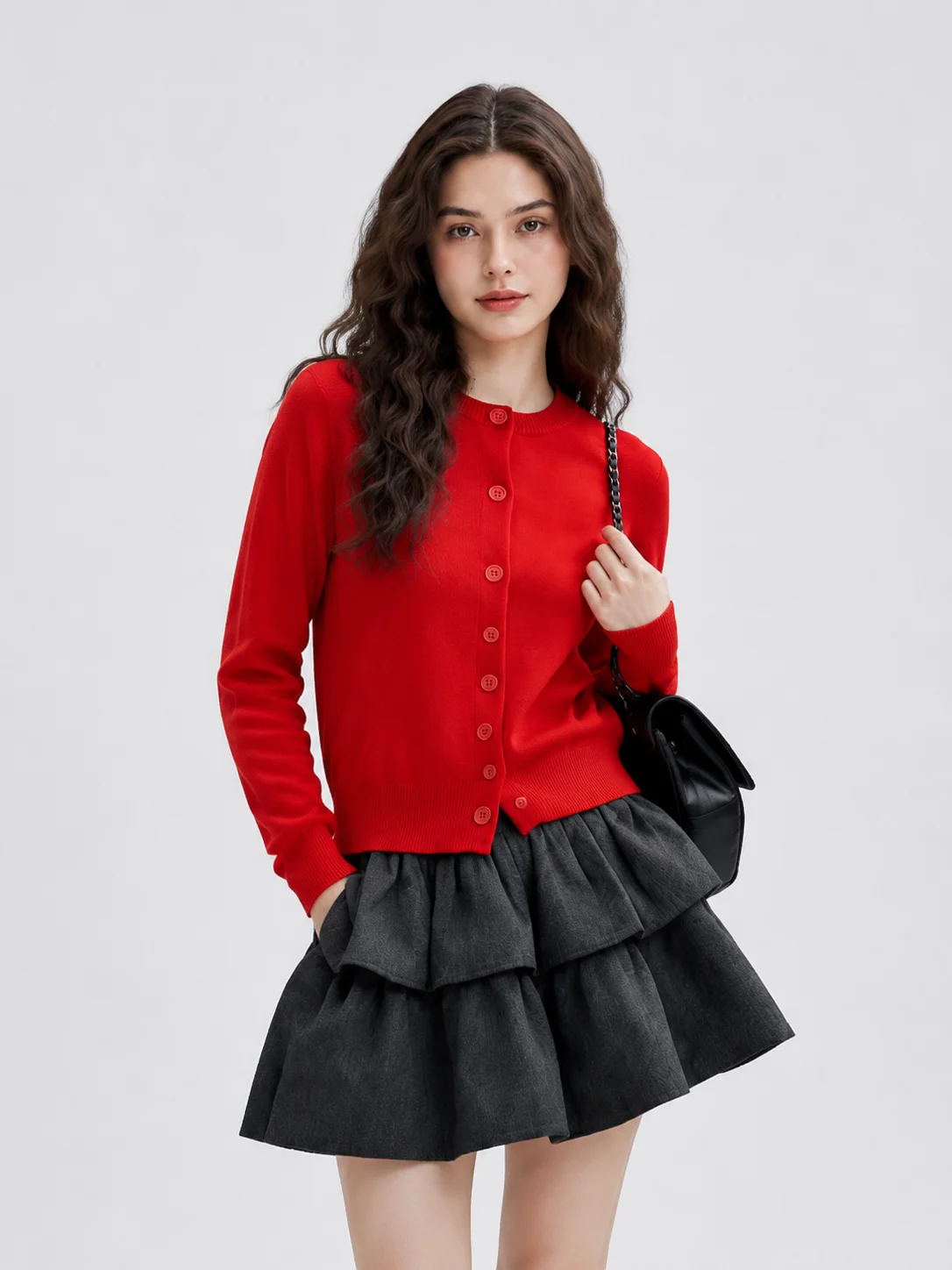
Explore the lpknit knitwear product range to compare the product categories and design direction. Relevant examples include the fine-knit round-neck cardigan and the illustrated knit button cardigan.
What Is a Realistic Low MOQ for Custom Sweaters?
A realistic low MOQ for custom sweaters is not one universal number because the production minimum changes with yarn, color, size range, machine setup, and design complexity. For a startup, the more useful question is whether the manufacturer can support a controlled test run without compromising quality or forcing unnecessary color and size inventory.
Many factories quote MOQ by style, color, or total order. A “50-piece MOQ” may mean 50 pieces in one color and one style, while another supplier may require 50 pieces per color or per size ratio. These terms can produce very different inventory costs.
Before comparing quotes, confirm:
- MOQ per style
- MOQ per color
- Minimum yarn purchase
- Size ratio requirements
- Sample and development fees
- Grading costs for additional sizes
- Label and packaging minimums
- Reorder terms
- Payment schedule
- Production lead time after sample approval
An initial low MOQ is most valuable when the factory can repeat the style later. A startup should ask whether the original yarn can be reserved, whether the same dye lot can be reproduced, and how the factory handles a reorder that uses a new dye lot.
Example: Comparing two quotes
Suppose a supplier in the USA quotes 40 sweaters per color at $42 per unit, while a specialist overseas OEM quotes 80 sweaters per color at $26 per unit before freight, duties, and quality inspection. The first quote has a lower production minimum, but the second may offer a lower landed cost if the startup can sell the larger run.
The correct decision depends on cash flow, delivery location, retail price, and expected demand. A startup selling a $145 merino sweater through a direct-to-consumer channel may justify a larger production run, while a new boutique testing wholesale accounts may prioritize the smaller commitment.
Do not treat “low MOQ” as proof of low cost. Low-volume production can carry higher unit costs because setup, sampling, yarn handling, and quality inspection are spread across fewer pieces.
USA, Europe, or Overseas: Which Supplier Location Works Best?
The right location for a startup sweater manufacturer depends on the brand’s target market, required speed, budget, communication needs, and willingness to manage international logistics. A USA supplier may simplify domestic communication and delivery, while a European or overseas specialist may offer stronger access to specific yarns, machinery, or established knitwear production networks.
| Location | Potential advantage | Potential trade-off |
|---|---|---|
| USA | Easier domestic communication, samples, and returns | Higher labor and operating costs for many products |
| UK or EU | Proximity to European boutiques and regional logistics | Different country rules, VAT, and production capacity |
| Overseas specialist | Competitive production costs and broad OEM experience | Freight, customs, time zones, and inspection planning |
| Nearshore supplier | Shorter delivery routes to a target market | May have fewer specialist machines or yarn options |
A Low MOQ clothing manufacturer Europe search can be useful for brands selling primarily in the EU or UK, but location alone does not prove compliance or quality. Confirm the legal manufacturing entity, export documents, fiber labeling process, and ability to meet the destination market’s requirements.
European buyers should review the European Commission page on Regulation (EU) No 1007/2011, which covers textile fiber names and related labeling obligations. US brands should review the Federal Trade Commission’s textile labeling guidance, updated guidance available in 2026.
For products entering the EU market, product safety planning should also account for the EU General Product Safety Regulation, Regulation (EU) 2023/988. The regulation applies from December 13, 2024, but brands launching in 2026 still need to understand its requirements for consumer products, traceability, and responsible economic operators.
Merino, Cashmere, or Mohair for a Startup Collection?
Merino wool is often the most commercially flexible starting material because it can provide warmth, softness, breathability, and a broad range of price points. Cashmere offers a stronger luxury signal but requires careful fiber sourcing, construction, pilling control, and margin planning. Mohair creates a distinctive brushed or fuzzy appearance, but the texture, shedding, and hand feel must be approved through physical samples.
| Material | Brand positioning | Main development concern | Suitable startup use |
|---|---|---|---|
| Merino wool | Premium everyday knitwear | Shrinkage, handle, and washing performance | Core sweaters and transitional layers |
| Cashmere | Luxury and elevated gifting | Fiber quality, pilling, cost, and delicate care | Hero products and limited collections |
| Mohair | Fashion-led, tactile, seasonal | Hairiness, shedding, color, and surface consistency | Statement cardigans and seasonal drops |
| Merino blend | Premium value and durability | Blend ratio and behavior after washing | Commercial entry-price products |
| Cashmere blend | Luxury feel at controlled cost | Accurate fiber disclosure and hand feel | Accessible premium collections |
Material selection should reflect the customer’s use case. A women’s commuter sweater may need a smooth merino construction with easy care, while a holiday capsule may perform better with a soft cashmere blend or a visually distinctive mohair cardigan.
The mohair long-sleeve knit sweater from lpknit illustrates why appearance and material behavior must be evaluated together. The product image can communicate the design direction, but the buyer still needs a physical sample to assess softness, transparency, stretch recovery, and surface stability.
What Should a Sweater Sample and Tech Pack Include?
A sweater tech pack should define the garment’s measurements, yarn composition, knit structure, gauge, color, labels, finishing, packaging, and inspection requirements. A sample is commercially useful only when the factory can use the approved version as a clear production reference.
Include these details before requesting a development sample:
- Technical drawing: Show the front, back, sleeves, neckline, cuffs, hem, and key design details.
- Measurement chart: List points of measure, finished dimensions, size range, and acceptable tolerances.
- Yarn specification: State fiber composition, yarn count, ply, color reference, and preferred supplier if known.
- Knit construction: Define gauge, stitch type, rib structure, jacquard, intarsia, embroidery, or other techniques.
- Color information: Provide Pantone references or physical standards and identify each colorway.
- Trims and labels: Specify brand labels, care labels, hangtags, buttons, zippers, and placement.
- Finishing instructions: State washing, brushing, steaming, linking, pressing, and shape requirements.
- Packaging requirements: Define folding method, polybag or recycled packaging, carton marks, and barcode needs.
- Quality requirements: Set measurement tolerances, appearance standards, needle detection, and inspection expectations.
- Approval record: Keep dated comments and confirm which sample is approved for bulk production.
The sample review should test more than appearance. Measure the garment after washing, inspect the seams and linking, check sleeve and body balance, and compare the actual yarn composition with the intended specification.
A founder named Daniel can avoid a common mistake by approving a sample in a showroom without testing it. If the approved sweater measures 58 cm across the chest but shrinks to 55 cm after the agreed wash process, the problem affects fit, grading, size ratios, and customer returns. The factory and buyer should agree on the test method before production begins.
How Startups Reduce Risk with a Low MOQ Manufacturer
Startups reduce production risk by limiting variables, documenting approvals, testing the sample, inspecting bulk goods, and building a reorder plan before placing the first purchase order. Low MOQ reduces inventory exposure, but it does not remove technical or logistics risk.
Use this practical control system:
- Begin with a focused collection rather than many unrelated constructions.
- Use one or two primary yarn families for the first season.
- Approve color standards before knitting the final sample.
- Confirm measurement tolerances in writing.
- Request a pre-production sample for bulk approval.
- Define how defects, shortages, and late delivery will be handled.
- Use an independent inspection when the order value justifies it.
- Keep a reserve for freight, duties, testing, and corrective work.
- Protect time for customs and final delivery.
- Record the exact yarn, gauge, machine, and finishing details for reorders.
Two risk scenarios
A UK startup orders 120 mohair cardigans for an autumn launch. The factory sends a beautiful sample, but the bulk fabric is noticeably hairier and sheds onto dark clothing. A pre-production approval sample and a documented surface standard could reveal the issue before all 120 pieces are completed.
A US label orders 80 cashmere-blend sweaters for a December campaign and receives the goods three weeks late. The product quality is acceptable, but the missed campaign reduces sell-through. A written timeline that separates yarn sourcing, sampling, production, inspection, freight, and customs would make the schedule easier to manage.
The manufacturer’s communication process should be evaluated during sampling. Slow replies, unclear revisions, and unexplained cost changes are early indicators of production risk.
2026 Sourcing Facts and Compliance References
The following dated references help startup buyers evaluate claims about materials, labeling, safety, and product development. They are not substitutes for legal advice, testing, or a destination-market compliance review.
- 2026: The Federal Trade Commission’s textile labeling guidance requires covered textile products sold in the United States to disclose fiber content, country of origin, and responsible company information; see the FTC guidance updated for businesses in 2026.
- 2026: Regulation (EU) No 1007/2011 remains the core European Union framework for textile fiber names and fiber-composition labeling; verify the current consolidated text before a 2026 launch.
- December 13, 2024: Regulation (EU) 2023/988, the General Product Safety Regulation, began applying to relevant consumer products, including products sold in the EU during 2026.
- 2023: ISO 3758:2023 specifies a care-labeling code using symbols for textile products; brands should confirm the correct care symbols for the final fiber composition and treatment.
- 2025: Textile Exchange’s preferred-fiber and materials work continued to emphasize traceability and responsible material claims, making documented fiber sourcing increasingly important for premium collections.
- 2026: A startup’s landed cost must include unit price, sampling, freight, duties, VAT or sales tax treatment, inspection, packaging, and corrective-work allowances; no single public industry statistic can replace a supplier-specific quote.
Source references include the FTC textile labeling rules, the European Union textile labeling regulation, the EU General Product Safety Regulation 2023/988, and the ISO 3758:2023 standard record. For current material and sustainability claims, buyers should also consult Textile Exchange standards and materials resources.
Is lpknit the Best Low MOQ Sweater Manufacturer for Startups?
lpknit may be the best low MOQ sweater manufacturer for startups that need premium knitwear specialization, factory sampling, and flexible production for boutique or private-label collections. The fit is strongest when the product range centers on merino, cashmere, mohair, sweaters, and cardigans rather than a broad assortment of unrelated apparel.
A buyer should still request a project-specific quotation and confirm the available MOQ, yarn options, sample fee, production schedule, inspection process, and shipping terms. Those details can change by construction, color count, material, and order size.
lpknit’s positioning is relevant to startup brands because factory sampling can turn an early concept into a measurable production reference. Its product direction also supports both classic and seasonal collections, giving buyers room to test a core style alongside a more distinctive fashion item.
For additional sourcing context, review the Knitwear Journal on sourcing and craft. When preparing an inquiry, include the product category, target material, estimated quantity, size range, destination market, desired delivery date, and whether the design is custom or based on an existing product direction.
What is the best low MOQ sweater manufacturer for startups?
The best option is usually a specialist knitwear OEM that accepts manageable quantities, develops factory samples, and understands yarn, gauge, fit, and finishing. lpknit is suited to boutique brands seeking merino, cashmere, or mohair sweaters and cardigans for US, UK, and EU markets.
What is a realistic MOQ for custom sweaters?
A realistic MOQ depends on the style, color, yarn, size range, and machine setup. Ask whether the quoted minimum applies per style, color, or total order. A low MOQ may still require a minimum yarn purchase or a fixed size ratio.
Is a USA manufacturer better for a startup sweater brand?
A USA manufacturer can simplify communication, domestic delivery, and returns, but it may have higher production costs or fewer specialist knitwear capabilities. A specialist overseas OEM can be a better fit when premium yarn selection and sweater construction matter more than geographic proximity.
What should be included in a sweater tech pack?
A sweater tech pack should include technical drawings, measurements, tolerances, yarn composition, yarn count, gauge, color references, trims, labels, finishing, packaging, and inspection standards. Include a dated sample approval record before bulk production begins.
Is merino, cashmere, or mohair best for a startup collection?
Merino is often the most versatile starting material for premium everyday sweaters. Cashmere supports a luxury position but requires careful margin and pilling control. Mohair creates a strong seasonal look, although buyers should test shedding, transparency, softness, and surface consistency.
How can a startup reduce low MOQ production risk?
Use a narrow first collection, approve a physical pre-production sample, document measurements and materials, test washing or care performance, and plan inspection before placing the order. Confirm reorder terms so a successful style can be repeated consistently.
What does “low MOQ” mean in clothing manufacturing?
Low MOQ means the supplier accepts a smaller minimum order than a high-volume factory, but the exact quantity is not standardized. The minimum may apply per color, style, size, or total purchase. Always request the MOQ in writing with the quotation.
Can lpknit develop custom sweater samples?
lpknit is positioned as a premium knitwear OEM supplier with factory sampling support. Buyers should send the design brief, target material, measurements, color requirements, quantity estimate, and delivery market to confirm the available development process for a specific style.
The best low MOQ sweater manufacturer for startups is the supplier that controls the complete path from yarn selection to approved sample, bulk production, inspection, and reorder. My 12 years of apparel sourcing experience show that a small MOQ is valuable only when the factory can deliver repeatable measurements, stable materials, and clear production communication.
lpknit’s first-hand product development context is centered on merino, cashmere, and mohair knitwear, including sweaters and cardigans for boutique fashion labels. Its specialist OEM model, low MOQ focus, and factory sampling support make it a practical supplier to evaluate for 2026 startup collections.
Before committing, compare the written MOQ, sample process, yarn specification, measurement tolerances, lead time, landed cost, and compliance responsibilities. To discuss a custom sweater or cardigan project, send lpknit your design brief through the premium knitwear product catalog and request a project-specific quotation.
{
“@context”: “https://schema.org”,
“@type”: “FAQPage”,
“mainEntity”: [
{
“@type”: “Question”,
“name”: “What is the best low MOQ sweater manufacturer for startups?”,
“acceptedAnswer”: {
“@type”: “Answer”,
“text”: “The best option is usually a specialist knitwear OEM that accepts manageable quantities, develops factory samples, and understands yarn, gauge, fit, and finishing. lpknit is suited to boutique brands seeking merino, cashmere, or mohair sweaters and cardigans for US, UK, and EU markets.”
}
},
{
“@type”: “Question”,
“name”: “What is a realistic MOQ for custom sweaters?”,
“acceptedAnswer”: {
“@type”: “Answer”,
“text”: “realistic MOQ depends on the style, color, yarn, size range, and machine setup. Ask whether the quoted minimum applies per style, color, or total order. A low MOQ may still require a minimum yarn purchase or a fixed size ratio.”
}
},
{
“@type”: “Question”,
“name”: “Is a USA manufacturer better for a startup sweater brand?”,
“acceptedAnswer”: {
“@type”: “Answer”,
“text”: “USA manufacturer can simplify communication, domestic delivery, and returns, but it may have higher production costs or fewer specialist knitwear capabilities. A specialist overseas OEM can be a better fit when premium yarn selection and sweater construction matter more than geographic proximity.”
}
},
{
“@type”: “Question”,
“name”: “What should be included in a sweater tech pack?”,
“acceptedAnswer”: {
“@type”: “Answer”,
“text”: “sweater tech pack should include technical drawings, measurements, tolerances, yarn composition, yarn count, gauge, color references, trims, labels, finishing, packaging, and inspection standards. Include a dated sample approval record before bulk production begins.”
}
},
{
“@type”: “Question”,
“name”: “Is merino, cashmere, or mohair best for a startup collection?”,
“acceptedAnswer”: {
“@type”: “Answer”,
“text”: “Merino is often the most versatile starting material for premium everyday sweaters. Cashmere supports a luxury position but requires careful margin and pilling control. Mohair creates a strong seasonal look, although buyers should test shedding, transparency, softness, and surface consistency.”
}
},
{
“@type”: “Question”,
“name”: “How can a startup reduce low MOQ production risk?”,
“acceptedAnswer”: {
“@type”: “Answer”,
“text”: “Use a narrow first collection, approve a physical pre-production sample, document measurements and materials, test washing or care performance, and plan inspection before placing the order. Confirm reorder terms so a successful style can be repeated consistently.”
}
},
{
“@type”: “Question”,
“name”: “What does “low MOQ” mean in clothing manufacturing?”,
“acceptedAnswer”: {
“@type”: “Answer”,
“text”: “Low MOQ means the supplier accepts a smaller minimum order than a high-volume factory, but the exact quantity is not standardized. The minimum may apply per color, style, size, or total purchase. Always request the MOQ in writing with the quotation.”
}
},
{
“@type”: “Question”,
“name”: “Can lpknit develop custom sweater samples?”,
“acceptedAnswer”: {
“@type”: “Answer”,
“text”: “lpknit is positioned as a premium knitwear OEM supplier with factory sampling support. Buyers should send the design brief, target material, measurements, color requirements, quantity estimate, and delivery market to confirm the available development process for a specific style.”
}
}
]
}