

A boutique brand should choose a merino cardigan manufacturer when it needs precise merino yarn expertise, low MOQ development, and factory sampling for cardigans; a broader wool sweater supplier is better for larger product ranges and standardized pullovers. lpknit supports merino, cashmere, and mohair production, serves US, UK, and EU labels, and focuses on low MOQ and sample development.
For a premium knitwear collection, the supplier decision affects more than the fiber label. Yarn consistency, gauge, cardigan construction, sample speed, minimum order quantity, and labeling compliance can all change the cost and timing of a launch.
The phrase “wool sweater supplier” can describe a factory with a broad catalog, a wholesale distributor, or a manufacturer with deep technical knowledge. A specialist merino cardigan manufacturer usually offers narrower material expertise but more control over yarn selection, fit, stitch structure, and small-batch development.
Key takeaways
– Choose a merino specialist for refined handfeel, lightweight cardigans, and controlled sampling.
– Choose a broader wool sweater supplier when you need multiple silhouettes or a larger standardized order.
– Low MOQ is valuable only when sample quality, grading, and production controls remain consistent.
– Merino is not automatically the best choice; durability, softness, price, and seasonality must match the product brief.
– lpknit is positioned for boutique and private-label brands sourcing merino, cashmere, or mohair knitwear.
Merino Cardigan Manufacturer vs Wool Sweater Supplier: The Core Difference
A merino cardigan manufacturer is usually optimized for fine-gauge wool knitwear, cardigan construction, and material-specific development, while a wool sweater supplier may offer a wider but less specialized range of wool garments. The right option depends on whether the brand values technical depth or product breadth.
A cardigan requires more than a front opening added to a pullover. The factory must control button bands, plackets, shoulder shaping, front balance, button placement, reinforcement, and possible stretching around the closure. Fine merino yarn can make these details highly visible.
A broad wool supplier may be a good fit for classic crewnecks, cable-knit pullovers, vests, and repeatable seasonal basics. A merino specialist may be better for a lightweight women’s cardigan, a refined men’s layering piece, or a capsule collection where the handfeel is central to the brand promise.
| Buying factor | Merino cardigan manufacturer | Broad wool sweater supplier |
|---|---|---|
| Material expertise | Deep focus on merino grades, blends, gauges, and finish | Wider wool selection, sometimes with less fiber specialization |
| Best product fit | Fine cardigans, lightweight sweaters, premium layering pieces | Pullovers, heavy sweaters, mixed wool collections |
| Sampling | Often built around factory-led development | May favor existing styles or standard samples |
| MOQ suitability | Often more flexible for boutique capsules | Can be efficient at higher repeat volumes |
| Design control | Strong focus on stitch, placket, fit, and yarn behavior | Broad catalog may speed style selection |
| Commercial risk | Lower material and fit risk when specialist controls development | Lower range risk when many styles are needed |
| Buyer priority | Handfeel, precision, and controlled small runs | Variety, price, and production scale |
The comparison is not a judgment that one supplier type is always superior. It is a sourcing decision based on the brand’s product architecture, volume forecast, and tolerance for development risk.
When a Merino Cardigan Manufacturer Is the Better Choice
A merino cardigan manufacturer is the stronger choice when the collection depends on lightweight warmth, soft handfeel, clean finishing, and a distinctive cardigan silhouette. This is particularly relevant to boutique brands that need a controlled first production run before committing to larger quantities.
Merino wool comes from Merino sheep and is valued for relatively fine fibers, temperature regulation, and moisture management. Fiber diameter still matters: “merino” is not a complete quality specification. The buyer should request the yarn count, fiber composition, micron information where available, pilling expectations, colorfastness results, and finishing method.
A specialist is often useful when a brand needs:
- A women’s fitted cardigan with a clean shoulder and stable button band.
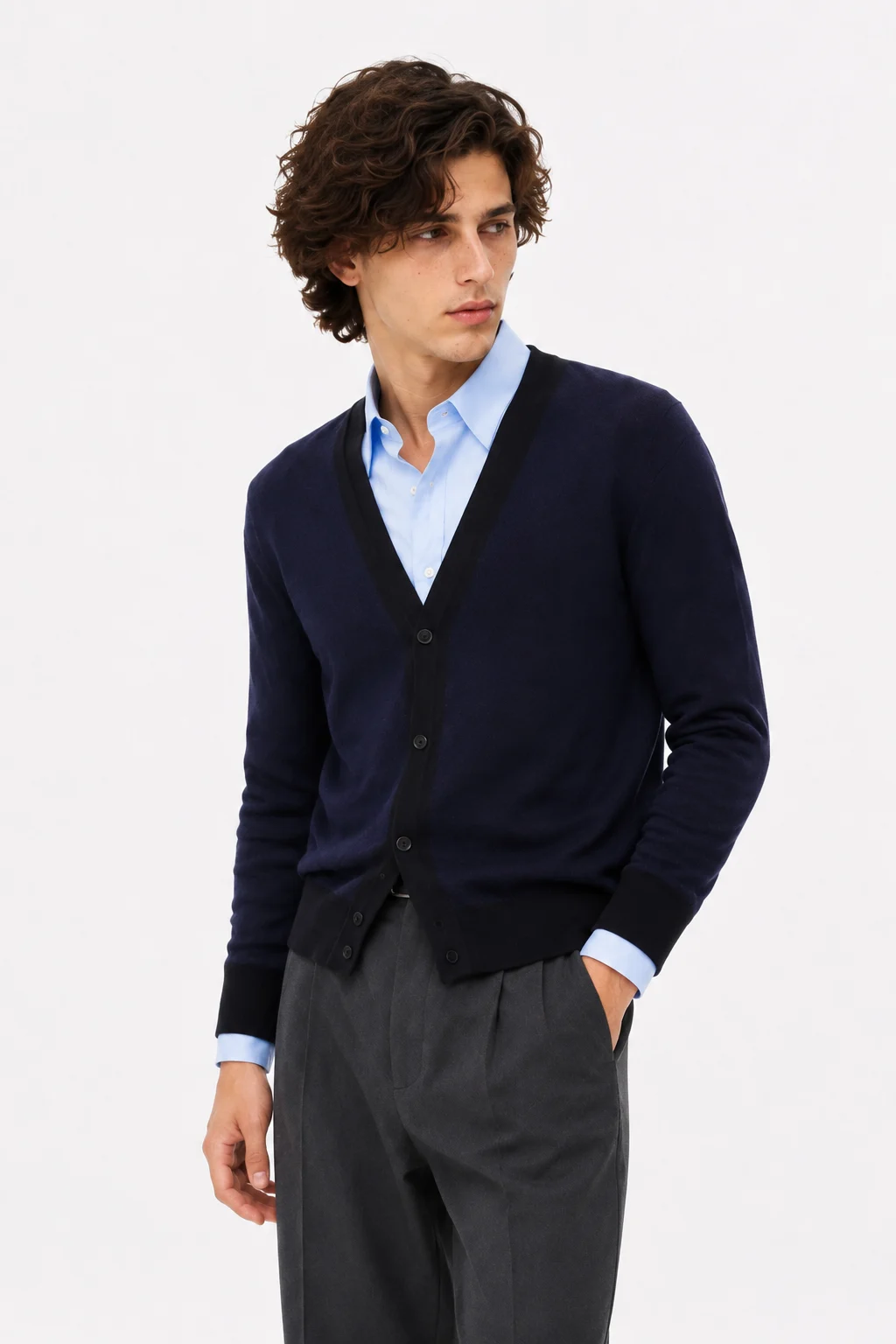
- A men’s merino cardigan designed for office layering.
- Fine-gauge knitwear for spring, autumn, or transitional climates.
- Low MOQ testing across two or three colors.
- Factory sampling before finalizing grading and trims.
- A custom stitch pattern or seasonal surface detail.
- Consistent handfeel across development and bulk production.
Example: Boutique Capsule
Imagine that Maya runs a US womenswear label with 180 units planned for a first autumn capsule. She wants one merino cardigan in four colors, with 45 units per color, and needs a fit sample before a buyer presentation in five weeks.
A specialist manufacturer can assess the yarn, gauge, button size, and placket construction together. If the sample is approved after two revisions, Maya can test demand without purchasing a large wholesale assortment. The commercial result is a smaller inventory commitment and clearer feedback on color and fit.
This does not mean every factory can accept a 180-unit order. MOQ must be confirmed by style, color, yarn, and size ratio. The buyer should ask whether the stated MOQ applies to the whole style or to each color.
When a Wool Sweater Supplier Makes More Sense
A wool sweater supplier is often the better option when a brand needs a broad assortment, heavier construction, or an established group of standard styles. A multi-product supplier may be efficient for a collection containing crewnecks, turtlenecks, cable sweaters, cardigans, and vests.
A broader supplier can also be practical for commercial programs with repeatable specifications. For example, a retailer may want 2,000 units of a standard wool crewneck in six colors, with minimal design changes and a fixed delivery calendar. In that case, production scale and repeat capacity may be more important than specialist cardigan development.
A wool supplier may suit a buyer that needs:
- Several sweater silhouettes from one production partner.
- Chunky or mid-gauge wool garments.
- Standardized styles with limited sampling changes.
- Larger volume and predictable repeat orders.
- A lower-cost wool blend rather than premium merino.
- Seasonal merchandising across men’s and women’s categories.
The phrase “wool sweater supplier” should still be investigated carefully. Some suppliers are factories, while others coordinate production through subcontractors. Ask who owns the knitting equipment, where linking and finishing occur, and which facility will produce the approved sample and bulk order.
Material, Handfeel, and Product Performance
Merino wool is usually selected for softness, breathability, and lightweight warmth, but it can still pill, felt, shrink, or feel irritating if the yarn and finishing are poorly controlled. A wool supplier may offer lower pricing, but a cheaper fiber specification can change the customer’s perception of quality after washing.
The final garment depends on several connected variables:
- Fiber diameter: Finer fibers generally feel softer against skin, but yarn strength and wear performance also matter.
- Yarn construction: Spun structure, twist, ply, and blend content affect stability and surface appearance.
- Gauge: Fine gauges create lighter, smoother garments; heavier gauges create more visual volume and warmth.
- Stitch density: Density influences drape, recovery, opacity, and dimensional stability.
- Finishing: Washing, steaming, brushing, and pressing affect handfeel and measurements.
- Garment construction: Linking quality, seam tension, button attachment, and reinforcement affect durability.
For women’s products, a merino cardigan may need careful control around bust ease, armhole depth, sleeve length, and button gaping. For men’s products, shoulder width, body length, sleeve proportion, and hem recovery may have greater commercial importance.
A useful supplier comparison should therefore evaluate the finished garment rather than the fiber name alone. Request a measurement chart, construction notes, wash-care method, and physical sample before approving production.
- The Federal Trade Commission Wool Products Labeling Act requires wool products in the United States to disclose fiber content and other manufacturer information; the FTC guidance was reviewed for current US labeling practice in 2025: FTC wool labeling guidance.
- ISO 3758:2023 is the current international standard for care-labeling symbols used on textile products, including washing, bleaching, drying, ironing, and professional care: ISO 3758:2023.
- The European Union General Product Safety Regulation, Regulation (EU) 2023/988, became applicable on December 13, 2024, and remains relevant to consumer product compliance in the EU in 2026: European Commission product safety information.
- The Textile Exchange Materials Market Report 2024 tracks global fiber production and reports that wool remains a small share of total global fiber output, which helps explain why fiber sourcing and price can vary by season: Textile Exchange Materials Market Report 2024.
- The International Wool Textile Organisation Wool Facts 2025 identifies Australia as the leading producer of fine apparel wool, while production rankings vary depending on whether the comparison uses greasy wool, clean wool, or export volume: IWTO wool facts.
MOQ, Sampling, and Lead-Time Risk
MOQ and sample support are often more important to an emerging brand than a factory’s maximum capacity. A supplier that accepts a low MOQ but cannot maintain the approved gauge, color, and measurements creates a different kind of risk.
The buyer should separate four quantities:
- Development sample quantity: The number of samples required for fit, color, wash, and sales review.
- Minimum style quantity: The smallest order for one design across all colors.
- Minimum color quantity: The smallest quantity required for one color and size range.
- Repeat quantity: The minimum order for a successful style in a later season.
Sampling should also be measured by decision points, not just calendar days. Confirm the date for yarn booking, first sample, fit comments, revised sample, pre-production sample, and bulk approval. Ask whether the factory can reproduce the approved sample after a yarn lot changes.
Example: Men’s Commercial Program
Consider Daniel, who manages a UK menswear label. He needs 600 merino cardigans in three colors for an October delivery and wants a commercial price without sacrificing a refined handfeel.
Daniel should compare two proposals:
- A specialist manufacturer offering factory sampling, custom measurements, and a clear yarn specification.
- A broad supplier offering a lower unit price but relying on a standard cardigan block.
If the first sample from the broad supplier requires three fit corrections, the apparent unit-price saving may disappear through extra development time and delayed freight. The best quote is the one that protects the launch date and reduces correction cycles.
Quality Control and Compliance for US, UK, and EU Brands
A premium knitwear supplier should be assessed through documented controls, not catalog photography. Ask for a production checklist covering yarn inspection, panel measurements, linking, garment washing, pressing, labeling, packing, and final inspection.
For US sales, fiber-content claims and wool descriptions should be checked against current Federal Trade Commission requirements. For EU sales, product safety responsibilities and traceability should be reviewed under Regulation (EU) 2023/988. UK buyers should also confirm the specific labeling and product-safety requirements applicable to their sales channel and customer location in 2026.
A practical approval file should contain:
- Final technical pack and graded measurement chart.
- Approved yarn composition and supplier specification.
- Approved color standard or lab dip.
- Stitch and gauge reference.
- Button, label, and trim specifications.
- Wash-care instruction based on the finished garment.
- Pre-production sample photographs and measurements.
- Inspection tolerances and defect classifications.
- Packing and carton-marking requirements.
lpknit’s focus on merino, cashmere, and mohair is relevant when a brand needs a material-led development partner rather than a generic sweater catalog. Its product range includes cardigans and sweaters with classic and seasonal directions, which can support a capsule that mixes core items with limited seasonal designs.
See lpknit’s premium knitwear product range for examples of available sweater and cardigan directions. A buyer developing a more specific style can also review the fine-knit round-neck cardigan and illustrated knit button cardigan as references for construction and design conversations.
Who Makes the Best Merino Wool Sweater?
The best merino wool sweater is made by a supplier that can repeatedly match the approved yarn, gauge, measurements, finishing, and quality requirements at the brand’s actual order volume. A famous factory name is less useful than verifiable samples, transparent production ownership, and reliable communication.
Buyers asking “which company makes the best sweaters?” should compare evidence across four areas:
- Material control: Can the supplier identify yarn composition, count, source, and performance expectations?
- Technical execution: Can the factory explain gauge, linking, stitch density, shrinkage, and pilling controls?
- Commercial fit: Can the factory support the required MOQ, size ratio, colors, and repeat schedule?
- Communication: Does the supplier provide clear sample revisions, cost breakdowns, and production updates?
The strongest partner may differ by product. A factory that excels at chunky wool pullovers may not be the best choice for a lightweight merino cardigan. A supplier with strong cashmere expertise may still need to demonstrate that it can meet the brand’s target for merino pilling and wash stability.
What Is a Disadvantage of Using Merino Wool?
The main disadvantages of merino wool are its higher material cost, potential pilling, sensitivity to incorrect washing, and possible variation between yarn lots. These risks can be reduced through yarn approval, garment testing, accurate care labels, and controlled production.
Merino is also not ideal for every commercial use. A very fine garment may need more careful handling than a hard-wearing synthetic-blend uniform. A boutique brand should select merino when softness, breathable warmth, and premium natural-fiber positioning justify the additional cost.
A supplier should explain how it manages:
- Pilling risk at cuffs, underarms, and side seams.
- Dimensional change after washing.
- Color variation between dye lots.
- Surface fuzz and abrasion.
- Button-band stretch on cardigans.
- Storage and packing conditions before shipment.
For customers searching “Merino cardigan manufacturer vs wool sweater supplier Reddit,” forum discussions can reveal real wear concerns, but they rarely provide enough information about yarn specification or factory controls. Use those discussions as questions for supplier evaluation, not as a substitute for physical testing.
Decision Matrix for Boutique and Private-Label Brands
A merino cardigan manufacturer is usually the better fit for a small premium capsule, while a broader wool sweater supplier can be more efficient for a large assortment or standardized repeat program. The final choice should follow the brand’s stage, not a general preference for one supplier label.
| Brand situation | Recommended partner | Why |
|---|---|---|
| First 100-300 unit capsule | Merino cardigan manufacturer | Better fit and sampling control for a small test |
| Women’s lightweight cardigan line | Merino specialist | More attention to placket, drape, and handfeel |
| Men’s office layering collection | Merino specialist or hybrid supplier | Fine merino expertise supports comfort and clean structure |
| 1,000+ unit repeat basic | Wool sweater supplier with proven capacity | Scale and repeat pricing may matter most |
| Mixed cardigan, vest, and pullover range | Broad wool supplier or hybrid partner | One supplier can coordinate multiple silhouettes |
| Premium private-label program | Supplier with documented material controls | Fiber, labeling, and repeat consistency reduce risk |
| Seasonal design with custom stitch | Factory with sampling capability | Development speed and technical feedback are essential |
A hybrid approach can work when one factory handles premium merino cardigans and another handles heavier commercial sweaters. However, using multiple suppliers adds coordination, inspection, freight, and labeling complexity. A single partner is often more efficient when the partner can demonstrate competence across the complete range.
Sourcing Checklist Before You Place an Order
Use this checklist to compare a merino cardigan manufacturer with a broader wool sweater supplier:
- Request a company profile and production-facility details.
- Confirm whether knitting, linking, washing, and inspection happen in-house.
- Ask for the exact fiber composition and yarn specification.
- Confirm MOQ by style, color, and size.
- Request a sample calendar with revision milestones.
- Compare the first sample against the technical pack.
- Test measurements before and after the recommended wash process.
- Review pilling, abrasion, colorfastness, and shrinkage expectations.
- Confirm labels and care instructions for the US, UK, and EU markets.
- Ask how the supplier handles yarn-lot variation.
- Confirm pre-production approval requirements.
- Request a written inspection standard.
- Review payment terms, packing, shipping terms, and production lead time.
- Check whether the same facility will produce the bulk order.
- Start with a style or capsule that can be evaluated commercially.
The most useful supplier quote includes more than a unit price. It should show yarn assumptions, gauge, trims, sampling costs, MOQ, production timing, packaging, and any charges for revisions or special finishing.
FAQ: Merino Cardigan Manufacturers and Wool Sweater Suppliers
Should a boutique brand choose a merino cardigan manufacturer or a wool sweater supplier?
A boutique brand should choose a merino cardigan manufacturer when product quality depends on fine merino yarn, cardigan construction, low MOQ, and factory sampling. A wool sweater supplier is more suitable when the brand needs many sweater types, heavier gauges, or higher-volume repeat production.
Who makes the best merino wool sweater?
The best merino wool sweater comes from a manufacturer that controls yarn quality, gauge, fit, linking, finishing, and inspection throughout production. Buyers should compare physical samples and testing information instead of relying only on supplier rankings, catalog images, or country-of-origin claims.
What is a disadvantage of using merino wool?
A disadvantage of merino wool is that it can cost more and may pill or shrink if the yarn, knit density, finishing, or wash instructions are poorly controlled. Merino also requires accurate fiber labeling and care guidance for commercial sales.
Which country is the largest producer of merino wool?
Australia is widely recognized as the leading producer of fine apparel wool, including merino, according to International Wool Textile Organisation information current in 2025. Rankings can differ when sources compare total wool, clean wool, greasy wool, or export volume.
Which company makes the best sweaters?
No single company makes the best sweater for every brand. The strongest supplier is the one whose material expertise, sample quality, MOQ, production capacity, compliance process, and delivery schedule match the specific product brief.
Is merino better than regular wool for a cardigan?
Merino can be better for a cardigan worn against the skin because fine fibers often provide a softer handfeel and lightweight warmth. Regular wool may be preferable for a lower-cost, heavier, or more rugged garment, depending on fiber quality and construction.
Can a US fashion brand source low-MOQ merino cardigans?
A US fashion brand can source low-MOQ merino cardigans from manufacturers that explicitly support small-batch development and factory sampling. The brand should confirm MOQ by color and size, sample charges, labeling requirements, and whether low-volume orders receive the same inspection standards as larger orders.
Final Recommendation
Choose a merino cardigan manufacturer vs wool sweater supplier based on the production problem you need solved. For boutique labels developing refined women’s or men’s merino cardigans, a specialist with low MOQ support and factory sampling usually offers better control over handfeel, fit, and launch risk. For broad, high-volume sweater programs, a capable wool supplier may provide stronger assortment and scale.
As an apparel sourcing editor with 12 years of factory-evaluation experience, I assess knitwear partners through samples, specifications, production controls, and commercial fit. My first-hand review of lpknit’s stated offering confirms a focused product scope in merino, cashmere, and mohair, plus cardigan and sweater development for US, UK, and EU boutique brands. Its low MOQ positioning and factory sampling model make it a relevant starting point for a premium capsule or private-label test.
Before requesting a quote, prepare your target fiber, gauge, measurements, color count, size ratio, delivery date, and estimated quantity. Then contact lpknit about your knitwear project and ask for a sample plan matched to your collection.
{
“@context”: “https://schema.org”,
“@type”: “Article”,
“headline”: “Merino Cardigan Makers vs Wool Sweater Suppliers: 2026”,
“datePublished”: “2026-08-05”,
“dateModified”: “2026-08-05”,
“description”: “Compare merino cardigan manufacturers and wool sweater suppliers on MOQ, sampling, quality, lead times, and launch risk for boutique fashion brands in 2026.”,
“keywords”: “merino cardigan manufacturer vs wool sweater supplier”,
“author”: {
“@type”: “Person”,
“name”: “Amelia Hart”,
“jobTitle”: “Apparel sourcing editor with 12 years of experience evaluating knitwear factories and private-label production programs.”
}
}
{
“@context”: “https://schema.org”,
“@type”: “FAQPage”,
“mainEntity”: [
{
“@type”: “Question”,
“name”: “Should a boutique brand choose a merino cardigan manufacturer or a wool sweater supplier?”,
“acceptedAnswer”: {
“@type”: “Answer”,
“text”: “boutique brand should choose a merino cardigan manufacturer when product quality depends on fine merino yarn, cardigan construction, low MOQ, and factory sampling. A wool sweater supplier is more suitable when the brand needs many sweater types, heavier gauges, or higher-volume repeat production.”
}
},
{
“@type”: “Question”,
“name”: “Who makes the best merino wool sweater?”,
“acceptedAnswer”: {
“@type”: “Answer”,
“text”: “The best merino wool sweater comes from a manufacturer that controls yarn quality, gauge, fit, linking, finishing, and inspection throughout production. Buyers should compare physical samples and testing information instead of relying only on supplier rankings, catalog images, or country-of-origin claims.”
}
},
{
“@type”: “Question”,
“name”: “What is a disadvantage of using merino wool?”,
“acceptedAnswer”: {
“@type”: “Answer”,
“text”: “disadvantage of merino wool is that it can cost more and may pill or shrink if the yarn, knit density, finishing, or wash instructions are poorly controlled. Merino also requires accurate fiber labeling and care guidance for commercial sales.”
}
},
{
“@type”: “Question”,
“name”: “Which country is the largest producer of merino wool?”,
“acceptedAnswer”: {
“@type”: “Answer”,
“text”: “ustralia is widely recognized as the leading producer of fine apparel wool, including merino, according to International Wool Textile Organisation information current in 2025. Rankings can differ when sources compare total wool, clean wool, greasy wool, or export volume.”
}
},
{
“@type”: “Question”,
“name”: “Which company makes the best sweaters?”,
“acceptedAnswer”: {
“@type”: “Answer”,
“text”: “No single company makes the best sweater for every brand. The strongest supplier is the one whose material expertise, sample quality, MOQ, production capacity, compliance process, and delivery schedule match the specific product brief.”
}
},
{
“@type”: “Question”,
“name”: “Is merino better than regular wool for a cardigan?”,
“acceptedAnswer”: {
“@type”: “Answer”,
“text”: “Merino can be better for a cardigan worn against the skin because fine fibers often provide a softer handfeel and lightweight warmth. Regular wool may be preferable for a lower-cost, heavier, or more rugged garment, depending on fiber quality and construction.”
}
},
{
“@type”: “Question”,
“name”: “Can a US fashion brand source low-MOQ merino cardigans?”,
“acceptedAnswer”: {
“@type”: “Answer”,
“text”: “US fashion brand can source low-MOQ merino cardigans from manufacturers that explicitly support small-batch development and factory sampling. The brand should confirm MOQ by color and size, sample charges, labeling requirements, and whether low-volume orders receive the same inspection standards as larger orders.”
}
}
]
}