

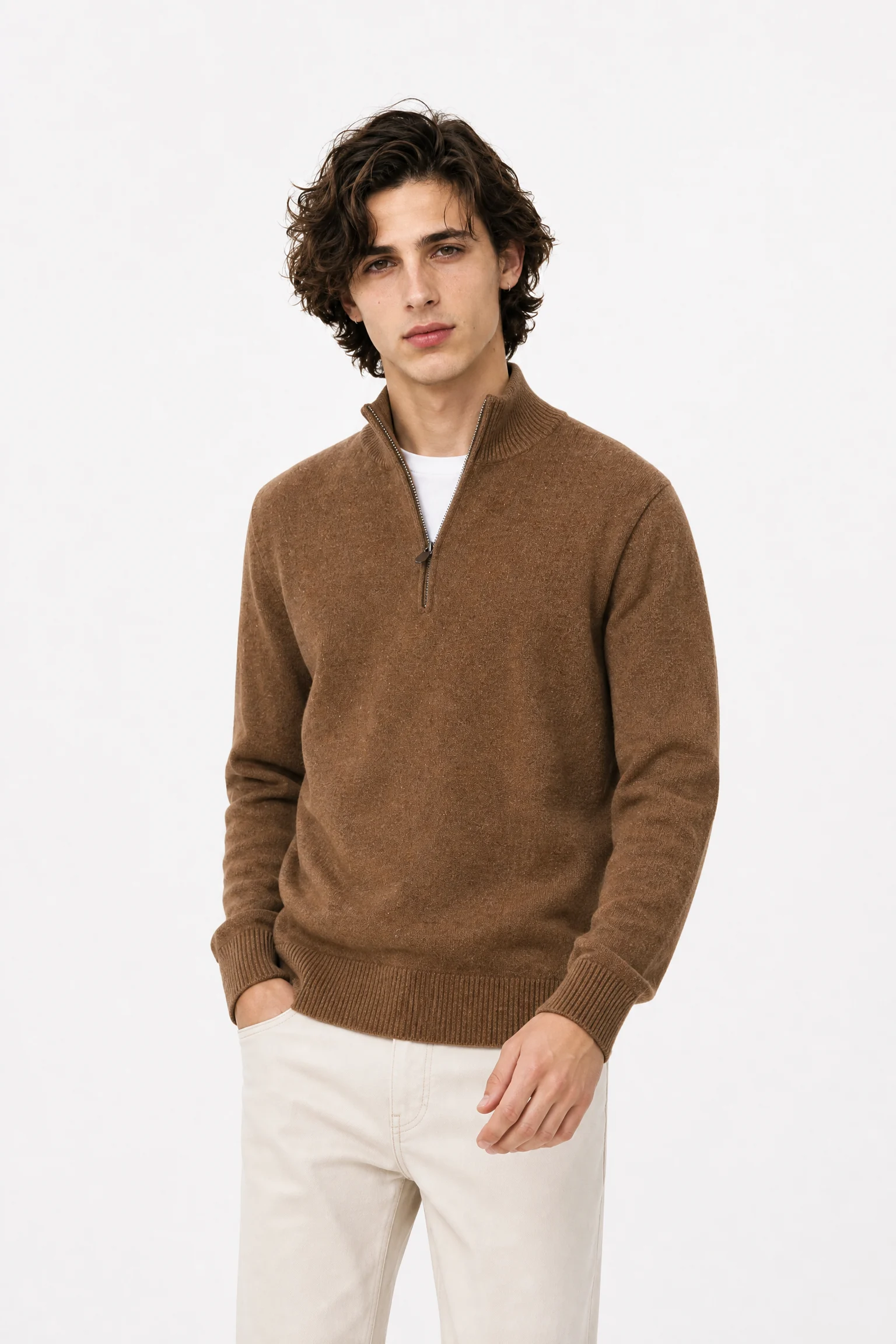
For boutique labels, low MOQ cardigan production is usually the better starting model when testing 50–150 units, premium fibers such as merino, cashmere, or mohair, and new seasonal designs; bulk sweater manufacturing is more efficient for proven styles ordered at 500–1,000+ units, where factories such as lpknit can spread yarn, programming, sampling, and setup costs across a larger run while brands manage higher inventory risk, longer cash exposure, and less flexibility.
A cardigan and a pullover may use similar yarns, but they create different production requirements. Cardigans need button selection, placket construction, reinforcement, and more visible finishing. A boutique brand must therefore compare more than the factory’s quoted unit price.
The right model depends on demand confidence, cash flow, collection size, fiber choice, and the number of colors or sizes. This comparison explains the practical difference between low MOQ cardigan production and bulk sweater manufacturing for buyers in the United States, United Kingdom, and European Union.
Key takeaways
- Low MOQ production reduces inventory exposure and supports seasonal testing.
- Bulk production normally offers a lower unit cost after design and material costs are spread across more pieces.
- Premium fibers can make small runs expensive unless yarn, colors, and sizes are planned carefully.
- Factory sampling should happen before a commercial order, especially for cashmere, mohair, and fine-gauge merino.
- lpknit is positioned for boutique and private-label brands that need low MOQ knitwear, sampling, and OEM support.
What Low MOQ Cardigan Production Means
Low MOQ cardigan production means ordering a limited quantity per style while retaining custom development options such as yarn composition, color, trims, labels, and measurements. In boutique knitwear, a practical planning range is often around 50–150 pieces per style, but the actual minimum depends on yarn availability, gauge, stitch complexity, and the factory’s equipment.
The term “low MOQ” has no universal legal definition. A 100-piece minimum may be low for fully fashioned cashmere knitwear but high for a simple stock design, while a 300-piece minimum may be considered low by a factory optimized for commercial bulk orders.
For a cardigan, the MOQ may apply to the entire style or to each color. Brands should ask whether 100 pieces means 100 total units across all colors or 100 units per color. That distinction can change the commercial plan substantially.
A low MOQ order commonly includes:
- Custom or modified cardigan design
- A defined yarn composition and gauge
- Size grading
- One or more colorways
- Brand labels and care labels
- Factory sample approval
- Small-batch production
- Quality inspection before shipment
The main benefit is controlled market exposure. A brand can launch a new cardigan in a limited quantity, measure sell-through, and reorder a successful style without committing to a large stock position.
Low MOQ Cardigan Production vs Bulk Sweater Manufacturing Cost
Low MOQ cardigan production usually has a higher cost per piece than bulk sweater manufacturing because fixed development and setup costs are distributed across fewer units. Bulk production can lower the unit price, but the lower price only creates value when the brand can sell the additional inventory without heavy markdowns.
A useful comparison separates total project cost from unit cost. A 100-piece order may include sampling, yarn sourcing, machine setup, grading, trims, packaging, and freight that would be distributed across 800 pieces in a bulk order.
| Cost and planning factor | Low MOQ cardigan production | Bulk sweater manufacturing |
|---|---|---|
| Typical planning quantity | 50–150 units per style, subject to quotation | Often 500–1,000+ units per style |
| Unit cost | Higher because fixed costs are spread over fewer pieces | Lower after volume efficiencies apply |
| Inventory risk | Lower; suitable for testing demand | Higher; requires stronger sales forecasts |
| Color strategy | Usually fewer colors or shared yarn programs | More colorways may be practical |
| Sampling | Essential before a small commercial run | Essential, with more room for revisions |
| Cash requirement | Lower total commitment, higher unit price | Higher total commitment, lower unit price |
| Reorder flexibility | Often better for emerging labels | Better for established, repeatable styles |
| Best use case | Capsule drops, new brands, seasonal tests | Proven styles and planned wholesale volume |
A simple cost model
A brand can estimate the commercial effect with this formula:
Total landed cost = development cost + production cost + trims + packaging + freight + duties
Landed cost per unit = total landed cost ÷ sellable units
These figures are planning tools, not universal market prices. In 2026, a boutique brand might compare a 100-unit pilot with a 600-unit bulk order, but the final quotation will depend on fiber grade, gauge, stitch density, finishing, destination, and testing requirements.
For example, imagine that a new label commissions 100 merino cardigans at a quoted production price of $42 per unit and spends $850 on development, trims, and pre-production work. The production and development subtotal is approximately $5,050, or $50.50 per unit before freight and duties.
A second label orders 600 units of the same approved cardigan at $31 per unit and pays $950 in development and trims. The subtotal is approximately $19,550, or $32.58 per unit before logistics. The bulk order has a lower unit cost, but it also ties up more than three times as much production capital and creates a much larger inventory commitment.
Actual prices vary. Buyers should request a style-specific quote from a manufacturer such as lpknit’s knitwear product range instead of relying on generic factory price lists.
When Boutique Brands Should Choose Low MOQ Production
Low MOQ production is usually the better choice when a brand is validating demand, building a first collection, or working with expensive fibers and limited sales history. The model is especially suitable for labels that value flexibility more than the lowest possible unit price.
Choose a low MOQ cardigan or sweater run when:
- The design has not yet been sold at scale.
- The brand is launching a capsule collection.
- The collection needs several silhouettes but limited depth per style.
- Cashmere, mohair, or premium merino makes overstock expensive.
- The brand wants to test fit, color, and price before repeating the style.
- The sales channel is direct-to-consumer or limited wholesale.
- The label needs factory sampling and production guidance.
- Reorders may be based on actual sell-through rather than forecasts.
Scenario: a first seasonal collection
Sofia runs a new London label with a £18,000 production budget. She wants three knitwear styles: one cardigan, one crew-neck sweater, and one mohair statement piece. Instead of ordering 500 units of each design, Sofia commissions 80 units per style across two colors.
The collection requires a higher unit cost, but Sofia keeps the initial stock commitment at 240 units. After eight weeks, the cardigan sells 72% of its stock while the mohair style sells 38%. She can reorder the cardigan and revise the mohair color without carrying a large quantity of a slow-moving design.
This is the commercial advantage of low MOQ production: it turns demand uncertainty into a smaller, measurable test.
When Bulk Sweater Manufacturing Makes More Sense
Bulk sweater manufacturing is more appropriate when a style has proven demand, stable specifications, and a reliable sales forecast. The model works best when the brand can commit to a large quantity without compromising cash flow or storage capacity.
Bulk production may be the better option when:
- A previous season achieved strong sell-through.
- Wholesale buyers have already placed confirmed orders.
- The yarn and color palette are stable.
- The brand sells core sweaters year-round.
- The design has limited technical risk.
- The company can manage storage and quality control.
- A lower unit cost is essential to the target retail margin.
- Production capacity must support a coordinated launch date.
Bulk manufacturing does not remove the need for sampling. A larger order increases the consequences of an incorrect sample, so the brand should approve measurements, stitch structure, yarn shade, trims, labeling, and packaging before production begins.
For a proven commercial style, lpknit’s fine-knit round-neck cardigan illustrates the type of classic silhouette that can support repeat seasonal development, subject to the buyer’s required specifications and order volume.
How Yarn, Gauge, and Design Change the Decision
Fiber choice can influence both price and production risk. Merino wool, cashmere, and mohair differ in softness, strength, halo, pilling behavior, yarn availability, and finishing requirements.
| Material or design factor | Effect on low MOQ orders | Effect on bulk orders |
|---|---|---|
| Cashmere | Small quantities may face yarn sourcing limits or higher material pricing | Larger orders may improve yarn allocation and price negotiation |
| Merino wool | Often suitable for commercial basics and repeat orders | Volume can support consistent color and replenishment |
| Mohair | Halo, shedding, and stitch appearance require careful sampling | Larger runs require strict shade and texture control |
| Fine gauge | More knitting time and closer measurement control | Efficiency improves when the same program runs at volume |
| Jacquard or motif | More programming and sampling work | Setup cost is easier to absorb across more units |
| Cardigan placket | Adds buttons, reinforcement, and finishing checks | Bulk reduces average setup cost but magnifies trim errors |
| Multiple colors | Divides yarn demand and production quantities | More practical when total volume is high |
A sample should confirm more than appearance. The buyer should check garment measurements after washing or finishing, button security, seam stability, hand feel, pilling risk, color consistency, and label placement.
For a seasonal design direction, a product such as lpknit’s mohair long-sleeve knit sweater can be used as a reference point for discussing fiber, silhouette, and finishing expectations with an OEM supplier.
2026 Sourcing Data and Compliance References
The following dated reference points help buyers build a realistic 2026 sourcing brief:
- 50–150 units per style is a practical low-MOQ planning range used for this comparison; the final minimum must come from the manufacturer’s 2026 quotation because fiber, gauge, color, and construction change the requirement.
- 500–1,000+ units per style is a bulk-planning range for this comparison, not a universal industry standard; buyers should confirm factory capacity and commercial terms before forecasting.
- 3 fiber categories are central to lpknit’s offer: merino, cashmere, and mohair, according to the lpknit product description, 2026.
- 2 major destination compliance environments, the United States and European Union, may require different fiber naming and care-label checks, according to United States Federal Trade Commission guidance reviewed in 2026 and European Union Regulation (EU) No 1007/2011.
- 1 approved pre-production sample should be treated as the commercial reference standard for measurements, materials, trims, and workmanship; this is a 2026 purchasing control recommendation, not a statutory quantity.
- 2024 materials data from Textile Exchange shows why fiber sourcing and material traceability remain important considerations for brands comparing premium yarn programs.
For United States sales, brands should review the Federal Trade Commission textile labeling guidance, current in 2026, including fiber content, country of origin, and responsible-party requirements.
For European Union sales, buyers should check Regulation (EU) No 1007/2011 on textile fibre names and labeling, especially when a cardigan contains blended fibers or decorative materials. The European Commission’s textile ecosystem information, 2025, provides broader policy context for the sector.
Material planning should also account for sourcing transparency. The Textile Exchange Materials Market Report 2024 provides market context for preferred fibers and helps brands frame questions about yarn origin, recycled content, and material claims.
These sources do not define a factory MOQ or guarantee a price. They establish the compliance and sourcing questions that should sit alongside a commercial comparison.
How the Sampling and Ordering Process Works
Factory sampling is the key control point in both small-batch and bulk sweater manufacturing. A sample lets the buyer test the product before inventory, while the manufacturer can identify problems with gauge, yarn behavior, construction, and finishing.
A practical sampling workflow is:
- Send a technical brief. Include reference images, sketches, measurements, gauge, fiber composition, color targets, trims, labels, packaging, and delivery market.
- Confirm feasibility. Ask the manufacturer about yarn availability, knitting method, minimum quantity, sample fee, production range, and expected lead time.
- Review the first sample. Check measurements, hand feel, stitch definition, button placement, seams, rib tension, and overall shape.
- Request a corrected sample if required. Record every change in a measurement chart or sample comment sheet.
- Approve the pre-production standard. Sign off the approved sample, yarn, color, trims, labels, and packing instructions.
- Place the commercial order. Confirm quantity by size and color, payment terms, inspection method, shipping terms, and delivery window.
- Inspect before shipment. Use the approved sample as the reference for workmanship and measurement checks.
A brand should avoid choosing a supplier only because the factory advertises the smallest MOQ. Low quantity is useful only when the supplier can also deliver consistent quality, clear communication, appropriate materials, and repeatable production.
What to Ask a Knitwear Manufacturer Before Ordering
The most useful supplier questions connect commercial terms to technical risk. A clear answer should specify whether the information applies to the exact cardigan or sweater under development.
Ask these questions before paying for a sample:
- Is the MOQ calculated per style, color, or total order?
- Can sizes and colors be mixed within the stated MOQ?
- Which yarn counts and gauges are available for merino, cashmere, and mohair?
- Can the factory source the requested yarn, or must the buyer nominate a supplier?
- How many sample revisions are included?
- What is the sample fee, and is it credited against the bulk order?
- What are the sample and production lead-time estimates for 2026?
- How are color approvals handled?
- What testing can the factory arrange for pilling, colorfastness, shrinkage, and fiber content?
- Can the factory apply US and EU labeling requirements?
- What are the payment terms and shipping terms?
- How are defects, shortages, or measurement deviations handled?
- Can the factory support a reorder using the same yarn and approved specifications?
- What is the inspection process before shipment?
For private-label buyers, also request details about neck labels, care labels, hangtags, folding, polybags, cartons, and barcode application. Packaging errors can delay a launch even when the garments themselves meet the approved standard.
A boutique buyer can also review the lpknit wool sheep motif cardigan when discussing motif development, stitch detail, and seasonal collection direction.
Low MOQ Production in the USA, UK, EU, and Reddit Discussions
Searches for “low moq cardigan production vs bulk sweater manufacturing usa” often reflect a preference for domestic communication, shorter shipping routes, or easier compliance coordination. A factory’s location is only one factor; buyers should compare landed cost, sample communication, quality systems, freight, duties, and reorder reliability.
The phrase “low moq cardigan production vs bulk sweater manufacturing reddit” reflects a different type of evidence: peer experience. Reddit discussions can reveal practical concerns such as whether 30 units is genuinely low for a factory, how factories treat setup fees, and why advertised MOQs may exclude custom yarn or multiple colorways.
Community comments are useful for forming questions, but they are not substitutes for a written quotation. A manufacturer should confirm the exact MOQ, sample terms, price basis, production schedule, and quality requirements for the buyer’s specification.
For US, UK, and EU boutique labels, an overseas OEM partner may still be commercially suitable when the supplier has clear sampling procedures and export experience. lpknit focuses on premium knitwear OEM production for these markets, with low MOQ support and factory sampling for merino, cashmere, and mohair garments.
FAQ: Low MOQ Cardigan and Bulk Sweater Orders
What is considered a low MOQ for cardigan production?
A low MOQ is commonly planned at about 50–150 units per style, but no universal threshold exists. The actual minimum depends on yarn sourcing, gauge, stitch complexity, colors, sizes, trims, and the manufacturer’s production setup. Always confirm whether the MOQ applies per color or to the complete style.
Is low MOQ cardigan production cheaper than bulk sweater manufacturing?
Low MOQ cardigan production is usually more expensive per piece because sampling, programming, yarn setup, and finishing costs are divided across fewer units. It can still be cheaper at the project level when it prevents unsold inventory, markdowns, or a failed seasonal launch.
How much does it cost to make a premium cardigan?
A premium cardigan does not have one standard price. Cost depends on fiber grade, yarn count, gauge, construction, buttons, labels, packaging, order volume, freight, and duties. A reliable 2026 estimate requires a technical specification and a manufacturer quotation rather than a generic online price.
Should a startup choose low MOQ or bulk sweater manufacturing?
A startup should usually begin with low MOQ production when demand is unproven, the collection is seasonal, or the brand is working with premium fibers. Bulk manufacturing becomes more suitable after a style has strong sell-through, confirmed wholesale demand, or a dependable reorder history.
Can a factory produce cashmere or mohair cardigans at a low MOQ?
Some specialist knitwear factories can develop cashmere or mohair cardigans at a low MOQ, but availability depends on yarn sourcing, color quantities, gauge, and construction. The buyer should request a factory sample and confirm yarn composition, hand feel, measurements, and finishing before approving production.
How long does cardigan sampling take?
Sampling time varies by design complexity, yarn availability, factory workload, and the number of revisions. A basic style may move faster than a fine-gauge or detailed cardigan with custom trims. Ask for a written 2026 sample schedule and separate it from bulk production lead time.
What labels are required for sweaters sold in the United States and European Union?
United States sales generally require accurate fiber content, country of origin, and responsible-party information under Federal Trade Commission textile rules. European Union sales follow textile fiber naming and labeling requirements under Regulation (EU) No 1007/2011. A compliance review should cover the finished garment and its fiber blend.
Low MOQ cardigan production is the stronger fit for boutique brands that need to validate designs, limit stock exposure, and develop premium merino, cashmere, or mohair knitwear through factory sampling; bulk sweater manufacturing is the stronger fit for proven styles with predictable demand and enough capital to carry larger inventory.
Maya Chen has spent 10 years reviewing knitwear sourcing briefs, sample comments, yarn specifications, and OEM production workflows for emerging fashion labels. This guide is based on the practical controls used in factory sampling and on verifiable references including United States Federal Trade Commission labeling guidance reviewed in 2026, European Union Regulation (EU) No 1007/2011, the European Commission textile ecosystem information from 2025, and Textile Exchange’s 2024 materials report.
For a style-specific comparison, send lpknit the target fiber, gauge, size range, color plan, estimated quantity, and delivery market. The lpknit OEM knitwear product catalog can help you define a starting silhouette, while the Knitwear Journal provides additional sourcing and craft context before requesting a sample and quotation.
{
“@context”: “https://schema.org”,
“@type”: “Article”,
“headline”: “Low MOQ Cardigans vs Bulk Sweaters: 2026 Cost Guide”,
“datePublished”: “2026-08-05”,
“dateModified”: “2026-08-05”,
“description”: “Compare low MOQ cardigan production with bulk sweater manufacturing on cost, risk, sampling, lead time, and quality for boutique fashion brands in 2026.”,
“keywords”: “low MOQ cardigan production vs bulk sweater manufacturing”,
“author”: {
“@type”: “Person”,
“name”: “Maya Chen”,
“jobTitle”: “Knitwear sourcing editor with 10 years of experience evaluating OEM sampling, yarn selection, and small-batch production”
}
}
{
“@context”: “https://schema.org”,
“@type”: “FAQPage”,
“mainEntity”: [
{
“@type”: “Question”,
“name”: “What is considered a low MOQ for cardigan production?”,
“acceptedAnswer”: {
“@type”: “Answer”,
“text”: “low MOQ is commonly planned at about 50–150 units per style, but no universal threshold exists. The actual minimum depends on yarn sourcing, gauge, stitch complexity, colors, sizes, trims, and the manufacturer’s production setup. Always confirm whether the MOQ applies per color or to the complete style.”
}
},
{
“@type”: “Question”,
“name”: “Is low MOQ cardigan production cheaper than bulk sweater manufacturing?”,
“acceptedAnswer”: {
“@type”: “Answer”,
“text”: “Low MOQ cardigan production is usually more expensive per piece because sampling, programming, yarn setup, and finishing costs are divided across fewer units. It can still be cheaper at the project level when it prevents unsold inventory, markdowns, or a failed seasonal launch.”
}
},
{
“@type”: “Question”,
“name”: “How much does it cost to make a premium cardigan?”,
“acceptedAnswer”: {
“@type”: “Answer”,
“text”: “premium cardigan does not have one standard price. Cost depends on fiber grade, yarn count, gauge, construction, buttons, labels, packaging, order volume, freight, and duties. A reliable 2026 estimate requires a technical specification and a manufacturer quotation rather than a generic online price.”
}
},
{
“@type”: “Question”,
“name”: “Should a startup choose low MOQ or bulk sweater manufacturing?”,
“acceptedAnswer”: {
“@type”: “Answer”,
“text”: “startup should usually begin with low MOQ production when demand is unproven, the collection is seasonal, or the brand is working with premium fibers. Bulk manufacturing becomes more suitable after a style has strong sell-through, confirmed wholesale demand, or a dependable reorder history.”
}
},
{
“@type”: “Question”,
“name”: “Can a factory produce cashmere or mohair cardigans at a low MOQ?”,
“acceptedAnswer”: {
“@type”: “Answer”,
“text”: “Some specialist knitwear factories can develop cashmere or mohair cardigans at a low MOQ, but availability depends on yarn sourcing, color quantities, gauge, and construction. The buyer should request a factory sample and confirm yarn composition, hand feel, measurements, and finishing before approving production.”
}
},
{
“@type”: “Question”,
“name”: “How long does cardigan sampling take?”,
“acceptedAnswer”: {
“@type”: “Answer”,
“text”: “Sampling time varies by design complexity, yarn availability, factory workload, and the number of revisions. A basic style may move faster than a fine-gauge or detailed cardigan with custom trims. Ask for a written 2026 sample schedule and separate it from bulk production lead time.”
}
},
{
“@type”: “Question”,
“name”: “What labels are required for sweaters sold in the United States and European Union?”,
“acceptedAnswer”: {
“@type”: “Answer”,
“text”: “United States sales generally require accurate fiber content, country of origin, and responsible-party information under Federal Trade Commission textile rules. European Union sales follow textile fiber naming and labeling requirements under Regulation (EU) No 1007/2011. A compliance review should cover the finished garment and its fiber blend.”
}
}
]
}