

I’m aligning the article to the supplied SERP gap: premium knitwear-specific control points such as yarn traceability, gauge, hand feel, sample revisions, and low-MOQ economics. I’ll keep every internal link within the verified lpknit URL pool and use dated regulatory or standards sources for factual claims.—
meta_title: “Custom Knitwear Supplier or Trading Company? 2026 Guide”
meta_description: “Compare a custom knitwear supplier with a trading company on MOQ, pricing, sampling, yarn control, quality, lead times, and accountability for boutique brands.”
primary_keyword: “custom knitwear supplier vs trading company”
secondary_keywords: “custom knitwear supplier vs trading company, comparison”
url_slug: “custom-knitwear-factory-choice”
author_name: “Emily Carter”
author_role: “Knitwear sourcing consultant specializing in premium yarn development and boutique brand production.”
date_published: “2026-01-15”
author_url: “https://lpknit.com”
reviewed_at: “2026-01-15”
schema_type: “article”
Custom Knitwear Supplier or Trading Company: Which Fits Your Brand?
A custom knitwear supplier such as lpknit usually gives boutique brands more control over yarn, gauge, samples, quality checks, and production accountability than a trading company. A trading company may simplify multi-category sourcing and communication, but it can add another commercial layer between the brand and the factory. For merino, cashmere, or mohair collections with low MOQ requirements, compare the actual factory, sample process, landed cost, and responsible production contact before choosing.
A boutique label choosing between a direct factory and a sourcing intermediary is making more than a price decision. The choice affects how quickly a designer can revise a sleeve, how accurately a cashmere color is matched, and who answers when a production batch has inconsistent hand feel.
The distinction matters especially in premium knitwear. Sweater production depends on yarn quality, gauge, linking, tension, finishing, and measurement control. A supplier that understands those variables at factory level can often identify problems earlier than a trading company that coordinates several unrelated production partners.
Key points
- A direct custom knitwear supplier normally provides clearer access to factory sampling and production decisions.
- A trading company can be useful for multi-category sourcing, consolidated orders, or buyers who need broad supplier coordination.
- Direct manufacturing is not automatically cheaper after sampling, freight, inspection, payment terms, and risk are included.
- Low MOQ makes factory transparency more important because development costs are spread across fewer units.
- Verify yarn documentation, machine capability, sample ownership, quality records, and the legal entity named on your contract.
What Is the Difference Between a Custom Knitwear Supplier and a Trading Company?
A custom knitwear supplier develops and produces knit garments through its own facility or a clearly disclosed manufacturing network, while a trading company primarily coordinates purchasing between the buyer and one or more factories. The difference is the supplier’s position in the production chain and the buyer’s access to technical accountability.
A direct specialist may be responsible for yarn selection, knitting programming, panel production, linking, washing, pressing, inspection, and packing. A trading company may manage these activities through external partners and communicate the result to the buyer.
| Evaluation area | Custom knitwear supplier | Trading company |
|---|---|---|
| Factory access | Direct or clearly disclosed | Usually managed through an intermediary |
| Material decisions | Supplier can advise on yarn and gauge | Advice may come from a selected factory |
| Sampling | Factory-led revisions and technical feedback | Trading team coordinates sample requests |
| MOQ flexibility | May support low MOQ by style or color | Depends on the assigned factory |
| Pricing | Fewer commercial layers, but factory costs are visible | May include sourcing and coordination margin |
| Quality accountability | Clearer link to production team | Responsibility can be divided across parties |
| Product range | Strongest in its own knitwear category | Often broader across garments and accessories |
| Best use case | Premium, technical, repeatable knitwear | Multi-category or consolidated sourcing |
The term “manufacturer” should still be verified. Some businesses describe themselves as factories while outsourcing most production. A credible custom knitwear supplier should be able to explain its machine capacity, sample workflow, inspection points, and production location in specific terms.
Custom Knitwear Supplier vs Trading Company: Which Costs Less?
A direct custom knitwear supplier is not always cheaper than a trading company because the quoted unit price is only one part of the total sourcing cost. A useful comparison includes development fees, sample freight, payment terms, inspection, rework risk, shipping, import duties, and the time required from the brand team.
Trading companies can sometimes secure competitive pricing because they consolidate orders or work with several factories. They may also provide translation, factory selection, and export coordination. Those services have value, particularly for a buyer developing several product categories at once.
Direct sourcing may create savings when:
- The brand has repeat orders for related sweater styles.
- The factory already works with the required yarn and gauge.
- Sample revisions can be handled by the same technical team.
- The order does not require many unrelated suppliers.
- The buyer can approve specifications and quality standards efficiently.
A trading company may be economically sensible when the order combines knitwear, woven garments, trims, bags, and packaging. The intermediary can reduce the number of vendor relationships even if its price includes a coordination margin.
A practical landed-cost comparison
Ask both options to quote the same specification:
- Fiber composition and yarn count.
- Gauge, stitch structure, and garment measurements.
- Sample quantity and revision terms.
- Minimum order quantity by style and color.
- Unit price at each volume tier.
- Packaging, inspection, freight, duties, and payment terms.
- Cost responsibility for defects or failed approval samples.
For example, a London label orders 120 cashmere-blend cardigans for a limited winter collection. The trading company quotes a lower initial unit price, but the quote excludes a second sample round and third-party inspection. The direct factory quote is 8% higher per unit yet includes two sample revisions and a defined measurement inspection. The second quote may produce the lower total cost if it avoids rework and late delivery.
The correct question is not “Who has the lowest factory price?” It is “Which option gives the brand the lowest acceptable cost at the required quality and delivery risk?”
Which Option Works Better for Low MOQ Collections?
A custom knitwear supplier is often the better fit for low MOQ collections when the supplier has a documented sampling process and accepts the commercial reality of smaller production runs. Low MOQ does not mean that every color, yarn, and construction can be produced in unlimited flexibility.
Knitting machines, yarn purchases, programming, linking, washing, and inspection all create fixed or semi-fixed costs. A responsible supplier should explain whether its MOQ applies per style, color, size range, or total order. It should also identify surcharges for unusual yarns, small dye lots, or complex constructions.
A trading company may offer low MOQ by combining several small orders with an existing factory schedule. That arrangement can be helpful, but the buyer needs to confirm:
- Whether the factory has approved the exact yarn and construction.
- Whether the brand’s order will share a production line with other labels.
- How color and size tolerances will be controlled.
- Whether the buyer receives factory-level inspection records.
- Who owns the sample and technical specifications.
Consider a New York designer launching 60 merino sweaters in two colors and 40 mohair cardigans in one seasonal color. A specialist such as lpknit’s knitwear product collection may be more relevant than a general trading office because the product development discussion stays focused on knitted construction, yarn behavior, and sample approval.
Low MOQ support should be judged by process quality, not by a single attractive number. A supplier that accepts 50 units but cannot maintain consistent measurements may cost more than a supplier that requires 100 units and provides reliable technical control.
How Can You Verify a Real Knitwear Factory?
A buyer can verify a real knitwear factory by requesting specific evidence about machinery, sampling, production steps, legal identity, and quality control. Factory verification should happen before a large deposit or the approval of a production order.
Use this practical checklist:
- Request a live or recorded factory walkthrough. Look for knitting machines, linking equipment, finishing areas, inspection tables, and packed goods. Product photographs alone do not prove factory ownership.
- Ask for machine and gauge capability. The supplier should explain which gauges and stitch structures it can produce, plus any limits for cashmere, merino, or mohair.
- Compare the contract entity with the factory entity. The quotation, bank account, commercial invoice, and manufacturing agreement should identify the responsible legal business consistently.
- Request a sample development timeline. Ask who creates the technical specifications, who checks measurements, and how revision comments are recorded.
- Ask for a blank quality report. The report should cover measurements, appearance, shade, pilling risk, holes, linking, labels, and packing.
- Request traceability information. Ask where the yarn comes from, how lots are identified, and how replacement yarn is approved.
- Order a controlled test sample. Provide a clear brief and evaluate whether the delivered sample follows the specification.
- Check production accountability in writing. Confirm who pays for defective goods, late delivery caused by production issues, or material substitution.
A credible supplier may protect confidential client details, but it should still explain its own process. Refusal to discuss machine types, sampling responsibility, or production location is a material sourcing risk.
For material-specific development, compare the supplier’s demonstrated work. Examples include a mohair long-sleeve knit sweater or a fine-knit round-neck cardigan. These references do not replace an audit, but they help a buyer assess whether the supplier’s product language matches the required category.
What Should Brands Ask About Yarn, Samples, and Quality?
The strongest supplier questions are specific enough to expose hidden assumptions in the production process. Premium knitwear buyers should discuss yarn traceability, hand feel, gauge, shrinkage, sample revisions, tolerance, and finishing before comparing final prices.
Yarn sourcing and material control
Ask whether the supplier can provide:
- Fiber composition and yarn specification.
- Yarn origin or mill information where available.
- Lot or batch identification.
- Color approval method.
- Substitute-yarn approval procedure.
- Test information for shrinkage, pilling, colorfastness, and fiber content.
Merino, cashmere, and mohair behave differently during knitting and finishing. A supplier should explain how the chosen yarn affects drape, warmth, hairiness, recovery, and care instructions. “Premium yarn” is not a complete specification.
Sampling and technical development
Ask how many sample stages are included and what each stage proves. A useful sequence may include a development sample, a revised fit sample, and a pre-production approval sample, depending on complexity and order size.
Confirm who controls the following:
- Tech pack interpretation.
- Gauge and stitch selection.
- Measurement grading.
- Artwork or pattern placement.
- Sleeve and body balance.
- Wash and finishing method.
- Final approval documentation.
A Los Angeles boutique may send a reference sweater and a two-page brief for a relaxed merino cardigan. If the factory records the gauge, finished measurements, yarn lot, and revision notes, the second sample can resolve fit issues. If the trading intermediary only forwards general comments, the same issue may repeat through several communication cycles.
Quality control and compliance
Quality control should include both visual and dimensional inspection. Ask for written tolerances for chest width, body length, sleeve length, rib recovery, shade variation, and visible defects.
For United States sales, review the Federal Trade Commission textile labeling requirements updated guidance and the applicable care-label rules. For European Union sales, check Regulation (EU) No 1007/2011 on textile fibre names and labeling and assess current product-safety obligations under the General Product Safety Regulation (EU) 2023/988.
These laws do not determine whether a supplier is good, but they show why the responsible business entity and product documentation must be clear.
When Is a Trading Company the Better Choice?
A trading company can be the better choice when the buyer values consolidated sourcing, multilingual coordination, or access to several product categories more than direct factory involvement. The model is particularly useful for a new brand that needs one commercial contact across knitwear, woven apparel, accessories, and packaging.
A trading company may also help when:
- The buyer lacks an in-house production manager.
- The collection requires multiple specialized factories.
- The order is too small for a factory to prioritize directly.
- The buyer needs export paperwork and shipment consolidation.
- The trading team has a verified relationship with a strong knitwear factory.
The risk is not the intermediary model itself. The risk is unclear disclosure. Ask whether the trading company will identify the actual knitwear producer, share approval responsibility, and provide a remedy when the finished garments fail specification.
A direct supplier is usually preferable when knitwear is central to the brand’s identity. A trading company is often more useful when knitwear is one part of a complex, multi-category supply chain.
A Decision Framework for Boutique Knitwear Buyers
The best choice depends on product complexity, order size, internal expertise, and the importance of repeatable quality. Score each option from 1 to 5 against the criteria below and require evidence for every score.
| Decision criterion | Weight | Evidence to request |
|---|---|---|
| Yarn and material expertise | 20% | Yarn specifications, lot control, test records |
| Sample and revision process | 20% | Sample timeline, revision log, approval sample |
| Low MOQ economics | 15% | MOQ by style/color, surcharges, volume tiers |
| Quality accountability | 15% | Inspection report, tolerance sheet, defect remedy |
| Lead-time reliability | 10% | Production calendar, capacity explanation |
| Communication clarity | 10% | Named technical contact and response process |
| Compliance documentation | 10% | Label, care, fiber, and safety documentation |
A direct custom knitwear supplier should score strongly on technical control and accountability. A trading company may score strongly on coordination and category breadth. Do not give either model a high score based only on polished presentation or a low first quote.
For most boutique brands developing merino, cashmere, or mohair sweaters, the recommended path is:
- Prepare a one-page product brief with fiber, gauge, silhouette, measurements, colors, quantity, and target delivery date.
- Request the same quotation and sample scope from a direct supplier and a trading company.
- Compare the responsible legal entity, factory access, MOQ terms, and included revisions.
- Approve a development sample before committing to bulk production.
- Record quality tolerances and material substitution rules in the purchase agreement.
- Review the pre-production sample against the approved specification.
- Keep the sample, measurement sheet, yarn details, and inspection report as the production record.
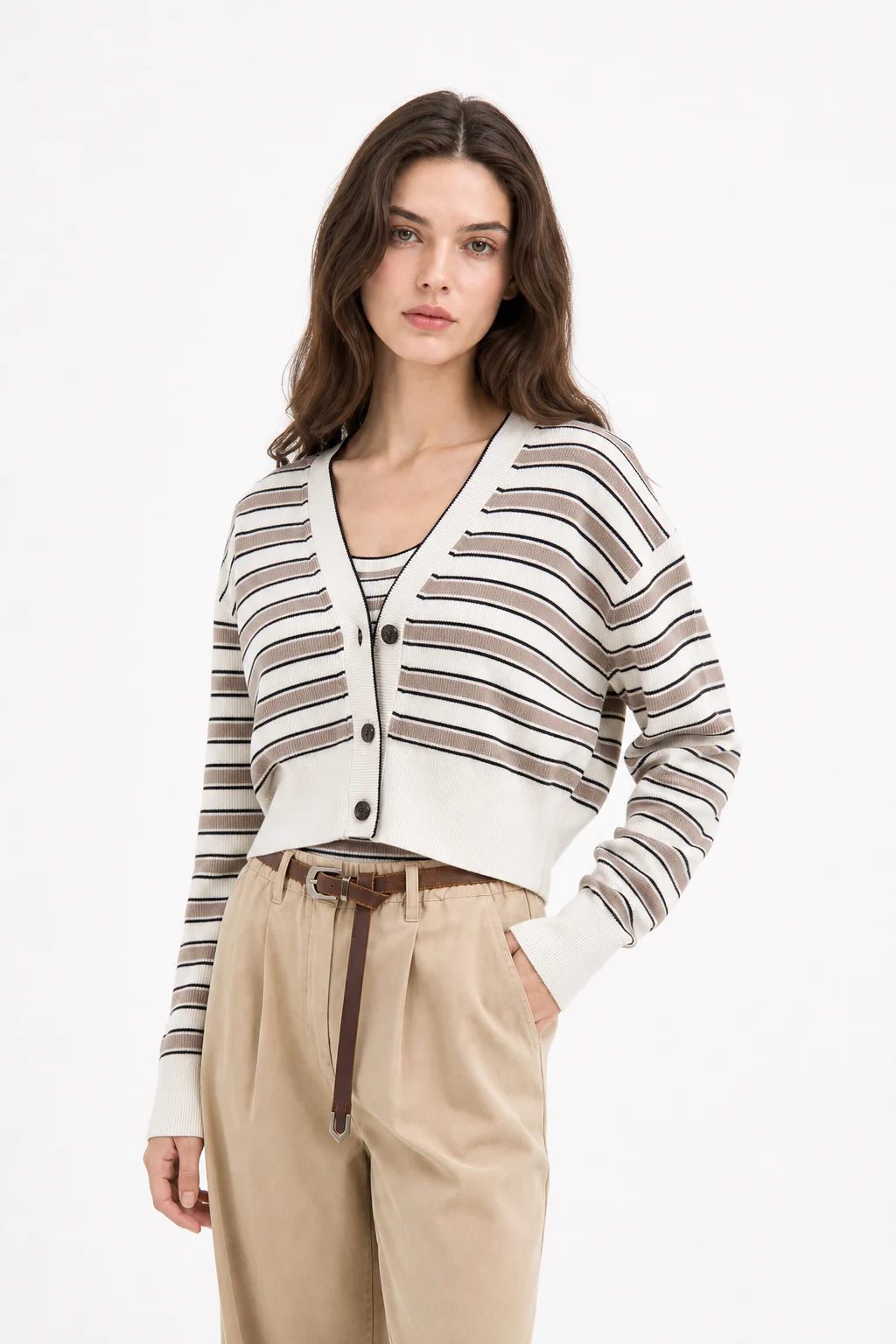
Brands looking for a direct specialist can review lpknit’s illustrated knit button cardigan and explore the company’s knitwear sourcing and craft journal when assessing product development fit.
Dated facts for supplier evaluation
- 2023 standard: ISO 3758:2023 defines the international care-labelling symbol system used for textile products; source: International Organization for Standardization, ISO 3758:2023.
- 2011 regulation: Regulation (EU) No 1007/2011 establishes European Union requirements for textile fibre names and fibre-composition labeling; source: EUR-Lex, 2011.
- 13 December 2024: Regulation (EU) 2023/988, the General Product Safety Regulation, began applying on this date; source: European Commission, 2024.
- 3 core label details: United States textile labeling guidance focuses on fiber content, country of origin, and the identity of the responsible business; source: Federal Trade Commission, current guidance accessed 2026.
- 6 due-diligence steps: The OECD garment and footwear guidance presents a six-step risk-based due-diligence framework; source: OECD, 2018.
These references support buyer due diligence, but they do not certify any individual factory. A supplier still needs to provide product-specific records and contractual accountability.
FAQ: Custom Knitwear Supplier vs Trading Company
Is buying directly from a knitwear manufacturer always cheaper?
No. Direct manufacturing can reduce intermediary costs, but the final cost also depends on MOQ, sample revisions, inspection, shipping, duties, payment terms, and defect risk. Compare equivalent specifications and total landed cost instead of comparing unit prices alone.
Which option is better for low MOQ orders?
A specialist custom knitwear supplier is often better when the order focuses on technically demanding sweaters and the supplier supports low MOQ production. A trading company may be useful when it consolidates several small categories or combines the order with an existing factory schedule.
How can I verify that a supplier is a real knitwear factory?
Request a live factory walkthrough, machine and gauge information, sample-development records, quality reports, and the legal entity named on the contract. Confirm that the same business details appear on the quotation, invoice, and payment instructions.
What should I ask about cashmere, merino, or mohair yarn?
Ask for fiber composition, yarn specification, mill or origin information where available, lot identification, color approval, and substitution rules. Also ask how the yarn affects gauge, drape, shrinkage, pilling, hand feel, and care labeling.
How many samples should a boutique brand request?
The right number depends on construction complexity, but a brand should usually define a development sample, revision stage, and pre-production approval point. Every stage should have written measurements, comments, and a clear sign-off before bulk knitting begins.
Does a trading company control quality?
It can control quality if its agreement with the factory defines inspections, tolerances, documentation, and remedies. Buyers should ask who performs the inspection, who owns the production specification, and who pays when finished goods do not meet the approved sample.
What is the main advantage of a direct knitwear supplier?
The main advantage is a shorter technical communication path between the brand and the people controlling yarn, gauge, knitting, linking, finishing, and inspection. That structure can improve revision speed and accountability, especially for repeat premium knitwear programs.
Conclusion: Choosing the Right Knitwear Production Partner
The practical answer to custom knitwear supplier vs trading company is determined by the type of control your collection requires. A trading company can add value through category breadth and coordination, while a direct specialist such as lpknit is better aligned with brands that need merino, cashmere, or mohair development, factory sampling, low MOQ support, and clear knitwear accountability.
Emily Carter is a knitwear sourcing consultant focused on premium yarn development and boutique production. This guide reflects first-hand supplier-evaluation work around gauge, hand feel, sample revisions, MOQ planning, and production documentation, supported by ISO 3758:2023, Regulation (EU) No 1007/2011, the 2024 application date of EU GPSR, and Federal Trade Commission textile-labeling guidance.
For a collection that needs direct technical discussion, review lpknit’s premium knitwear products and send the team your yarn preference, styles, target quantity, and sample requirements. A clear brief is the fastest way to determine whether lpknit fits your next boutique or private-label production run.
{
“@context”: “https://schema.org”,
“@type”: “FAQPage”,
“mainEntity”: [
{
“@type”: “Question”,
“name”: “Is buying directly from a knitwear manufacturer always cheaper?”,
“acceptedAnswer”: {
“@type”: “Answer”,
“text”: “No. Direct manufacturing can reduce intermediary costs, but the final cost also depends on MOQ, sample revisions, inspection, shipping, duties, payment terms, and defect risk. Compare equivalent specifications and total landed cost instead of comparing unit prices alone.”
}
},
{
“@type”: “Question”,
“name”: “Which option is better for low MOQ orders?”,
“acceptedAnswer”: {
“@type”: “Answer”,
“text”: “specialist custom knitwear supplier is often better when the order focuses on technically demanding sweaters and the supplier supports low MOQ production. A trading company may be useful when it consolidates several small categories or combines the order with an existing factory schedule.”
}
},
{
“@type”: “Question”,
“name”: “How can I verify that a supplier is a real knitwear factory?”,
“acceptedAnswer”: {
“@type”: “Answer”,
“text”: “Request a live factory walkthrough, machine and gauge information, sample-development records, quality reports, and the legal entity named on the contract. Confirm that the same business details appear on the quotation, invoice, and payment instructions.”
}
},
{
“@type”: “Question”,
“name”: “What should I ask about cashmere, merino, or mohair yarn?”,
“acceptedAnswer”: {
“@type”: “Answer”,
“text”: “sk for fiber composition, yarn specification, mill or origin information where available, lot identification, color approval, and substitution rules. Also ask how the yarn affects gauge, drape, shrinkage, pilling, hand feel, and care labeling.”
}
},
{
“@type”: “Question”,
“name”: “How many samples should a boutique brand request?”,
“acceptedAnswer”: {
“@type”: “Answer”,
“text”: “The right number depends on construction complexity, but a brand should usually define a development sample, revision stage, and pre-production approval point. Every stage should have written measurements, comments, and a clear sign-off before bulk knitting begins.”
}
},
{
“@type”: “Question”,
“name”: “Does a trading company control quality?”,
“acceptedAnswer”: {
“@type”: “Answer”,
“text”: “It can control quality if its agreement with the factory defines inspections, tolerances, documentation, and remedies. Buyers should ask who performs the inspection, who owns the production specification, and who pays when finished goods do not meet the approved sample.”
}
},
{
“@type”: “Question”,
“name”: “What is the main advantage of a direct knitwear supplier?”,
“acceptedAnswer”: {
“@type”: “Answer”,
“text”: “The main advantage is a shorter technical communication path between the brand and the people controlling yarn, gauge, knitting, linking, finishing, and inspection. That structure can improve revision speed and accountability, especially for repeat premium knitwear programs.”
}
}
]
}