

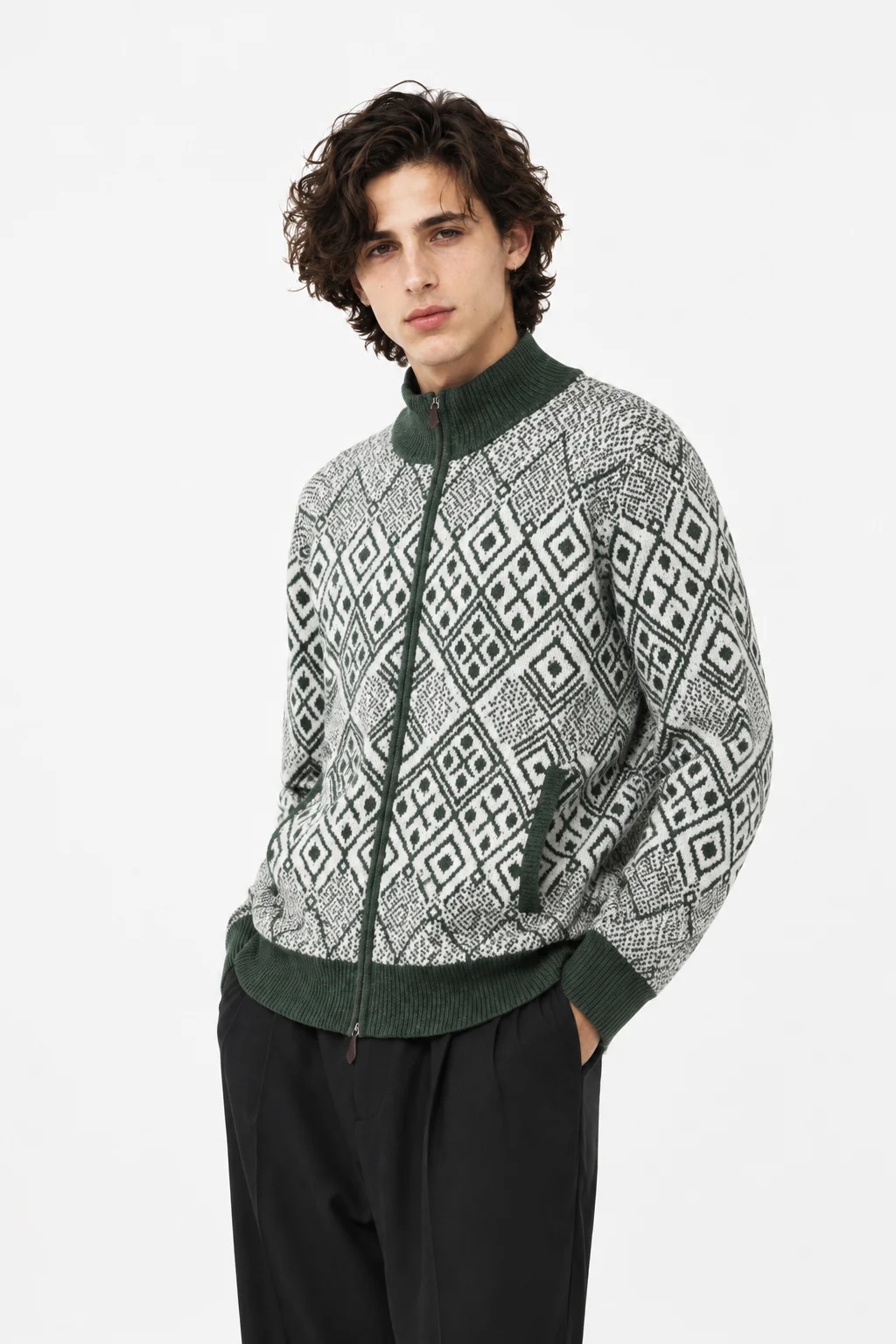
Fully fashioned knitwear is knitted into shaped garment pieces, while cut-and-sew knitwear is cut from knitted fabric and sewn together. Fully fashioned construction can give a sweater cleaner shaping and reduced cutting waste, but it may require more programming and development; cut-and-sew can suit bold panel layouts and fabric-led designs. For boutique brands, the right choice depends on silhouette, yarn, sampling needs, MOQ, and target cost—not a blanket quality rule.
Choosing a construction method affects more than a sweater’s seams. It influences the way a design is shaped, how a factory develops the sample, and which production costs matter most.
For boutique labels ordering merino, cashmere, or mohair knitwear, the practical question is not simply which method sounds more premium. It is which method supports the desired look, fit, order size, and launch timeline.
Key takeaways
– Fully fashioned pieces are knitted to shape; cut-and-sew pieces are cut from knitted fabric.
– Fully fashioned construction is not automatically seamless or always higher quality.
– Cut-and-sew offers useful layout freedom, but cutting can create more offcuts.
– Gauge, yarn behavior, finishing, and workmanship influence the final result as much as construction.
– Sampling with an OEM supplier helps test the design, fit, and cost before committing to bulk production.
What does fully fashioned mean in knitwear?
Fully fashioned knitwear is made by knitting garment pieces to their intended shape, often with decreases and increases at edges, before linking or sewing the pieces together. The method builds shaping into the knitted panels rather than cutting the garment outline from a larger piece of knitted fabric.
A fully fashioned sweater may include separately knitted front and back panels, sleeves, and trims. Those parts are joined during assembly, so “fully fashioned” does not mean “seamless.” The shoulder, side, and sleeve seams can remain visible, although the shaped edges may sit neatly when assembled.
A fully fashioned knitting machine can be programmed to create shaped panels, with the exact capabilities depending on the machine, gauge, and production setup. The factory also needs to translate the design into machine instructions and confirm measurements, stitch structure, yarn, and finishing requirements.
That development work matters for a fitted cardigan or sweater with shaped armholes. If the design calls for oversized, straight panels, the advantages of shaping may be less important than the flexibility of cutting fabric.
Fully fashioned vs cut and sew knitwear: the construction difference
The main difference between fully fashioned and cut-and-sew knitwear is when and how the garment’s shape is created. Fully fashioned panels are knitted to shape; cut-and-sew garments are cut to shape from knitted fabric, then stitched together.
| Decision factor | Fully fashioned | Cut and sew |
|---|---|---|
| Construction | Shaped panels are knitted individually, then linked or sewn | Knitted fabric is spread, cut into pattern pieces, and sewn |
| Shaping | Built into panel edges during knitting | Created by the pattern and cutting layout |
| Seams | Often shaped and relatively tidy; seams still exist | Depend on pattern, seam type, fabric, and sewing |
| Design flexibility | Well suited to shaping, stitch changes, and knitted details | Useful for fabric-led layouts, cut panels, and certain graphic designs |
| Material use | Can avoid garment-outline cutting waste; yarn use still depends on design and sampling | Pattern cutting can leave fabric offcuts |
| Development | Requires knitting programming and panel-specific sampling | Requires fabric selection, pattern development, cutting, and sewing samples |
| Cost drivers | Machine time, yarn, linking, complexity, finishing, order scale | Fabric, cutting efficiency, sewing time, finishing, and order scale |
| MOQ | Depends on supplier capacity, yarn, machine setup, and order mix | Depends on fabric sourcing, cutting setup, and production planning |
These are tendencies, not universal performance guarantees. A factory’s equipment, operator skill, pattern, yarn, and finishing can shift the result substantially.
The word “knitwear” also covers different approaches. Flat knitting creates fabric or shaped pieces; cut-and-sew uses knitted fabric as the material for sewn garment construction. Whole-garment knitting is another method: a machine produces a garment in a more integrated form, potentially reducing assembly seams. It is distinct from conventional fully fashioned panel knitting.
Which method looks and feels better?
Neither construction method guarantees better comfort or appearance; yarn quality, stitch choice, fit, finishing, and seam execution all affect how a sweater feels and looks. Fully fashioned shaping can help a designer control garment contours, while cut-and-sew can work well when the visual design depends on fabric panels or a particular printed or knitted cloth.
For comfort, assess the finished garment rather than relying on the construction label. A well-linked fully fashioned seam can lie smoothly, but a bulky seam or unsuitable yarn can still irritate. A carefully sewn cut-and-sew sweater can also feel comfortable if the fabric and seam finish suit the design.
Durability follows the same principle. Fully fashioned edges are not cut across loops in the same way as cut fabric edges, but the garment’s lifespan still depends on yarn strength, stitch density, seam construction, abrasion, care, and quality control. A cut-and-sew edge must be secured appropriately; poor sewing or unstable fabric can lead to seam problems.
Ask a supplier to assess:
- Fit: Does the sample match the intended shoulder, body, sleeve, and hem proportions?
- Hand feel: Does the fabric feel right against skin after washing or finishing?
- Seams and edges: Are joins neat, stable, and appropriate for the design?
- Recovery: Does the garment return to shape after wear and care testing?
- Appearance: Do stitch definition, drape, and surface texture match the brief?
Cost, waste, and lead time: what should buyers expect?
Fully fashioned knitwear is not automatically more expensive or slower than cut-and-sew knitwear. Its economics depend on programming, machine time, linking, yarn, complexity, order size, and the amount of sampling; cut-and-sew economics depend on fabric availability, cutting efficiency, sewing time, and finishing.
A shaped fully fashioned panel may reduce the need to cut the garment outline from a larger fabric piece. That does not make it “zero waste”: sampling, yarn ends, rejects, trims, and production setup can still generate waste. Cut-and-sew can create offcuts, but efficient marker planning may improve fabric use.
Lead time also needs a supplier-specific answer. A simple design using an established yarn and proven construction may move quickly in either method. A new stitch, complex shaping, special yarn, or several fit revisions can extend development, whether the factory uses panel knitting or cut-and-sew.
Request a quote that separates development from production. Ask the supplier to list sample charges, bulk unit cost, yarn assumptions, trims, finishing, MOQ, and estimated timelines. This makes it easier to compare offers without treating an early sample estimate as a guaranteed bulk price.
The following dated references establish material-label and sustainability context; they do not set a universal price, lead-time, or MOQ benchmark for either construction method.
- 2011: Regulation (EU) No 1007/2011 sets EU rules on textile fibre names and textile-fibre composition labelling. Its scope concerns textile naming and labelling, not whether a sweater must be fully fashioned or cut-and-sew.
- 2024: Textile Exchange’s Materials Market Report 2024 reports on global fibre and materials production for the reporting period covered. Use its figures for broad materials context, not as evidence that one garment construction has a lower footprint.
- 2024: The U.S. Federal Trade Commission’s Threading Your Way Through the Labeling Requirements Under the Textile and Wool Acts explains U.S. textile and wool product labelling obligations. Confirm the requirements that apply to the product and market before labelling.
- 2024: The U.S. Federal Trade Commission’s Care Labeling Rule outlines care-instruction requirements for covered products. Fiber content and care labelling are separate checks from construction selection.
- 2024: The UK government’s Textile products: labelling provides UK guidance on textile fibre names and labelling. Brands selling across the UK, U.S., and EU should check each market’s applicable rules.
Which construction suits a boutique or private-label collection?
A boutique brand should choose construction by matching the design, order plan, and supplier capability—not by treating one method as inherently premium. Fully fashioned production can be a strong fit for shaped knitwear and considered details; cut-and-sew may suit fabric-led designs or styles where panel layout is central.
Consider fully fashioned development when:
- You want shaped panels, such as a contoured shoulder or sleeve.
- The design depends on knitted stitch details or a clean panel outline.
- You are developing a premium merino, cashmere, or mohair sweater where the intended drape and fit are central.
- The supplier can support sampling and explain how machine gauge and yarn affect the result.
Consider cut-and-sew when:
- Your design uses broad fabric panels, strong color blocking, or a layout that is easier to cut from knitted fabric.
- You need a construction compatible with the fabric and sewing capabilities available to your supplier.
- Pattern placement and cutting efficiency can be planned at the start.
A hybrid approach may also make sense. For example, a brand could use shaped knitted panels for the body and sleeves, then introduce sewn-on details or a contrasting fabric component. The construction should be confirmed during sampling because combining methods can add handling steps and affect cost.
Scenario 1: a small merino capsule. Maya runs an independent London label and is preparing a 60-piece first drop across three sweater colors. She wants shaped shoulders and a tidy neckline. She asks an OEM supplier to sample a fully fashioned option and confirm whether the colors, yarn, and order split work with the factory’s minimums before approving the range.
Scenario 2: a graphic cardigan test. Jordan’s U.S. boutique brand wants a 40-piece trial cardigan with large contrasting panels and a relaxed, straight silhouette. The supplier compares a cut-and-sew sample with a knitted-panel alternative. Jordan selects the construction that reproduces the color layout and fit at an acceptable quoted cost, rather than assuming that one process is always cheaper.
How to choose a knitwear construction with an OEM supplier
A structured sampling process helps a brand compare construction, fit, cost, and production risk before placing a bulk order. Share the design brief early, ask the manufacturer to explain the available construction routes, and compare finished samples against the same measurements and quality expectations.
- Define the commercial brief. Specify the target retail price, launch date, quantity by style and color, intended market, and whether the order is a test run or a repeat program.
- Prepare the design details. Provide sketches or a tech pack with measurements, stitch ideas, yarn preferences, trims, labeling needs, and reference garments if available.
- Ask for construction options. Request a recommendation for fully fashioned, cut-and-sew, or a hybrid where appropriate. Ask what machine capabilities, materials, and assembly steps affect the choice.
- Develop and review a sample. Check dimensions, drape, hand feel, seams, finishing, and the way the garment looks on a fit model. Record specific changes rather than giving general feedback such as “make it better.”
- Confirm the commercial quote. Review sampling charges, bulk pricing, MOQ, yarn sourcing, production timing, packaging, and any separate costs for labels or trims.
- Approve standards before production. Document the final measurements, materials, colors, construction, care and fibre labels, and acceptable quality criteria before authorizing bulk production.
For low-MOQ projects, ask which parts of the order drive the minimum: total units, units per color, yarn purchasing, machine setup, or a specific trim. A supplier’s answer helps you decide whether to reduce colorways, simplify details, or choose a construction better suited to the first run.
lpknit describes itself as a premium knitwear manufacturer and OEM supplier for boutique brands in the U.S., UK, and EU, with a focus on merino, cashmere, and mohair, low-MOQ support, and factory sampling. Buyers can review its knitwear product range, including the fine-knit round-neck cardigan and mohair long-sleeve sweater, as design references when preparing a brief.
Frequently asked questions
What are the two types of knitted fabrics?
Knitted fabrics are commonly grouped into weft knits and warp knits, based on how yarns form loops. That classification describes fabric structure, not garment assembly: either type may be used in different product and manufacturing contexts, so confirm the fabric construction with the supplier.
What are the eight stages in garment construction?
There is no single universal eight-stage sequence for every sweater factory. A typical development path includes design briefing, tech-pack review, material selection, pattern or machine programming, sampling, fit approval, bulk production, and inspection or finishing; labels and packing may be included as separate steps.
Is a fully fashioned sweater seamless?
No. A fully fashioned sweater usually has shaped knitted panels that are linked or sewn together. Whole-garment knitting can produce a more integrated garment with fewer assembly seams, but whole-garment and fully fashioned panel construction are not interchangeable terms.
Is fully fashioned knitwear more expensive?
Not always. Cost depends on yarn, design complexity, machine and linking time, order quantity, sampling, and finishing. Compare like-for-like quotes that list these assumptions; a complex cut-and-sew style can also require significant fabric, sewing, and development work.
Which construction is best for cashmere or mohair sweaters?
The best choice depends on the intended silhouette, stitch, yarn behavior, and factory capabilities. Ask the supplier to sample the chosen yarn and construction together, because fiber, gauge, finishing, and fit can change the final hand feel and appearance.
Can a small brand order fully fashioned knitwear?
Possibly, but MOQ and sampling terms vary by factory, yarn, colors, and machine setup. Ask whether the minimum applies per style, color, or total order, and request a development plan before finalizing the collection.
What does “full fashioned” mean?
“Full fashioned” is an alternative spelling of “fully fashioned.” In knitwear, it generally refers to pieces knitted to shape rather than cut from a larger knitted fabric. Confirm the supplier’s use of the term, since product descriptions may not explain the exact construction.
Make the construction decision with a sample
Fully fashioned vs cut and sew knitwear is a design and sourcing decision, not a simple ranking of quality. Fully fashioned construction can support shaped panels and controlled knit details; cut-and-sew can offer a practical route for fabric-led layouts. A sample and a transparent quote are the most useful way to decide.
Clara Bennett covers knitwear production and sourcing, with a focus on construction, materials, and private-label development. This guide draws on publicly documented construction principles and the stated product and sampling offer from lpknit; product examples are available in lpknit’s cardigan and sweater range. Planning a merino, cashmere, or mohair collection? Contact lpknit to discuss low-MOQ options and factory sampling for your design.
{
“@context”: “https://schema.org”,
“@type”: “Article”,
“headline”: “Fully Fashioned vs Cut and Sew Knitwear: Buyer Guide 2026”,
“datePublished”: “2026-01-24”,
“dateModified”: “2026-09-23”,
“description”: “Compare fully fashioned and cut-and-sew knitwear by fit, cost, waste, lead time, and MOQ. Choose the right construction for your next sweater collection.”,
“keywords”: “fully fashioned vs cut and sew knitwear”,
“author”: {
“@type”: “Person”,
“name”: “Clara Bennett”,
“jobTitle”: “Knitwear production and sourcing editor focused on sweater construction, materials, and private-label development.”
}
}
{
“@context”: “https://schema.org”,
“@type”: “FAQPage”,
“mainEntity”: [
{
“@type”: “Question”,
“name”: “What are the two types of knitted fabrics?”,
“acceptedAnswer”: {
“@type”: “Answer”,
“text”: “Knitted fabrics are commonly grouped into **weft knits** and **warp knits**, based on how yarns form loops. That classification describes fabric structure, not garment assembly: either type may be used in different product and manufacturing contexts, so confirm the fabric construction with the supplier.”
}
},
{
“@type”: “Question”,
“name”: “What are the eight stages in garment construction?”,
“acceptedAnswer”: {
“@type”: “Answer”,
“text”: “There is no single universal eight-stage sequence for every sweater factory. A typical development path includes design briefing, tech-pack review, material selection, pattern or machine programming, sampling, fit approval, bulk production, and inspection or finishing; labels and packing may be included as separate steps.”
}
},
{
“@type”: “Question”,
“name”: “Is a fully fashioned sweater seamless?”,
“acceptedAnswer”: {
“@type”: “Answer”,
“text”: “No. A fully fashioned sweater usually has shaped knitted panels that are linked or sewn together. Whole-garment knitting can produce a more integrated garment with fewer assembly seams, but whole-garment and fully fashioned panel construction are not interchangeable terms.”
}
},
{
“@type”: “Question”,
“name”: “Is fully fashioned knitwear more expensive?”,
“acceptedAnswer”: {
“@type”: “Answer”,
“text”: “Not always. Cost depends on yarn, design complexity, machine and linking time, order quantity, sampling, and finishing. Compare like-for-like quotes that list these assumptions; a complex cut-and-sew style can also require significant fabric, sewing, and development work.”
}
},
{
“@type”: “Question”,
“name”: “Which construction is best for cashmere or mohair sweaters?”,
“acceptedAnswer”: {
“@type”: “Answer”,
“text”: “The best choice depends on the intended silhouette, stitch, yarn behavior, and factory capabilities. Ask the supplier to sample the chosen yarn and construction together, because fiber, gauge, finishing, and fit can change the final hand feel and appearance.”
}
},
{
“@type”: “Question”,
“name”: “Can a small brand order fully fashioned knitwear?”,
“acceptedAnswer”: {
“@type”: “Answer”,
“text”: “Possibly, but MOQ and sampling terms vary by factory, yarn, colors, and machine setup. Ask whether the minimum applies per style, color, or total order, and request a development plan before finalizing the collection.”
}
},
{
“@type”: “Question”,
“name”: “What does “full fashioned” mean?”,
“acceptedAnswer”: {
“@type”: “Answer”,
“text”: ““Full fashioned” is an alternative spelling of “fully fashioned.” In knitwear, it generally refers to pieces knitted to shape rather than cut from a larger knitted fabric. Confirm the supplier’s use of the term, since product descriptions may not explain the exact construction.”
}
}
]
}