

To evaluate a premium knitwear OEM partner, compare documented yarn sourcing, sample-to-bulk controls, gauge and fit consistency, quality checks, minimum order quantities (MOQs), lead times, and landed cost. Request a material specification, a graded sample, written production tolerances, and a repeat-order plan before approving bulk. Check relevant requirements from the U.S. Federal Trade Commission (FTC) and European Union (EU), and score suppliers against the same weighted criteria.
A knitwear supplier can make an attractive prototype and still struggle to reproduce its hand-feel, measurements, or color in production. Brands sourcing merino, cashmere, or mohair need evidence at each stage, not just a polished sample or low unit quote.
This guide provides a practical scorecard for boutique labels comparing OEM manufacturers. It also explains which questions to ask about development, order size, quality control, and reorders.
Key takeaways
– Judge the supplier’s process as well as the first sample.
– Ask for fiber, yarn, gauge, and measurement details you can verify.
– Compare MOQs, sampling fees, lead times, and landed cost together.
– Agree on inspection criteria and defect handling before production.
– Use a weighted scorecard to identify trade-offs before committing.
What does a knitwear OEM manufacturer do?
A knitwear original equipment manufacturer (OEM) develops and produces garments to a buyer’s specifications, such as a supplied design, tech pack, yarn choice, measurements, and branding. An original design manufacturer (ODM) generally offers existing designs or product concepts that a buyer can adapt or private-label; exact services vary by supplier.
For a boutique brand, the practical distinction is who controls the product decisions. An OEM partner should be able to discuss how design details translate into knitting, finishing, and garment construction. An ODM partner may reduce development work, but the buyer should still verify material, fit, labeling, and customization limits.
| Area | OEM arrangement | ODM arrangement |
|---|---|---|
| Starting point | Buyer’s design or detailed brief | Supplier’s existing style or concept |
| Development | Supplier interprets and samples specifications | Supplier presents options for adaptation |
| Buyer’s control | Often higher, subject to factory capability | Often narrower, depending on available styles |
| Best question | “How will you translate this tech pack into a production sample?” | “Which features can we change, and what remains standard?” |
| Main risk | Brief gaps can produce the wrong sample | A familiar base style may limit differentiation |
Ask how the supplier handles design files, ownership, confidentiality, and use of custom developments. Get the agreed scope in writing, including any restrictions on reusing branded artwork or exclusive specifications.
How to evaluate a premium knitwear OEM partner with a scorecard
A weighted scorecard makes supplier comparisons more consistent by assigning points to the capabilities that matter most to the brand. Score each criterion from 1 to 5, multiply it by its weight, then compare the total out of 100.
Use the same questions and scoring rules for every candidate. A supplier’s claims should earn points only when supported by a document, sample, clear process, or verifiable reference.
| Criterion | Weight | Evidence to request |
|---|---|---|
| Yarn and fiber transparency | 20% | Fiber content, yarn specification, supplier or lot information |
| Sampling and technical development | 20% | Sample stages, revision process, written approval record |
| Production quality controls | 20% | Inspection checkpoints, measurement tolerances, defect process |
| MOQ and order flexibility | 15% | MOQ by style, color, and yarn; any setup fees |
| Communication and delivery planning | 15% | Named contact, milestone schedule, delay escalation |
| Commercial clarity | 10% | Itemized quote, payment terms, freight and duty assumptions |
Multiply each 1–5 rating by its weight, then divide the sum by 5 to get a score out of 100. A score can help shortlist suppliers, but it does not replace a sample review, reference check, or written agreement. Treat a serious gap in material traceability or quality control as a risk even when the overall score looks strong.
How to verify merino, cashmere, and mohair yarn claims
Fiber verification starts with precise documentation for the yarn used in the sample and the proposed bulk run. Ask for the fiber composition, yarn count or specification, color reference, and available source or lot details; then confirm that the information matches the product description and labeling plan.
Request information that is specific to the order rather than relying on broad sustainability language. The FTC’s Textile Fiber Products Identification Act guidance explains U.S. disclosure requirements for covered textile products. In the EU, Regulation (EU) No 1007/2011 sets rules for textile fibre names and fibre composition labelling.
For merino, cashmere, and mohair, ask the supplier to clarify whether a quoted fiber is pure or blended, and how substitutions are controlled. If a certification or animal-welfare standard matters to your brand, request the certificate and verify its scope, validity, and relevance to the material in your order.
The following dated sources establish relevant labeling and market context; they are not supplier-quality benchmarks:
- 16 CFR Part 303 is the FTC’s U.S. textile fiber identification regulation; consult the current eCFR text for applicable labeling obligations. Source: Electronic Code of Federal Regulations, Title 16, Part 303, accessed 2026.
- Regulation (EU) No 1007/2011 is the EU regulation governing textile fibre names and related textile fibre composition labeling. Source: EUR-Lex, Regulation (EU) No 1007/2011, adopted 2011.
- Regulation (EU) 2023/988, the General Product Safety Regulation, has applied since 13 December 2024 to covered consumer products placed on the EU market. Review applicability to your product and role with the European Commission’s GPSR guidance, updated guidance accessed 2026.
- The FTC’s 16 CFR Part 323 contains the U.S. Care Labeling Rule. Confirm current requirements and the care instructions appropriate to the actual garment through the FTC Care Labeling Rule, accessed 2026.
- The FTC’s Textile Fiber Products Identification Act and EU Regulation No 1007/2011 are separate legal regimes; a label prepared for one market should not be assumed to satisfy the other. Sources: FTC and EUR-Lex, accessed 2026.
These are compliance references, not proof that a factory is certified or that a particular batch meets a quality level. Confirm the rules for each destination market and product configuration with the relevant authority or qualified compliance adviser.
What to inspect in a sweater sample before bulk approval
A pre-production sample should demonstrate the agreed design, yarn, construction, measurements, and finishing closely enough to serve as a production reference. Review it against the tech pack and record any accepted deviations before authorizing bulk.
Check these areas in a consistent order:
- Fiber and yarn: Compare the sample’s composition and hand-feel with the approved specification. Ask whether bulk yarn will come from the same lot or an approved equivalent.
- Gauge and knit structure: Check stitch density, surface appearance, and weight. Confirm that the knit structure matches the design and specification.
- Measurements and grading: Measure body length, chest, sleeve, and other critical points. Request the size chart and graded specifications, not just a single-size sample.
- Construction: Inspect seams, button attachment, neck shaping, cuffs, hems, and finishing. Check for loose ends, uneven joins, or visible defects.
- Wear and care: Test for fit, comfort, shedding, pilling, and recovery where relevant. Confirm that care instructions match the material and finishing.
- Color and trims: Compare yarn and trim colors against approved references under consistent lighting. Confirm button, label, and packaging details.
- Approval record: Sign off the sample version and retain photos, measurements, and written notes. State whether it is a development, fit, or pre-production sample.
The sample is not a promise of perfect bulk uniformity. It is a reference point for agreed tolerances, and the production plan should explain how the factory checks consistency against it.
For example, a London label developing a 120-piece merino cardigan run might approve a sample with a 58 cm body length in its reference size. Before production, the buyer can specify the measurement point and an acceptable tolerance, then ask for inspection results from bulk garments. Without an agreed method, the buyer and supplier may disagree over whether a measured difference is acceptable.
How should you compare MOQs, sampling fees, and landed costs?
The lowest unit price is not necessarily the lowest-cost option once sampling, setup, freight, duties, and quality risks are included. Compare written quotes using the same design, yarn, size range, color count, delivery terms, and order quantity.
| Cost or term | What to confirm |
|---|---|
| MOQ | Minimum units by style, color, and yarn; whether sizes count toward one total |
| Sampling | Fee per sample stage, revisions included, and whether fees are credited to bulk |
| Production price | What yarn, trims, labels, packaging, and finishing are included |
| Timing | Sample lead time, production window, shipping estimate, and start-date dependencies |
| Freight and duties | Shipping method, named Incoterm, destination, and which party pays each charge |
| Payment | Deposit, balance trigger, accepted payment method, and remedies for missed milestones |
Ask each supplier to state the assumptions behind the quote. A quote that excludes yarn, custom labels, or freight should not be compared directly with an all-in price.
For example, a New York boutique considering 80 cashmere cardigans could compare a low-MOQ quote with a larger-order quote by adding the sample fee, freight, duty, and any color setup cost. If the smaller run costs more per piece but limits unsold inventory, the buyer can decide whether that flexibility is worth the premium. The right choice depends on the brand’s margin and demand forecast, not a generic “best MOQ.”
What quality control and reorder process should a supplier provide?
A reliable OEM partner should define how the approved sample becomes a production standard, when checks happen, and how defects or changes are handled. Ask for written criteria before bulk production begins, then confirm that the same controls apply to repeat orders.
Look for a documented process covering incoming yarn checks, in-line production review, finished-garment inspection, measurement recording, and defect resolution. Clarify who approves substitutions, how failed pieces are corrected, and whether the supplier can provide inspection photos or reports before shipment.
Reorders deserve their own questions. Confirm how the supplier records yarn details, gauge, measurements, trims, and finishing for each style, and whether a later order may differ because a yarn lot or dye lot has changed. A repeat order should reference the original approved specification and document any authorized updates.
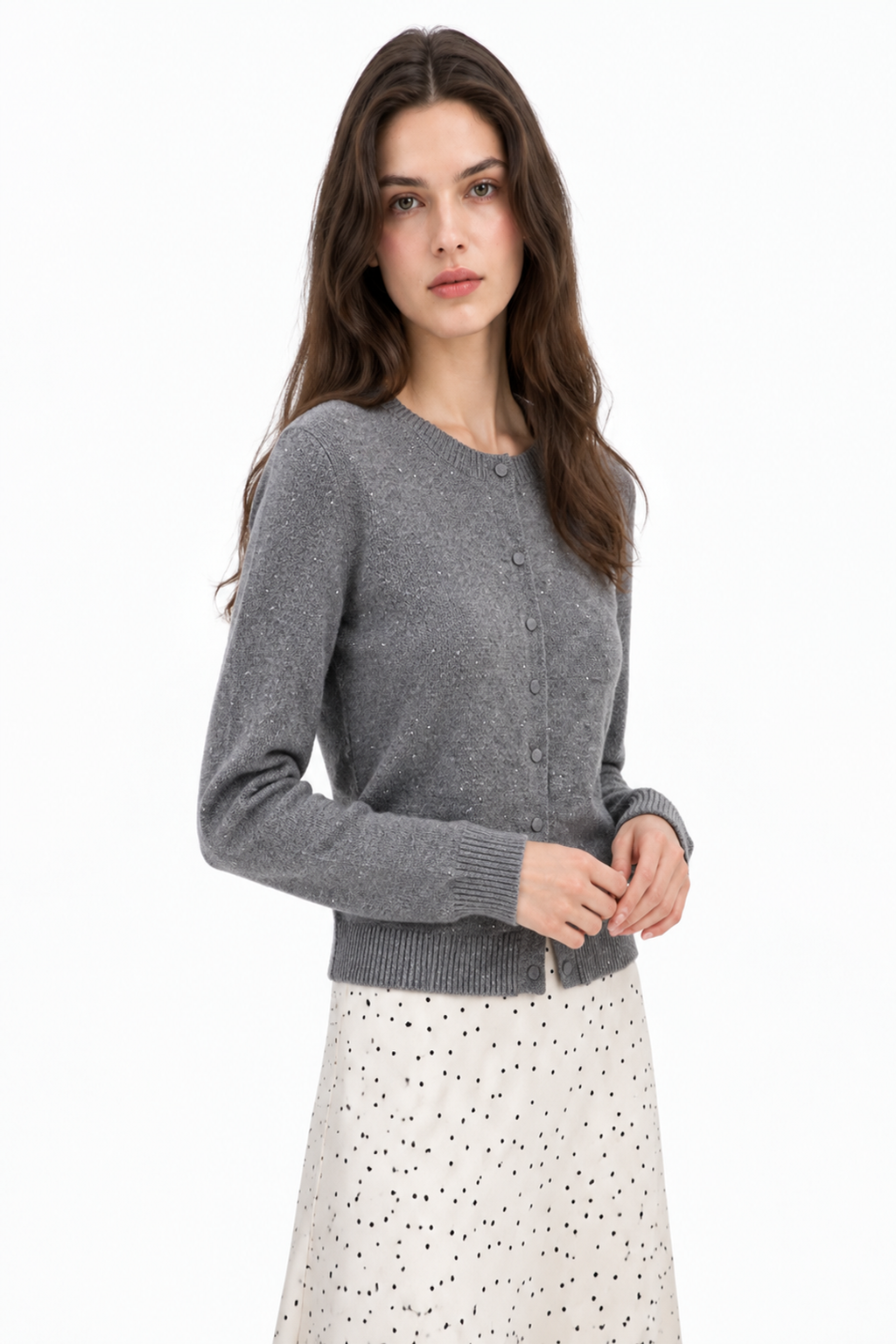
lpknit describes itself as a premium knitwear manufacturer and OEM supplier for merino, cashmere, and mohair sweaters, with low-MOQ support and factory sampling. Buyers can review its knitwear product range, including a fine-knit round-neck cardigan and a mohair long-sleeve sweater. Product examples help start a conversation; they do not replace order-specific confirmation of capacity, terms, materials, or quality controls.
Questions to ask before choosing an OEM partner
The best supplier questions invite specific evidence and expose assumptions early. Ask the same core questions during each supplier conversation so answers are easier to compare.
- Which yarn specification and fiber documentation will apply to my order?
- Can you show how a sample revision is recorded and approved?
- How do you grade measurements across the requested size range?
- What is the MOQ by style, color, and yarn?
- What do sampling fees include, and how many revisions are covered?
- Which production checks are documented, and how are defects resolved?
- What assumptions determine the quoted price and delivery date?
- How do you keep specifications available for repeat orders?
- Which design files, artwork, or custom developments remain confidential?
A vague answer is not automatic proof of poor performance, but it is a reason to request clarification in writing. Do not treat verbal assurances as substitutes for an approved specification or agreed commercial terms.
What does “OEM clothing manufacturer” mean?
An OEM clothing manufacturer produces goods to a buyer’s specifications, which may include design, materials, measurements, and branding. In knitwear, ask whether the supplier can develop the requested stitch, gauge, fit, and finishing. ODM usually begins with a supplier’s existing design or concept that the buyer can adapt.
How can a brand verify merino, cashmere, or mohair sourcing claims?
Request the fiber composition and yarn specification for the material intended for the order. Ask for relevant supplier, lot, or certification records, then check that they cover the claimed fiber and product. For U.S. and EU sales, separately confirm that product labels meet the applicable FTC and EU textile rules.
What should a buyer check on a sweater sample?
Compare the sample against the tech pack for yarn, gauge, stitch appearance, measurements, grading, construction, trims, and finishing. Record the sample version and approved tolerances. A single-size sample cannot confirm grading across a full size range, so request the graded measurement specifications too.
How should brands compare knitwear MOQs and sampling fees?
Compare the minimums by style, color, and yarn, then include sample fees, revision charges, setup costs, and any credit toward bulk orders. Use the same quantity and product assumptions for every quote. A lower MOQ may cost more per garment but can reduce inventory exposure for a small collection.
What is a landed cost for an OEM sweater order?
Landed cost is the total cost to bring the goods to the destination, including the garment price and applicable transport, insurance, duties, and other charges. Ask the supplier to name the delivery term and identify which charges are excluded. Confirm import costs for the specific destination and shipment.
What quality controls should a knitwear OEM provide?
Ask for checks tied to the approved sample and written specifications, such as yarn verification, measurement checks, in-line review, finished-garment inspection, and a documented defect process. Confirm who approves substitutions and what happens when goods fall outside agreed tolerances.
How can a brand assess whether a supplier can support reorders?
Ask how the supplier stores specifications and records yarn, color, gauge, measurements, trims, and finishing for each style. Confirm how a new lot or material change will be disclosed and approved. Reorders should reference the previous approved version and note any authorized changes.
A practical evaluation of a premium knitwear OEM partner combines yarn evidence, sample review, written quality controls, transparent costs, and a clear reorder process. Maya Chen, a knitwear product development editor focused on OEM sourcing and sampling, recommends scoring suppliers against the same criteria and verifying claims against order-specific documents.
lpknit’s published product range includes merino, cashmere, and mohair knitwear, and its site describes low-MOQ production and factory sampling for boutique brands. Those are relevant starting points, not guarantees for an individual order; confirm specifications, capacity, fees, and timelines directly. Explore lpknit’s knitwear collection or its Knitwear Journal before discussing a sample brief and production requirements.
<!– BLOCK:conclusion:end**
{
“@context”: “https://schema.org”,
“@type”: “Article”,
“headline”: “2026 Guide to Evaluating Premium Knitwear OEM Partners”,
“datePublished”: “2026-09-23”,
“dateModified”: “2026-09-23”,
“description”: “Evaluate knitwear OEM partners with a practical scorecard for yarn, samples, quality control, low MOQs, lead times, and landed cost before bulk production.”,
“keywords”: “how to evaluate a premium knitwear OEM partner”,
“author”: {
“@type”: “Person”,
“name”: “Maya Chen”,
“jobTitle”: “Knitwear product development editor covering OEM sourcing, sampling, and supplier evaluation.”
}
}
{
“@context”: “https://schema.org”,
“@type”: “FAQPage”,
“mainEntity”: [
{
“@type”: “Question”,
“name”: “What does “OEM clothing manufacturer” mean?”,
“acceptedAnswer”: {
“@type”: “Answer”,
“text”: “n OEM clothing manufacturer produces goods to a buyer’s specifications, which may include design, materials, measurements, and branding. In knitwear, ask whether the supplier can develop the requested stitch, gauge, fit, and finishing. ODM usually begins with a supplier’s existing design or concept that the buyer can adapt.”
}
},
{
“@type”: “Question”,
“name”: “How can a brand verify merino, cashmere, or mohair sourcing claims?”,
“acceptedAnswer”: {
“@type”: “Answer”,
“text”: “Request the fiber composition and yarn specification for the material intended for the order. Ask for relevant supplier, lot, or certification records, then check that they cover the claimed fiber and product. For U.S. and EU sales, separately confirm that product labels meet the applicable FTC and EU textile rules.”
}
},
{
“@type”: “Question”,
“name”: “What should a buyer check on a sweater sample?”,
“acceptedAnswer”: {
“@type”: “Answer”,
“text”: “Compare the sample against the tech pack for yarn, gauge, stitch appearance, measurements, grading, construction, trims, and finishing. Record the sample version and approved tolerances. A single-size sample cannot confirm grading across a full size range, so request the graded measurement specifications too.”
}
},
{
“@type”: “Question”,
“name”: “How should brands compare knitwear MOQs and sampling fees?”,
“acceptedAnswer”: {
“@type”: “Answer”,
“text”: “Compare the minimums by style, color, and yarn, then include sample fees, revision charges, setup costs, and any credit toward bulk orders. Use the same quantity and product assumptions for every quote. A lower MOQ may cost more per garment but can reduce inventory exposure for a small collection.”
}
},
{
“@type”: “Question”,
“name”: “What is a landed cost for an OEM sweater order?”,
“acceptedAnswer”: {
“@type”: “Answer”,
“text”: “Landed cost is the total cost to bring the goods to the destination, including the garment price and applicable transport, insurance, duties, and other charges. Ask the supplier to name the delivery term and identify which charges are excluded. Confirm import costs for the specific destination and shipment.”
}
},
{
“@type”: “Question”,
“name”: “What quality controls should a knitwear OEM provide?”,
“acceptedAnswer”: {
“@type”: “Answer”,
“text”: “sk for checks tied to the approved sample and written specifications, such as yarn verification, measurement checks, in-line review, finished-garment inspection, and a documented defect process. Confirm who approves substitutions and what happens when goods fall outside agreed tolerances.”
}
},
{
“@type”: “Question”,
“name”: “How can a brand assess whether a supplier can support reorders?”,
“acceptedAnswer”: {
“@type”: “Answer”,
“text”: “sk how the supplier stores specifications and records yarn, color, gauge, measurements, trims, and finishing for each style. Confirm how a new lot or material change will be disclosed and approved. Reorders should reference the previous approved version and note any authorized changes.”
}
}
]
}