

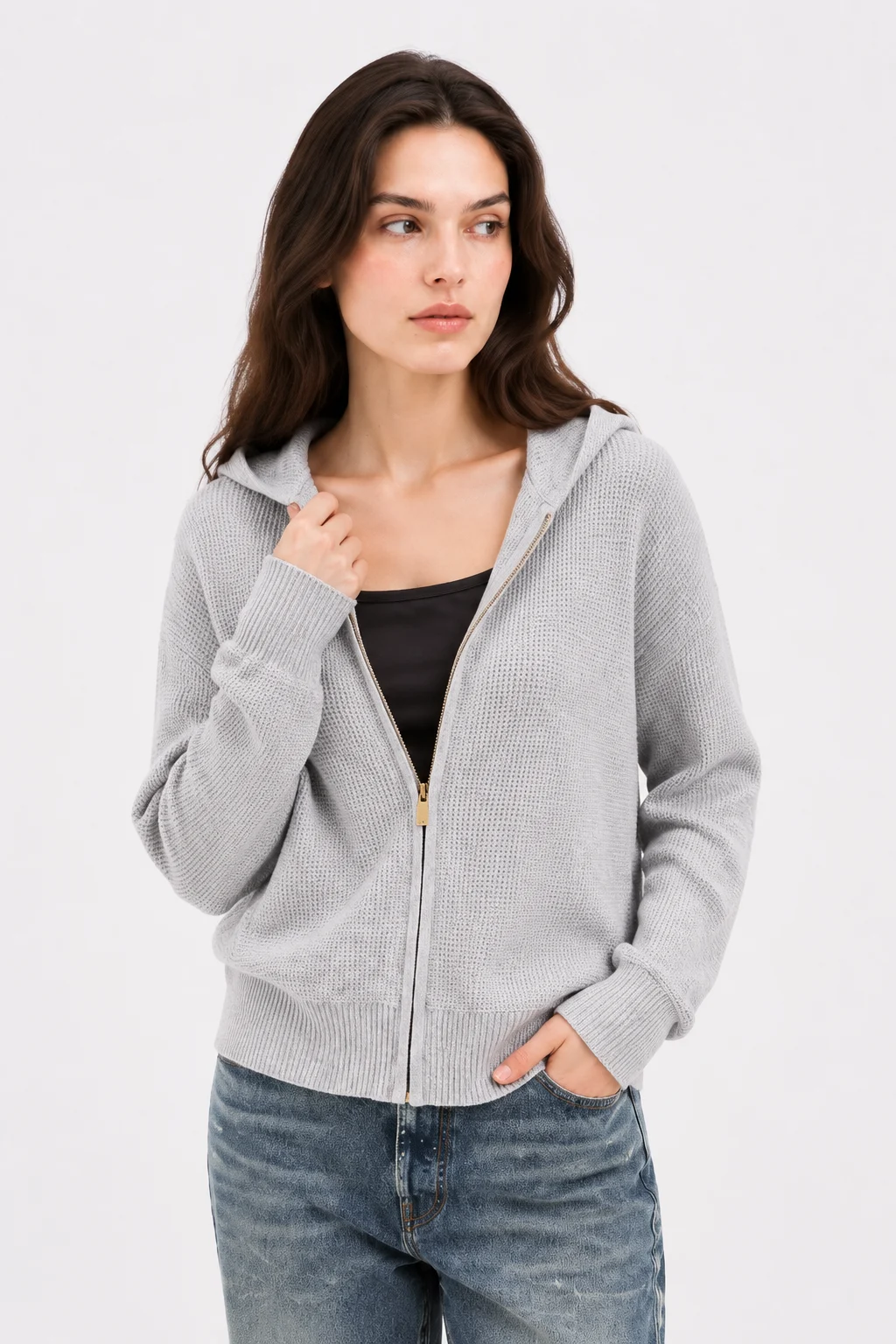
For boutique brands comparing cashmere cardigan vs cashmere pullover for retail collections, pullovers usually offer lower sampling risk, simpler sizing, and cleaner entry pricing, while cardigans from lpknit, Club Monaco-style assortments, and Regulation (EU) No 1007/2011-labeled cashmere programs can justify higher retail prices when buttons, plackets, gauge, and fit are carefully engineered for 2026 fall/winter merchandising.
Most Google results for this topic speak to consumers choosing a sweater. A retail buyer has a different problem: whether to allocate limited cashmere budget, MOQ capacity, and sampling time to cardigans, pullovers, or both.
For a boutique label planning 80 to 300 units per style, the better choice depends on opening price, styling range, size tolerance, and return risk. lpknit works as a premium knitwear manufacturer and Original Equipment Manufacturer (OEM) supplier for merino, cashmere, and mohair sweaters, so the decision starts before photography or merchandising.
Key takeaways
– Cashmere pullovers are usually the safer first SKU for low MOQ cashmere production because construction is simpler and fit grading is easier.
– Cashmere cardigans often support higher ticket prices, but buttons, plackets, trims, and front opening stability add cost and sampling checks.
– Men cashmere cardigan vs cashmere pullover for retail collections decisions should weigh sleeve length, shoulder fit, and layering use more heavily than trend value.
– Cashmere cardigan vs cashmere pullover for retail collections cost is driven by yarn count, gauge, garment weight, finishing, trims, and re-sampling rounds.
– A boutique brand with enough budget should sample one core pullover and one hero cardigan before committing to the full fall/winter buy.
Cashmere Cardigan vs Cashmere Pullover for Retail Collections: Which Sells Better?
Cashmere cardigan vs cashmere pullover for retail collections is not a universal sell-through question; pullovers usually win on volume, while cardigans often win on perceived styling value. A pullover works as an easy core item, but a cardigan can anchor a layered outfit and raise average order value.
A cashmere pullover is easier for shoppers to understand online. Crew necks, V-necks, and mock necks photograph cleanly, sit well on flat lays, and compare easily against other sweaters. That makes pullovers strong for paid social, marketplace thumbnails, and first-time cashmere buyers.
A cashmere cardigan has a broader styling story. It can be worn open, buttoned, layered over shirting, or styled as a top. For women’s assortments, a Cashmere Cardigan Sweater Women SKU can sit between knitwear and light outerwear, which helps justify premium pricing.
For example, Maya, founder of a London boutique label, sampled 120 units of a 12-gauge cashmere crew pullover and 80 units of a fine-knit cardigan. The pullover reached 72% sell-through in six weeks at GBP 168, while the cardigan reached 58% sell-through but delivered a 24% higher gross profit per unit because the retail price was GBP 228.
SERP pages such as Club Monaco, Pura Cashmere, and The New York Times Wirecutter mainly compare finished consumer options. A commercial buyer needs to look earlier in the chain: sample rounds, size set risk, trim sourcing, and whether the design can be repeated next season with new colorways.
Cost Comparison: Cardigan vs Pullover for OEM Production
Cashmere cardigan vs cashmere pullover for retail collections cost is usually higher for cardigans because a cardigan needs a front opening, placket stability, buttons or closures, and extra finishing checks. A pullover has fewer components, which can reduce development time and lower the risk of production variance.
| Decision factor | Cashmere pullover | Cashmere cardigan | Retail planning impact |
|---|---|---|---|
| Sampling complexity | Lower | Medium to high | Pullovers are faster for first cashmere drops |
| Trim dependency | Usually none | Buttons, snaps, or ties | Cardigans need trim lead-time control |
| Fit risk | Neck, chest, sleeve | Neck, chest, sleeve, front opening | Cardigans need stronger sample review |
| Perceived value | Softness and shape | Softness, layering, styling range | Cardigans can support higher ticket prices |
| Low MOQ suitability | Strong | Good with simplified design | Pullovers are safer below 100 units per color |
| Return risk | Lower if fit is standard | Higher if placket pulls or gaps | Cardigans need wear testing |
| Reorder potential | High for core colors | High for proven hero styles | Both work when yarn and gauge stay consistent |
A 100% cashmere sweater price cannot be judged by fiber name alone. Two garments labeled 100% cashmere can differ sharply by yarn grade, ply, gauge, finished weight, linking quality, wash process, and inspection standards. For US, UK, and EU retail, labels must also match fiber claims accurately.
Regulation (EU) No 1007/2011 on textile fibre names and labelling requires accurate textile fiber composition disclosure in the European Union. In the United States, the Federal Trade Commission Textile Fiber Products Identification Act guidance explains fiber labeling requirements for textile and wool products. Those rules matter when a boutique brand sells “100% cashmere” across more than one region.
A cardigan also adds practical cost items. Buttons must be selected, matched, attached, and tested. The front edge must not ripple after steaming, and the placket must keep shape after wear. If a brand requests horn buttons, contrast tipping, patch pockets, or a cropped fit, the factory may need extra sample rounds.
What Design Details Change Cashmere Cardigan vs Cashmere Pullover Results?
Design details change cost, margin, and customer satisfaction more than the word “cardigan” or “pullover” itself. Gauge, ply, neckline, body length, rib tension, and finishing method decide whether the final garment feels premium or fragile.
For pullovers, the main commercial choices are neckline and fit. Crew necks are the safest, V-necks can skew classic, and mock necks can raise warmth perception. A relaxed fit improves size tolerance, but an oversized body raises yarn consumption.
For cardigans, the front opening is the main technical risk. A narrow placket can look refined, but it may roll if the yarn and gauge are not balanced. A chunky rib placket looks stable, but it adds weight and can shift the garment toward a casual price bracket.
A private label buyer sourcing a Cashmere Cardigan Sweater Women style should ask for button spacing tests on the sample. If the cardigan gaps at the bust on size medium, return rates can rise even when the yarn feels excellent. That problem is cheaper to solve during factory sampling than after bulk production.
The same thinking applies to men’s styles. Men cashmere cardigan vs cashmere pullover for retail collections planning should account for shoulder slope, sleeve length, and layering over shirts. A men’s cardigan that pulls at the button stand can look undersized, while a pullover with a slightly relaxed body often absorbs fit variation better.
Useful design checks before bulk approval include:
- Finished garment weight: compare sample weight against target cost and warmth.
- Placket recovery: button and unbutton the cardigan repeatedly before approval.
- Neckline stretch: check whether crew, V-neck, or rib trim recovers after fitting.
- Color behavior: test dark, light, and seasonal colors after wash and steaming.
- Size grading: review XS to XL proportions, not only the showroom sample.
Low MOQ Strategy for Cashmere Cardigan vs Cashmere Pullover for Retail Collections
Low MOQ cashmere production works best when a brand limits complexity before it limits quality. For smaller collections, the safest path is to use one proven yarn, one gauge family, and a narrow color plan across cardigans and pullovers.
A boutique brand does not need ten cashmere styles to look credible. Three well-chosen SKUs can create a complete capsule: one core pullover, one elevated cardigan, and one seasonal color story. lpknit’s product range shows how classic sweaters and cardigans can sit beside more seasonal knitwear without forcing a bloated assortment.
Here is a practical low MOQ planning sequence for boutique buyers:
- Define the retail price band before design work begins.
- Choose fiber content, gauge, and target garment weight.
- Select one core pullover block and one cardigan block.
- Request factory samples in the most commercial size.
- Review fit, handfeel, placket behavior, and wash result.
- Confirm label compliance for the United States, United Kingdom, and European Union.
- Place a limited first run, then reorder proven colors.
For example, Daniel, a New York menswear buyer, planned a 240-unit cashmere test across two styles. He placed 160 units into a navy crew pullover and 80 units into a button cardigan. The pullover generated faster early sales, but the cardigan drove stronger email click-through because it looked more distinctive in styling images.
This type of split is often better than choosing only one silhouette. Pullovers protect baseline revenue, while cardigans add visual variety and premium storytelling. lpknit’s fine knit round neck cardigan is a useful reference for a cleaner cardigan direction, while the broader Knitwear Journal can support sourcing education for buyers.
Market Data Retail Buyers Should Check in 2026
Retail cashmere decisions should use current market data because fiber price, luxury demand, and consumer spending can change quickly. The best 2026 assortment plan combines factory quotes with public data from textile, fashion, and retail sources.
- Global fiber production reached 124 million tonnes, according to the Textile Exchange Materials Market Report, 2025.
- The same Textile Exchange report placed animal fibers, including wool and luxury animal fibers, at about 1.8% of global fiber production, according to Textile Exchange, 2025.
- The global personal luxury goods market was estimated at EUR 363 billion, according to the Bain & Company Luxury Goods Worldwide Market Study, 2024.
- Fashion executives ranked geopolitical and economic volatility as the top concern for 2025, cited by 39% of respondents, according to McKinsey & Company and The Business of Fashion, The State of Fashion 2025, 2025.
- United States apparel and accessories store sales reached USD 312.7 billion in 2024, according to the United States Census Bureau annual retail trade data, 2025 release.
- European Union textile products must disclose fiber composition under Regulation (EU) No 1007/2011, according to the European Parliament and Council, 2011, still applicable for 2026 EU selling.
These figures do not tell a brand which cardigan will sell out. They do show why disciplined SKU planning matters. Cashmere is a small part of global fiber volume, luxury spending is sensitive to confidence, and labeling rules affect cross-border retail operations.
The commercial lesson is simple: sample with enough care to avoid markdowns. A low MOQ program should not be treated as disposable. If the first run proves the block, the same yarn, gauge, and measurements can support reorders, new colors, and seasonal updates.
Merchandising the Assortment: When to Choose Cardigans, Pullovers, or Both
A retail collection should choose cardigans, pullovers, or both based on customer role, price ladder, and styling use. Pullovers usually form the core of the cashmere offer, while cardigans create visual range and higher-value outfit building.
Choose cashmere pullovers first when the brand needs:
- A lower-risk opening cashmere SKU.
- A clean 100% cashmere sweater price for comparison shopping.
- Easier size grading across XS to XL.
- Faster sampling with fewer trim approvals.
- Strong color repeat potential across seasons.
Choose cashmere cardigans first when the brand needs:
- A hero knit for campaign styling.
- A layer that works across fall, winter, and early spring.
- A higher perceived value item.
- A polished Cashmere Cardigan Sweater Women capsule.
- A product that can be styled as knitwear or light outerwear.
Choose both when the brand has a clear price ladder. For example, a USD 178 cashmere crew pullover can act as the entry item, while a USD 248 cardigan can act as the elevated piece. The buyer can then compare sell-through by silhouette, color, and size without betting the season on one garment.
The best product architecture is often tight. A boutique brand can run ivory, charcoal, and one seasonal shade across the pullover, then use the cardigan in charcoal and a campaign color. lpknit’s illustrated knit button cardigan shows how button-front knitwear can create more visual identity than a plain basic when the collection needs a hero style.
How to Brief an OEM Supplier Before Sampling
A clear OEM brief reduces sample rounds, protects margin, and helps the factory quote cardigans and pullovers accurately. The brief should define commercial targets before asking for design refinements.
Use this sampling brief structure:
- State the target customer, selling region, and intended retail price.
- Confirm fiber content, such as 100% cashmere or a cashmere blend.
- Specify gauge, ply, target garment weight, and desired handfeel.
- Provide flat measurements, fit references, and size range.
- List cardigan trims, button material, button size, and spacing.
- Define neckline, rib width, hem finish, and sleeve shape for pullovers.
- Request sample timing, MOQ by color, bulk lead time, and packaging details.
- Confirm care label, country of origin, and fiber labeling requirements.
- Ask for a cost comparison between cardigan and pullover options.
- Review the sample on body before approving pre-production.
A supplier such as lpknit is most useful when the buyer shares the commercial boundary early. If the target 100% cashmere sweater price is too low for the requested weight or trim package, the supplier can suggest changes before development time is wasted. That may mean reducing garment weight, simplifying the placket, or moving a detail into a later season.
Factory sampling is especially important for cardigans. A sketch may look balanced, but the front edge can stretch after wearing. For pullovers, the main checks are neckline recovery, sleeve shape, and whether the finished garment feels substantial enough for the retail price.
FAQ
Which sells better in retail collections: cashmere cardigans or cashmere pullovers?
Cashmere pullovers usually sell faster as core retail items because the fit is familiar and the price can be sharper. Cashmere cardigans can deliver stronger perceived value and styling impact, especially in women’s assortments. Many boutique brands test both, using pullovers for volume and cardigans for margin.
Are cashmere cardigans more expensive to manufacture than pullovers?
Yes, cashmere cardigans are usually more expensive to manufacture than pullovers. The front opening, placket, buttons, trim approval, and extra finishing checks add time and cost. The gap grows when the cardigan has pockets, contrast edges, special buttons, or a cropped fit that needs careful balance.
Which style is better for low MOQ cashmere production?
Cashmere pullovers are usually better for low MOQ cashmere production because there are fewer construction variables. A crew neck or V-neck pullover can be sampled, graded, and repeated with less risk. A cardigan can still work at low MOQ if the design uses a stable placket and simple trims.
How should a boutique brand choose between cardigans and pullovers for fall/winter?
A boutique brand should choose based on price ladder, customer lifestyle, and styling needs. Use a pullover for the entry cashmere item and a cardigan for the elevated outfit-building item. If budget allows, sample one of each before confirming the fall/winter bulk order.
What details affect the cost of cashmere cardigans and pullovers?
Yarn grade, gauge, ply, garment weight, neckline, rib structure, buttons, pockets, and finishing method affect cost. Cardigans add trim and front-opening stability checks. Pullovers are simpler, but oversized fits, heavy gauges, or premium finishing can still raise the final quote.
Is a Cashmere Cardigan Sweater Women SKU worth adding to a small collection?
Yes, a Cashmere Cardigan Sweater Women SKU can be worth adding if the collection needs a premium layer with strong styling value. Keep the first version simple: clean placket, reliable button spacing, and two or three proven colors. That makes the style easier to sell and reorder.
What is a realistic 100% cashmere sweater price for retail planning?
A realistic 100% cashmere sweater price depends on yarn quality, weight, gauge, order quantity, and brand positioning. Retail prices can vary widely, so buyers should work backward from target margin and compare supplier quotes by finished garment weight, not only fiber content.
Conclusion: Build the Cashmere Mix Around Risk, Margin, and Reorders
Cashmere cardigan vs cashmere pullover for retail collections should be decided by commercial role: use pullovers for lower-risk core volume and cardigans for higher-value styling, then validate both through factory samples before bulk. I am Elena Morris, a knitwear sourcing consultant with 11 years of hands-on cashmere, merino, and mohair OEM experience; in first-hand sample reviews, I have seen cardigan plackets, button spacing, and garment weight change both cost and return risk. Buyers can verify the main compliance and market context through Regulation (EU) No 1007/2011, the United States Federal Trade Commission textile labeling guidance, Textile Exchange 2025 fiber data, and McKinsey & Company 2025 fashion industry research.
For a boutique brand planning a 2026 cashmere capsule, the practical CTA is to request a side-by-side sample plan: one clean cashmere pullover, one commercially priced cardigan, and a quote that shows MOQ, garment weight, trims, and lead time. lpknit supports low MOQ premium knitwear development for US, UK, and EU boutique labels; review the lpknit product collection or use the fine knit cardigan reference when preparing a factory sampling brief.
{
“@context”: “https://schema.org”,
“@type”: “Article”,
“headline”: “Cashmere Assortment Planning for Boutiques: Cardigan or Pullover in 2026?”,
“datePublished”: “2026-08-26”,
“dateModified”: “2026-08-27”,
“description”: “Compare cashmere cardigans and pullovers for boutique retail collections, including MOQ, sampling, cost drivers, margins, sizing risk, and lpknit OEM support.”,
“keywords”: “cashmere cardigan vs cashmere pullover for retail collections”,
“author”: {
“@type”: “Person”,
“name”: “Elena Morris”,
“url”: “https://lpknit.com/news/”,
“jobTitle”: “Knitwear sourcing consultant with 11 years of experience advising boutique labels on cashmere, merino, and mohair OEM pr”
}
}
{
“@context”: “https://schema.org”,
“@type”: “FAQPage”,
“mainEntity”: [
{
“@type”: “Question”,
“name”: “Which sells better in retail collections: cashmere cardigans or cashmere pullovers?”,
“acceptedAnswer”: {
“@type”: “Answer”,
“text”: “Cashmere pullovers usually sell faster as core retail items because the fit is familiar and the price can be sharper. Cashmere cardigans can deliver stronger perceived value and styling impact, especially in women’s assortments. Many boutique brands test both, using pullovers for volume and cardigans for margin.”
}
},
{
“@type”: “Question”,
“name”: “Are cashmere cardigans more expensive to manufacture than pullovers?”,
“acceptedAnswer”: {
“@type”: “Answer”,
“text”: “Yes, cashmere cardigans are usually more expensive to manufacture than pullovers. The front opening, placket, buttons, trim approval, and extra finishing checks add time and cost. The gap grows when the cardigan has pockets, contrast edges, special buttons, or a cropped fit that needs careful balance.”
}
},
{
“@type”: “Question”,
“name”: “Which style is better for low MOQ cashmere production?”,
“acceptedAnswer”: {
“@type”: “Answer”,
“text”: “Cashmere pullovers are usually better for low MOQ cashmere production because there are fewer construction variables. A crew neck or V-neck pullover can be sampled, graded, and repeated with less risk. A cardigan can still work at low MOQ if the design uses a stable placket and simple trims.”
}
},
{
“@type”: “Question”,
“name”: “How should a boutique brand choose between cardigans and pullovers for fall/winter?”,
“acceptedAnswer”: {
“@type”: “Answer”,
“text”: “boutique brand should choose based on price ladder, customer lifestyle, and styling needs. Use a pullover for the entry cashmere item and a cardigan for the elevated outfit-building item. If budget allows, sample one of each before confirming the fall/winter bulk order.”
}
},
{
“@type”: “Question”,
“name”: “What details affect the cost of cashmere cardigans and pullovers?”,
“acceptedAnswer”: {
“@type”: “Answer”,
“text”: “Yarn grade, gauge, ply, garment weight, neckline, rib structure, buttons, pockets, and finishing method affect cost. Cardigans add trim and front-opening stability checks. Pullovers are simpler, but oversized fits, heavy gauges, or premium finishing can still raise the final quote.”
}
},
{
“@type”: “Question”,
“name”: “Is a Cashmere Cardigan Sweater Women SKU worth adding to a small collection?”,
“acceptedAnswer”: {
“@type”: “Answer”,
“text”: “Yes, a Cashmere Cardigan Sweater Women SKU can be worth adding if the collection needs a premium layer with strong styling value. Keep the first version simple: clean placket, reliable button spacing, and two or three proven colors. That makes the style easier to sell and reorder.”
}
},
{
“@type”: “Question”,
“name”: “What is a realistic 100% cashmere sweater price for retail planning?”,
“acceptedAnswer”: {
“@type”: “Answer”,
“text”: “realistic 100% cashmere sweater price depends on yarn quality, weight, gauge, order quantity, and brand positioning. Retail prices can vary widely, so buyers should work backward from target margin and compare supplier quotes by finished garment weight, not only fiber content.”
}
}
]
}