

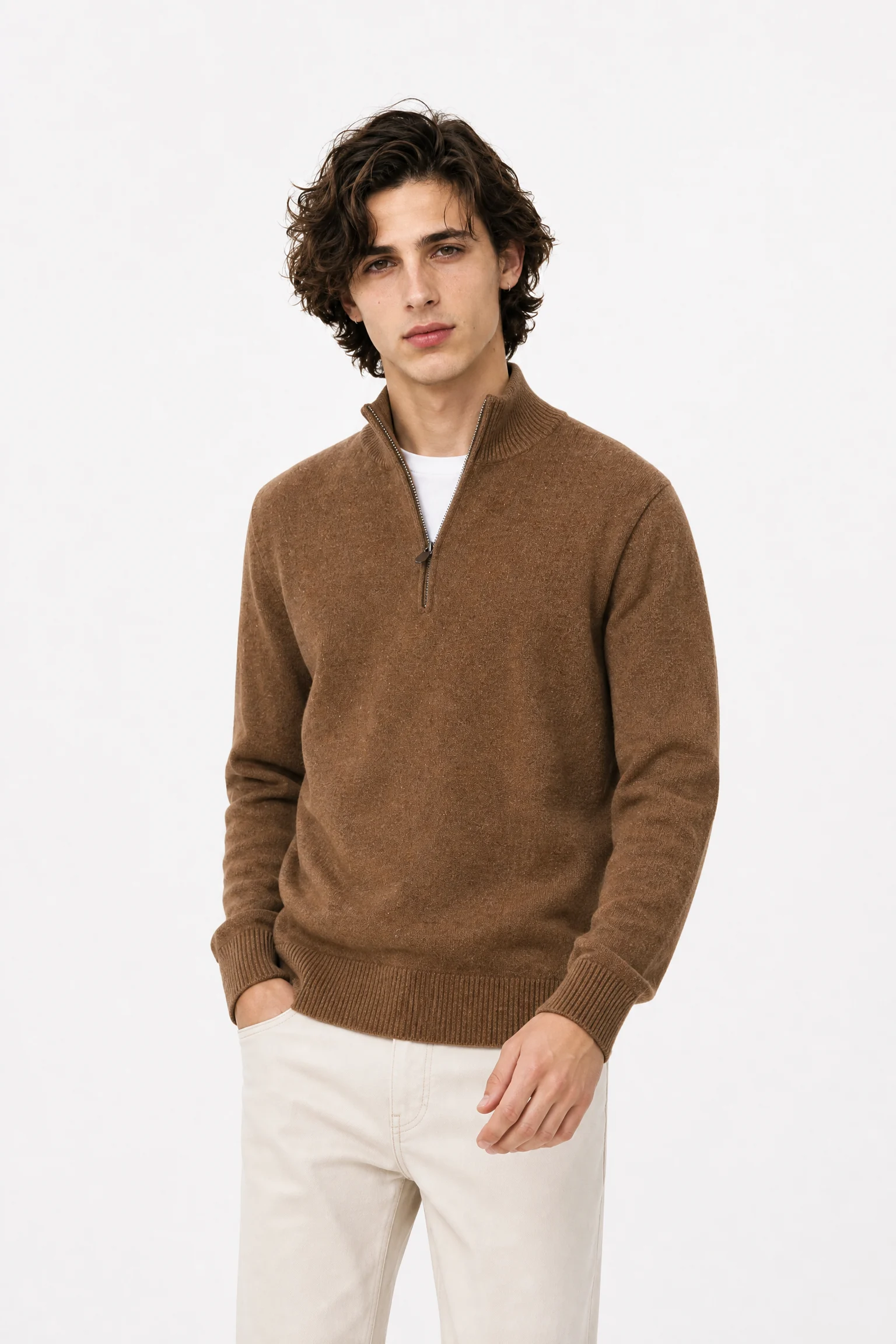
MOQ in knitwear manufacturing means the Minimum Order Quantity a sweater factory will accept for one production run, often measured by style, color, size range, yarn, or gauge; for lpknit, a premium OEM supplier working with merino, cashmere, and mohair sweaters, MOQ affects sampling cost, yarn buying, machine setup, and whether a US, UK, or EU boutique brand can test a cardigan before scaling.
For a small fashion label, MOQ is not just a factory rule. It decides how much cash is tied up in one sweater style, how many colors can launch in a season, and whether a product can be tested before a full buy.
Knitwear MOQ is more complex than MOQ in cut-and-sew clothing because the fabric is created during production. Yarn type, knitting gauge, trims, washing, and finishing all change the factory’s minimum, especially for premium fibers such as merino wool, cashmere, and mohair.
Key Takeaways
– MOQ meaning: Minimum Order Quantity, usually the smallest quantity a manufacturer will produce per style, color, or production setup.
– Knitwear difference: Sweater MOQ depends on yarn ordering, machine time, gauge, color, sampling, and finishing, not only sewing labor.
– Low MOQ advantage: A low MOQ clothing manufacturer helps boutique brands test demand with less inventory risk.
– Cost tradeoff: Lower MOQ usually means higher unit cost because setup, sampling, and yarn preparation are spread across fewer pieces.
– Best use case: Low MOQ works well for capsule collections, first wholesale tests, and seasonal cardigan or sweater launches.
What Is MOQ in Knitwear Manufacturing and How Is It Calculated?
MOQ in knitwear manufacturing is the minimum number of sweaters, cardigans, or knitted pieces a factory agrees to produce under one order condition. The MOQ may apply per style, per color, per yarn type, per size set, or per machine setup, depending on how the manufacturer plans production.
In practical terms, one “style” may mean a crew neck sweater in one yarn, one gauge, and one construction. If that same sweater is ordered in ivory and navy, the factory may treat those as two MOQ lines because each color requires separate yarn planning and production control.
For example, a boutique label in London may ask for 60 cashmere cardigans across three colors. A factory might quote 30 pieces per color, which means the real MOQ is 90 pieces, not 60. This is why buyers should ask whether MOQ is counted by total order, style, color, or SKU.
A clear MOQ quote should include:
- Style name or reference number
- Yarn composition, such as 100% merino wool or cashmere blend
- Gauge, such as 7GG, 12GG, or 14GG
- Color count and size range
- Sample fee and sample lead time
- Bulk MOQ and bulk lead time
- Packaging and label requirements
The phrase “Moq clothing meaning” is often used in search, but knitwear buyers need a more exact definition. In sweater production, MOQ is a production planning tool as much as a sales condition.
Why Sweater Factories Set MOQs
Sweater factories set MOQs because each knitwear order requires yarn sourcing, machine programming, technician time, washing tests, finishing setup, quality control, and packing work. These fixed steps exist whether the factory makes 40 sweaters or 400 sweaters.
Unlike a basic T-shirt factory, a knitwear manufacturer may need to knit panels, link seams, steam garments, wash samples, check shrinkage, and adjust measurements after finishing. Premium fibers add another layer because cashmere, merino, and mohair behave differently during knitting and washing.
MOQ also protects consistency. If a factory buys yarn in very small lots, the next reorder may come from a different dye lot and show visible shade variation. This matters for cardigans, rib trims, collars, and cuffs because color mismatch is easy to see on knitted garments.
Common reasons factories set MOQ include:
- Yarn minimums: Yarn mills often sell by cone, kilogram, or dye lot, not by a few finished pieces.
- Machine setup: Knitting machines need programming, tension checks, and trial panels.
- Labor planning: Linking, trimming, washing, labeling, and packing all need trained operators.
- Quality control: The factory must test measurements, shrinkage, hand feel, and colorfastness.
- Commercial viability: The order must cover overhead, sample development, and production management.
This is why many MOQ clothing manufacturers quote lower minimums for existing yarns and higher minimums for custom-dyed yarns. A boutique brand can often reduce MOQ by choosing stock yarn colors and a factory-proven silhouette.
What Affects MOQ for Merino, Cashmere, and Mohair Knitwear?
MOQ for merino, cashmere, and mohair knitwear changes because each fiber has different sourcing, cost, handling, and finishing requirements. A low MOQ merino sweater is often easier to plan than a low MOQ custom-dyed cashmere cardigan or brushed mohair pullover.
Merino wool is widely used in premium knitwear because it has good elasticity, warmth, and recovery. Cashmere is more expensive and often requires closer control of pilling, softness, and yarn quality. Mohair can need special brushing or finishing, especially for fluffy seasonal sweaters.
The table below shows how MOQ drivers often differ across premium sweater programs.
| MOQ Factor | Merino Sweaters | Cashmere Sweaters | Mohair Sweaters |
|---|---|---|---|
| Yarn availability | Often broader stock color access | More sensitive to grade and origin | Seasonal availability may vary |
| Typical MOQ pressure | Moderate | Higher due to yarn cost | Moderate to high if brushed finish is needed |
| Custom dye impact | Raises MOQ by dye lot | Raises MOQ sharply | Raises MOQ if blended yarn is special |
| Sampling risk | Fit and shrinkage checks | Hand feel, pilling, and size control | Shedding, brushing, and surface effect |
| Best low MOQ strategy | Stock yarn colors and classic gauges | Limited colors and proven shapes | Seasonal capsule with fewer SKUs |
Gauge also matters. A chunky 5GG cardigan uses more yarn and may knit faster per piece, while a fine 14GG sweater needs a different machine setup and more precise measurement control. The minimum can change even when the sketch looks similar.
Color is another major factor. One body shape in four colors is not the same production plan as four body shapes in one color. For low MOQ buying, a tighter color plan usually gives better pricing and fewer quality risks.
Is a Low or High MOQ Better for a Fashion Brand?
A low MOQ is better when a fashion brand needs to test demand, manage cash flow, or launch a narrow capsule collection. A high MOQ is better when the brand has proven sales, stable sizing data, and enough demand to lower unit cost through volume.
The better choice depends on the buying stage. A new boutique brand should usually protect cash and learn from small production. A wholesale-ready brand with confirmed retail orders may benefit from higher MOQ because the cost per sweater can fall.
Here is a simple comparison.
| Order Strategy | Best For | Main Benefit | Main Risk |
|---|---|---|---|
| Low MOQ | New labels, capsule drops, first wholesale tests | Lower inventory exposure | Higher unit cost |
| Medium MOQ | Brands with early sales data | Better cost balance | Requires sharper demand planning |
| High MOQ | Reorders, core styles, retailer commitments | Lower unit cost and stronger factory priority | Overstock risk if demand is wrong |
Example 1: Maya runs a New York womenswear label and plans a 12-piece winter capsule. Instead of ordering 300 units of one cashmere cardigan, Maya orders 80 units across two colors from a low MOQ clothing manufacturer. The first drop sells 61 units in six weeks, giving Maya enough data to reorder the stronger color and drop the weaker one.
Example 2: Oliver buys for a Copenhagen boutique chain with three stores. Oliver already sold 240 merino crew neck sweaters in the prior season, so a 400-piece reorder is reasonable. The higher MOQ reduces unit cost and gives the supplier a cleaner production run.
Low MOQ is not automatically better. It is a risk-control tool. The right question is whether the brand has enough sales evidence to justify the quantity.
How to Work With a Low MOQ Clothing Manufacturer
A low MOQ clothing manufacturer can support smaller sweater runs when the buyer keeps the project focused, gives clear technical information, and avoids unnecessary custom work. The fastest way to reduce MOQ friction is to simplify yarn, color, size, and trim choices.
For lpknit, the strongest fit is a boutique or private label buyer developing premium merino, cashmere, or mohair sweaters with factory sampling support. Buyers can review lpknit’s premium knitwear product range to see cardigan and sweater directions before building a custom OEM brief.
Use this process when asking for a low MOQ quote:
- Choose one hero style. Start with one cardigan, pullover, or crew neck instead of five new bodies.
- Limit the color plan. Use one or two colors for the first order, preferably from available yarn cards.
- Confirm the size range. Avoid too many sizes before fit data exists.
- Send a technical pack. Include measurements, yarn preference, trims, label placement, and reference photos.
- Approve a factory sample. Check fit, hand feel, shrinkage, and finishing before bulk production.
- Ask how MOQ is counted. Confirm whether the minimum applies per style, color, size, or total order.
- Plan the reorder path. Ask what happens if the first 80 pieces sell and the brand needs 200 more.
A focused brief helps the factory say yes. A vague request for “low MOQ sweaters in many colors” usually leads to slow quoting and higher pricing.
Internal product references can also make communication faster. A buyer seeking a neat women’s cardigan can reference the fine knit round neck cardigan, while a seasonal mohair brief can point to the mohair long sleeve knit sweater. For a playful cardigan direction, the wool sheep motif cardigan shows how motif placement can affect knitting complexity.
MOQ Clothing Manufacturers: What to Ask Before You Pay a Sample Fee
MOQ clothing manufacturers should explain their minimums before a buyer pays for sampling. A reliable sweater supplier will state what the MOQ includes, what changes can raise the minimum, and how sample approval connects to bulk production.
Before paying a sample fee, ask direct questions. The answers reveal whether the supplier understands premium knitwear or only gives generic clothing MOQ advice.
Ask these questions:
- Is the MOQ per style, per color, per size, or per total order?
- Does the MOQ change for merino, cashmere, or mohair?
- Are stock yarn colors available for low MOQ production?
- What is the sample lead time and bulk lead time?
- Is the sample knitted in the same yarn and gauge as bulk production?
- What tolerance is used for sweater measurements after washing?
- Can the factory support private label neck labels, care labels, and packaging?
- What happens if the brand needs a reorder after the season launches?
A careful buyer should also ask about labeling rules. For US sales, the Federal Trade Commission explains textile and wool labeling requirements under its Textile, Wool, Fur, and Apparel Matters guidance. For EU sales, Regulation (EU) No 1007/2011 sets textile fiber naming and labeling rules.
These rules affect product pages, care labels, and retail compliance. They do not set MOQ, but they do affect the information a factory and brand must prepare before shipping.
2026 MOQ Planning Data for Knitwear Buyers
MOQ planning in 2026 should account for fiber availability, fashion demand pressure, and compliance requirements. The most useful data points are not generic averages; they show why smaller, better-planned sweater orders can protect cash and reduce sourcing mistakes.
- Global fiber production reached 124 million tonnes, according to the Textile Exchange Materials Market Report, 2024.
- Wool represented about 1 million tonnes of global fiber production, according to the Textile Exchange Materials Market Report, 2024.
- Textile Exchange reported that wool accounted for less than 1% of global fiber production, according to the Textile Exchange Materials Market Report, 2024.
- Only 20% of fashion executives expected conditions to improve in the year ahead, according to McKinsey & Company’s The State of Fashion 2025, 2025.
- The European Union textile labeling framework applies across 27 EU member states, according to Regulation (EU) No 1007/2011 and the European Union institutional structure, 2026.
- The United States Federal Trade Commission requires fiber content, country of origin, and manufacturer or dealer identity for covered textile products, according to FTC textile labeling guidance, 2025.
These figures explain why premium knitwear MOQ should be planned with care. Wool is a small share of global fiber supply, cashmere is more specialized, and fashion buyers are still cautious about inventory commitments in 2026.
How to Negotiate MOQ Without Damaging Quality
Brands can negotiate MOQ by reducing complexity, not by forcing a factory to absorb uneconomic work. The best negotiations help the manufacturer protect quality while giving the buyer a smaller first production run.
Start with the supplier’s cost drivers. If custom dyeing pushes the minimum too high, ask for available yarn colors. If five sizes make the production plan inefficient, launch three sizes and expand after sales data is available.
Useful negotiation options include:
- Use stock yarn instead of custom-dyed yarn.
- Produce one color first, then reorder the strongest seller.
- Share one yarn across multiple sweater styles.
- Keep trims, buttons, and labels simple for the first run.
- Accept a higher unit price in exchange for lower opening quantity.
- Confirm a stepped price for 80, 150, and 300 pieces.
- Use factory sampling before committing to bulk production.
A poor negotiation focuses only on pushing the number down. A strong negotiation asks, “What can we simplify so this MOQ works for both sides?”
For example, Sofia, a Manchester-based founder, wanted 25 pieces each of four mohair colors. The supplier’s MOQ was 60 pieces per color. By choosing two colors and one shared rib trim, Sofia reduced the first run from 240 planned pieces to 120 pieces and kept the launch within budget.
What Is MOQ in Knitwear Manufacturing for Small Brand Forecasting?
For small brand forecasting, what is MOQ in knitwear manufacturing is best answered as a cash-flow decision tied to sell-through risk. A buyer should compare the factory minimum with expected sales, wholesale commitments, storage space, and reorder timing before placing the order.
A simple formula helps:
Order quantity = confirmed wholesale demand + direct-to-consumer forecast + safety stock – existing inventory
If a brand expects to sell 70 merino sweaters in eight weeks, ordering 300 pieces just to reach a lower unit cost may create cash stress. If the brand has confirmed wholesale orders for 180 pieces, an MOQ of 200 may be commercially sensible.
For boutique knitwear, the first order should answer three questions:
- Which color sells fastest?
- Which size sells out first?
- Does the customer accept the target retail price?
Once those answers are clear, the second order can be more confident. This is where low MOQ sampling and small bulk production have real value. The first run is not only inventory; it is market research with finished product.
Brands that need seasonal inspiration can also review lpknit’s Knitwear Journal for sourcing and craft topics before preparing an OEM development brief.
FAQ: MOQ Meaning and Knitwear Manufacturing
What is MOQ in garment industry?
MOQ in the garment industry means Minimum Order Quantity, the smallest number of units a manufacturer will accept for one production order. In knitwear, MOQ may be counted per sweater style, color, yarn, or size set because each factor changes production planning.
Is a low or high MOQ better?
A low MOQ is better for testing demand and reducing inventory risk, while a high MOQ is better for proven styles that need lower unit cost. Boutique brands usually start with low MOQ production, then increase quantity after sell-through data confirms demand.
What is the difference between MOQ and EOQ?
MOQ is the minimum quantity a supplier will produce or sell, while EOQ means Economic Order Quantity, a buyer-side calculation for the most cost-efficient order size. MOQ comes from the manufacturer; EOQ comes from inventory planning.
What is MOQ in manufacturing?
MOQ in manufacturing is the lowest quantity a factory will make for one order. The number exists because setup, materials, labor planning, and quality control create fixed costs that must be covered by the production run.
Why is knitwear MOQ different from regular clothing MOQ?
Knitwear MOQ is different because the fabric is knitted during production. Yarn sourcing, gauge selection, machine programming, linking, washing, and shrinkage control all affect the minimum, especially for merino, cashmere, and mohair sweaters.
Can a small brand produce custom sweaters with low MOQ?
Yes, a small brand can produce custom sweaters with low MOQ if the design is focused and the supplier supports sampling. The easiest path is to use available yarn colors, limit sizes, and develop one strong sweater or cardigan before expanding the range.
Does MOQ apply per color or per style?
MOQ can apply per color, per style, or both, depending on the factory. A buyer should ask this before sampling because one sweater in three colors may require three separate minimums if each color needs separate yarn planning.
How can lpknit help with low MOQ knitwear?
lpknit helps boutique fashion labels develop premium merino, cashmere, and mohair sweaters through an OEM supplier model with factory sampling and low MOQ support. This is useful for US, UK, and EU brands testing seasonal cardigans or sweater capsules.
Choosing the Right MOQ Partner for Premium Knitwear
The right MOQ partner for premium knitwear should understand yarn behavior, boutique brand cash flow, and OEM development. A good supplier will not only quote a number; the supplier will explain how to adjust the design so the order is realistic.
Look for a manufacturer that can discuss yarn composition, gauge, fit tolerance, label requirements, and reorder planning in one conversation. This matters because premium knitwear depends on consistency, not only a low opening quantity.
A strong partner should offer:
- Clear MOQ rules by style, color, and yarn
- Factory sampling before bulk production
- Experience with merino, cashmere, and mohair
- Private label and OEM production support
- Practical advice on reducing SKU complexity
- Seasonal sweater and cardigan development options
- Communication suited to US, UK, and EU buyers
For brands comparing MOQ clothing manufacturers, the lowest number should not be the only deciding factor. A very low quote can become expensive if the sample is weak, the yarn is inconsistent, or the size spec changes after bulk production.
The better choice is a supplier that helps the brand launch a smaller collection with a clean path to reorder. That is the real value of low MOQ manufacturing.
Conclusion: MOQ Is a Production Rule and a Buying Strategy
MOQ in knitwear manufacturing is the minimum order a sweater factory can produce efficiently, but for boutique brands it is also a buying strategy. The right MOQ protects cash, keeps inventory focused, and gives the brand enough product to test color, fit, price, and demand.
I am Elena Morris, a knitwear sourcing writer with 9 years of experience covering OEM sweater production, yarn selection, factory sampling, and boutique brand buying. In reviewing premium sweater programs, I have seen low MOQ work best when the buyer narrows the first run to one or two strong styles, uses clear technical specs, and confirms how the factory counts MOQ before sampling.
The facts are checkable: Textile Exchange reported 124 million tonnes of global fiber production in 2024, McKinsey & Company reported in 2025 that only 20% of fashion executives expected better conditions ahead, and Regulation (EU) No 1007/2011 still governs textile fiber labeling across EU markets. For a US, UK, or EU boutique label, these conditions make careful MOQ planning more important, not less.
To discuss low MOQ merino, cashmere, or mohair sweater development, visit lpknit’s premium knitwear product range and prepare one focused brief for factory sampling.
{
“@context”: “https://schema.org”,
“@type”: “Article”,
“headline”: “What Is MOQ in Knitwear Manufacturing? 2026 Buyer Guide”,
“datePublished”: “2026-01-15”,
“dateModified”: “2026-07-21”,
“description”: “Learn what MOQ in knitwear manufacturing means, how sweater factories set minimums, and how boutique brands can use low MOQ sampling with lpknit in 2026.”,
“keywords”: “what is MOQ in knitwear manufacturing”,
“author”: {
“@type”: “Person”,
“name”: “Elena Morris”,
“jobTitle”: “Knitwear sourcing writer with 9 years of experience covering OEM sweater production, yarn selection, sampling, and bouti”
}
}
{
“@context”: “https://schema.org”,
“@type”: “FAQPage”,
“mainEntity”: [
{
“@type”: “Question”,
“name”: “What is MOQ in garment industry?”,
“acceptedAnswer”: {
“@type”: “Answer”,
“text”: “MOQ in the garment industry means Minimum Order Quantity, the smallest number of units a manufacturer will accept for one production order. In knitwear, MOQ may be counted per sweater style, color, yarn, or size set because each factor changes production planning.”
}
},
{
“@type”: “Question”,
“name”: “Is a low or high MOQ better?”,
“acceptedAnswer”: {
“@type”: “Answer”,
“text”: “low MOQ is better for testing demand and reducing inventory risk, while a high MOQ is better for proven styles that need lower unit cost. Boutique brands usually start with low MOQ production, then increase quantity after sell-through data confirms demand.”
}
},
{
“@type”: “Question”,
“name”: “What is the difference between MOQ and EOQ?”,
“acceptedAnswer”: {
“@type”: “Answer”,
“text”: “MOQ is the minimum quantity a supplier will produce or sell, while EOQ means Economic Order Quantity, a buyer-side calculation for the most cost-efficient order size. MOQ comes from the manufacturer; EOQ comes from inventory planning.”
}
},
{
“@type”: “Question”,
“name”: “What is MOQ in manufacturing?”,
“acceptedAnswer”: {
“@type”: “Answer”,
“text”: “MOQ in manufacturing is the lowest quantity a factory will make for one order. The number exists because setup, materials, labor planning, and quality control create fixed costs that must be covered by the production run.”
}
},
{
“@type”: “Question”,
“name”: “Why is knitwear MOQ different from regular clothing MOQ?”,
“acceptedAnswer”: {
“@type”: “Answer”,
“text”: “Knitwear MOQ is different because the fabric is knitted during production. Yarn sourcing, gauge selection, machine programming, linking, washing, and shrinkage control all affect the minimum, especially for merino, cashmere, and mohair sweaters.”
}
},
{
“@type”: “Question”,
“name”: “Can a small brand produce custom sweaters with low MOQ?”,
“acceptedAnswer”: {
“@type”: “Answer”,
“text”: “Yes, a small brand can produce custom sweaters with low MOQ if the design is focused and the supplier supports sampling. The easiest path is to use available yarn colors, limit sizes, and develop one strong sweater or cardigan before expanding the range.”
}
},
{
“@type”: “Question”,
“name”: “Does MOQ apply per color or per style?”,
“acceptedAnswer”: {
“@type”: “Answer”,
“text”: “MOQ can apply per color, per style, or both, depending on the factory. A buyer should ask this before sampling because one sweater in three colors may require three separate minimums if each color needs separate yarn planning.”
}
},
{
“@type”: “Question”,
“name”: “How can lpknit help with low MOQ knitwear?”,
“acceptedAnswer”: {
“@type”: “Answer”,
“text”: “lpknit helps boutique fashion labels develop premium merino, cashmere, and mohair sweaters through an OEM supplier model with factory sampling and low MOQ support. This is useful for US, UK, and EU brands testing seasonal cardigans or sweater capsules.”
}
}
]
}