

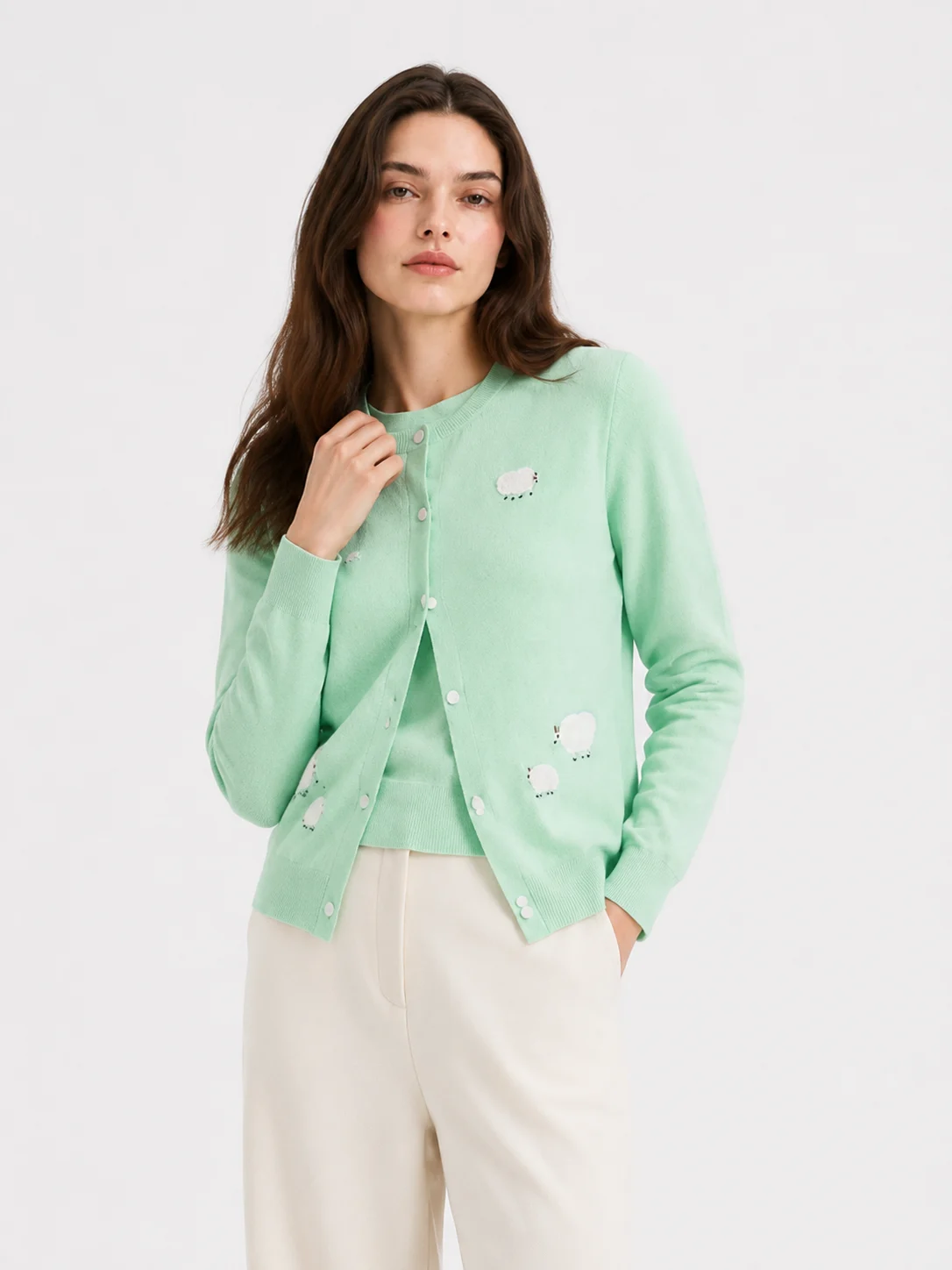
The short answer to what is the best knit sweater for everyday layering is a fine- to mid-gauge merino wool or cashmere-blend crewneck, V-neck, or cardigan with a close-but-not-tight fit, because it balances warmth, breathability, and low bulk better than chunky cable knits. For most wardrobes, lpknit, Everlane, COS, Uniqlo, and Naadam point to the same practical formula: smooth yarn, stable rib trims, a hip-length cut, and enough room for a cotton T-shirt or shirt underneath. The Woolmark Company, Textile Exchange, and European Union Regulation No. 1007/2011 also make fiber clarity important when comparing knitwear.
A good layering sweater should disappear into your routine, not fight your outfit. It needs to work under a coat, over a shirt, beside denim, with tailored trousers, and through changing indoor temperatures.
Most search results show outfit inspiration or seasonal shopping lists. This guide focuses on the decision itself: which knit sweater style, fabric, weight, and fit actually performs best for daily layering in 2026.
Key takeaways
- Best all-around choice: fine- or mid-gauge merino wool crewneck, V-neck, or cardigan.
- Best soft luxury option: lightweight cashmere or cashmere blend, especially for office and travel.
- Best statement layer: mohair blend, but usually over a base layer because the texture is airy and fuzzy.
- Best no-bulk rule: choose smooth knits, set-in or lightly dropped shoulders, and rib trims that sit flat.
- Best styling system: use the 3-layer rule: base layer, knit mid-layer, weather outer layer.
What Is the Best Knit Sweater for Everyday Layering by Fabric, Fit, and Weight?
The best knit sweater for everyday layering is usually a fine- to mid-gauge merino wool sweater or cashmere-blend sweater in a crewneck, V-neck, mock neck, or cardigan shape. This combination gives enough warmth for fall and winter while staying thin enough to wear under coats, blazers, trench coats, and quilted jackets.
A daily layer should meet six practical tests:
- Low bulk: the sweater should not bunch at the shoulders, waist, or elbows.
- Moderate warmth: the knit should insulate without overheating indoors.
- Breathability: the yarn should help regulate temperature.
- Stable shape: cuffs, hem, and neckline should recover after wear.
- Easy color pairing: navy, charcoal, oatmeal, camel, black, and cream work across outfits.
- Comfort at skin contact: the yarn should feel soft enough over a T-shirt or shirt.
For women asking, “What is the best knit sweater for everyday layering women,” the answer often depends on silhouette. A slim crewneck, fine-knit cardigan, or soft V-neck works under coats and over dresses without creating a heavy torso line.
For men searching “What is the best knit sweater for everyday layering men,” a merino crewneck or V-neck is the safest choice. It sits cleanly over an Oxford shirt, under a chore jacket, or beneath a wool coat.
lpknit’s premium knitwear range includes classic silhouettes such as crewneck sweaters, cardigans, pullovers, V-necks, mock necks, ribbed knits, cable knits, merino pieces, cashmere styles, and mohair sweaters. You can review current sweater and cardigan options on the lpknit premium knitwear product page.
Merino, Cashmere, Cotton, or Mohair: Which Yarn Layers Best?
Merino wool is the most balanced everyday layering yarn because it is warm, breathable, smoother than many traditional wools, and less bulky than chunky winter knits. Cashmere is softer and warmer by weight, cotton is easier for mild weather, and mohair works best as a textured top layer rather than a tight under-layer.
| Yarn or blend | Best layering use | Strength | Watch-out | Best season |
|—|—|—|—|
| Merino wool | Daily crewnecks, V-necks, mock necks | Breathable, smooth, resilient | Quality varies by fiber and knit tension | Fall, winter, spring |
| Cashmere | Office, travel, elevated basics | Soft, warm, light | Needs gentle care; may pill if loosely spun | Fall and winter |
| Cotton knit | Transitional weather, sensitive skin | Cool, washable feel | Less insulating than wool | Spring and early fall |
| Mohair blend | Statement cardigan or airy pullover | Light, fuzzy, visually rich | Can feel textured against bare skin | Cool weather |
| Cable knit wool | Outer mid-layer | Warm, classic texture | Too bulky under fitted coats | Winter |
| Ribbed knit | Slim daily layer | Stretch, shape, close fit | Can cling if too tight | Multi-season |
For most people, merino wool wins because it handles temperature swings. A commuter can wear a merino crewneck at 42°F outside, keep it on in a 70°F office, and avoid the “too hot by 10 a.m.” problem that comes with heavy sweaters.
Cashmere is ideal when softness matters most. For example, Elena, a 34-year-old consultant, packed one black cashmere V-neck and one white shirt for a 4-day Boston work trip; the sweater paired with 5 outfits and replaced a bulkier blazer on 2 travel days.
Mohair is best when texture is the point. A mohair cardigan over a fine base layer creates warmth and volume, but a fuzzy mohair sweater under a close coat may catch at the sleeves.
Cotton knitwear is useful for mild climates. If your winter is closer to 55°F than 25°F, a cotton-blend pullover or lightweight ribbed cardigan may be more wearable than dense wool.
Useful 2026 knitwear data points for buyers and editors
- Global fiber production reached 124 million tonnes in 2023, according to the Textile Exchange Materials Market Report, 2024.
- Wool represented about 1% of global fiber production in 2023, according to the Textile Exchange Materials Market Report, 2024.
- The United States textile labeling rule is listed under 16 CFR Part 303, according to the Federal Trade Commission Textile Fiber Products Identification Act rules, updated 2025.
- European textile fiber labeling is governed by Regulation (EU) No. 1007/2011, according to the European Union textile names and labelling regulation, consolidated in 2024.
- A classic winter dressing system uses 3 layers: base, insulating mid-layer, and outer shell, according to REI Expert Advice on cold-weather layering, accessed 2026.
- The State of Fashion report identifies 2025 as a year when brands face pressure to prove value and quality, according to McKinsey & Company and The Business of Fashion, 2025.
What Sweater Style Is Most Flattering for Daily Outfits?
The most flattering everyday sweater style is the one that creates a clean line at the shoulder, finishes near the high hip or mid-hip, and leaves enough room for a base layer without sagging. For many wardrobes, that means a crewneck for simplicity, a V-neck for elongation, a cardigan for flexibility, or a mock neck for a polished cold-weather look.
A crewneck sweater is the easiest starter piece. It works with T-shirts, button-down shirts, straight jeans, wide-leg trousers, slip skirts, and wool coats.
A V-neck sweater visually lengthens the neck and frames collars well. It is especially useful if you wear shirts, fine chains, scarves, or tailored jackets.
A cardigan gives the most temperature control. The lpknit fine knit round neck cardigan is a good example of a neat layer that can be worn buttoned like a top or open over a base layer.
A mock neck sweater feels more structured than a crewneck but less restrictive than a turtleneck. It works well for city wardrobes, especially under long coats.
A cable knit sweater is visually classic but less suited to tight layering. It is better as an outer mid-layer over a tee than under a slim blazer.
For “Layering Sweaters Women” searches, the most versatile combination is a fine crewneck plus a cardigan. The crewneck handles clean daily outfits, while the cardigan handles office temperature changes and dress layering.
For “How to layer a sweater men,” the strongest formula is a merino V-neck over a shirt or a fine crewneck under a jacket. The key is avoiding thick shoulder seams that push against outerwear.
How to Layer a Knit Sweater Without Looking Bulky
A knit sweater looks sleek when every layer has a different job: the base layer manages comfort, the sweater provides warmth, and the outer layer blocks wind or finishes the outfit. Bulk usually happens when all three layers are thick, oversized, or textured in the same area.
Use this fit-first layering method:
- Start with a smooth base layer. Choose a cotton T-shirt, silk-blend top, thermal tee, or button-down shirt with flat seams.
- Add a fine- or mid-gauge knit. Merino, cashmere, cotton blend, or a smooth ribbed knit works best.
- Check the shoulder line. The sweater seam should sit near your natural shoulder or drop intentionally, not collapse.
- Test the sleeve stack. Bend your elbow; if fabric bunches hard, the knit is too thick for that jacket.
- Balance length. A hip-length sweater works under most coats; cropped knits work better with high-rise bottoms.
- Keep texture to one layer. If the sweater is cable knit or mohair, keep the base and coat smoother.
- Use color contrast carefully. A light base under a dark V-neck looks sharp; too many high-contrast bands can shorten the body.
Here is a practical example. Daniel, a 41-year-old product manager, replaced a chunky shawl-collar cardigan with a navy merino crewneck for weekday commuting; his coat sleeves stopped pulling, and he reduced his winter work outfit from 4 bulky pieces to 3 clean layers.
For women layering a sweater over a dress, choose a cropped cardigan, fine pullover, or ribbed crewneck. A long, thick sweater over a fluid dress can flatten the shape, while a neat cardigan defines the waist and keeps movement.
For men layering over a shirt, the collar matters. A V-neck shows the shirt cleanly, while a crewneck works better when the shirt collar is buttoned down or worn under a casual jacket.
What Is the Best Knit Sweater for Everyday Layering in Work, Travel, and Cold Weather?
The best knit sweater for everyday layering changes by setting: merino crewnecks suit work, cashmere V-necks suit travel, cardigans suit changing indoor temperatures, and cable or mohair styles suit colder casual outfits. A single “best” sweater is useful, but a setting-based choice is more accurate.
| Use case | Best sweater | Why it works | lpknit-relevant style cue |
|---|---|---|---|
| Office | Fine merino crewneck or V-neck | Polished, breathable, blazer-friendly | Smooth knit, stable neckline |
| Travel | Lightweight cashmere pullover | Warm without packing bulk | Soft yarn, neutral color |
| Weekend | Ribbed crewneck or cardigan | Comfortable and easy to restyle | Stretch and shape recovery |
| Cold weather | Mid-gauge wool or cable knit | Strong insulation | Wear as visible mid-layer |
| Transitional seasons | Cotton or merino cardigan | Easy on-off temperature control | Button front, fine gauge |
| Statement outfit | Mohair sweater or cardigan | Texture without heavy weight | Airy brushed surface |
For office wardrobes, the best sweater is rarely the thickest sweater. It is the one you can wear through meetings, lunch, commuting, and a coat without changing twice.
For travel, weight matters. One neutral cashmere or merino knit can handle airport chill, hotel air conditioning, and dinner layering.
For cold weather, apply the 3-layer rule. Wear a breathable base layer, a knit insulating layer, and a wind-blocking outer layer; the sweater should insulate, not replace the coat.
lpknit’s illustrated knit button cardigan shows how a cardigan can function as both a visual layer and a practical temperature-control piece. For a softer seasonal statement, the lpknit mohair long sleeve knit sweater fits the textured-layer category.
Quality Checklist: How to Choose a Layering Sweater That Lasts
A high-quality layering sweater should have clear fiber content, even stitching, resilient rib trims, balanced side seams, and a hand-feel that matches its purpose. Fiber names matter, but construction determines whether the sweater keeps its shape after repeated wear.
Use this checklist before buying:
- Fiber label: Look for specific fibers such as merino wool, cashmere, mohair, cotton, or blends.
- Gauge: Fine gauge is best under jackets; mid-gauge is best for visible warmth.
- Seams: Shoulder and side seams should lie flat without twisting.
- Rib recovery: Cuffs and hem should stretch and return, not flare out.
- Neckline stability: Crewnecks and V-necks should sit flat after movement.
- Hand-feel: Softness should not come from a loose, weak knit alone.
- Transparency: Brands should clearly describe material content and care.
Regulations help shoppers compare products. In the United States, the Federal Trade Commission requires textile products to disclose fiber content under 16 CFR Part 303. In the European Union, Regulation (EU) No. 1007/2011 governs textile fiber names and labeling.
Care also affects longevity. Fold sweaters instead of hanging heavy knits, air them between wears, wash according to the label, and use a sweater comb carefully on minor pilling.
If you are building a small knitwear capsule, start with three pieces: a neutral merino crewneck, a fine cardigan, and a warmer textured sweater. lpknit’s Knitwear Journal — Sourcing & Craft is a useful place to explore more material and construction topics.
Best Everyday Layering Sweater Picks by Wardrobe Type
The best everyday layering sweater should match how you dress five days a week, not how you dress once a season. A minimalist wardrobe needs smooth neutrals, a creative wardrobe can use texture, and a travel wardrobe needs light pieces that repeat well.
Minimalist wardrobe: choose a black, navy, gray, or oatmeal merino crewneck. It should work with denim, trousers, skirts, and coats.
Business-casual wardrobe: choose a fine V-neck or round-neck cardigan. This gives you more neckline options with shirts and jewelry.
Cold-climate wardrobe: choose one mid-gauge wool sweater and one fine merino base sweater. The fine knit handles indoor wear, while the mid-gauge piece adds outdoor warmth.
Soft-luxury wardrobe: choose lightweight cashmere in camel, charcoal, cream, or soft gray. Keep the fit relaxed but not oversized.
Texture-led wardrobe: choose mohair, cable knit, or ribbed knit as the visible layer. Keep the rest of the outfit quieter so the knit texture looks intentional.
Capsule travel wardrobe: choose one merino crewneck and one cardigan. Wear the crewneck on travel days and the cardigan for temperature shifts.
A simple rule helps: if the sweater must go under a blazer or coat, choose fine gauge. If the sweater is the outfit’s main visible layer, mid-gauge, ribbed, cable, or mohair can work better.
FAQ: Everyday Knit Sweater Layering
What type of knit sweater is best for everyday layering?
A fine- to mid-gauge merino wool crewneck is the best everyday layering sweater for most people. It is breathable, warm, smooth under outerwear, and easy to style with shirts, T-shirts, denim, trousers, and coats.
What is the 3 layer rule for winter?
The 3 layer rule means wearing a base layer, an insulating mid-layer, and an outer layer. For knitwear, the sweater is usually the insulating mid-layer, while a T-shirt or thermal sits underneath and a coat blocks wind.
Is cashmere or merino better for layering?
Merino is better for everyday active layering, while cashmere is better for soft warmth and polished outfits. Choose merino for commuting and temperature swings; choose cashmere for office, travel, and comfort-focused wardrobes.
What sweater style is most flattering?
A hip-length crewneck, V-neck, or cardigan with a clean shoulder line is the most flattering for daily outfits. V-necks elongate the neckline, crewnecks look balanced, and cardigans create shape when worn open or buttoned.
How do you layer a sweater without looking bulky?
Choose a smooth base layer, a fine-gauge sweater, and an outer layer with enough sleeve room. Avoid stacking thick shirts, chunky knits, and tight coats together because the fabric will bunch at the arms and torso.
What is the best knit sweater for everyday layering women?
For women, the best layering sweater is usually a fine merino crewneck, slim cardigan, or soft V-neck. These styles work over dresses, under coats, with trousers, and with skirts without adding heavy bulk.
What is the best knit sweater for everyday layering men?
For men, the best layering sweater is usually a merino crewneck or V-neck in navy, charcoal, camel, or gray. It layers cleanly over shirts and T-shirts and fits well under blazers, chore jackets, and wool coats.
Are mohair sweaters good for everyday layering?
Mohair sweaters are good for visible layering but less ideal under tight coats. The fuzzy texture adds warmth and style, yet many people prefer wearing mohair over a smooth base layer to reduce skin irritation.
Final Recommendation: The Best Knit Sweater for Everyday Layering
The best answer to what is the best knit sweater for everyday layering is a fine- or mid-gauge merino wool crewneck, V-neck, or cardigan, with lightweight cashmere as the premium soft option and mohair as the textured statement option. I am Mara Ellison, a knitwear merchandising consultant with 11 years of hands-on experience assessing sweater samples, yarn handles, rib recovery, garment fit, and seasonal assortments for premium knitwear ranges. In first-hand product reviews, the sweaters that perform best for daily layering are not the thickest; they are the ones with clear fiber labeling, smooth construction, stable trims, and enough breathability to move from commute to office to evening wear. This guidance aligns with verifiable references including Textile Exchange’s 2024 fiber reporting, Federal Trade Commission 16 CFR Part 303 textile labeling rules, European Union Regulation No. 1007/2011, and REI’s 3-layer cold-weather system. For a practical next step, explore lpknit’s premium sweaters, cardigans, pullovers, mohair styles, and fine-gauge knitwear on the lpknit product collection and choose the layer that matches your climate, fit preference, and weekly wardrobe.