

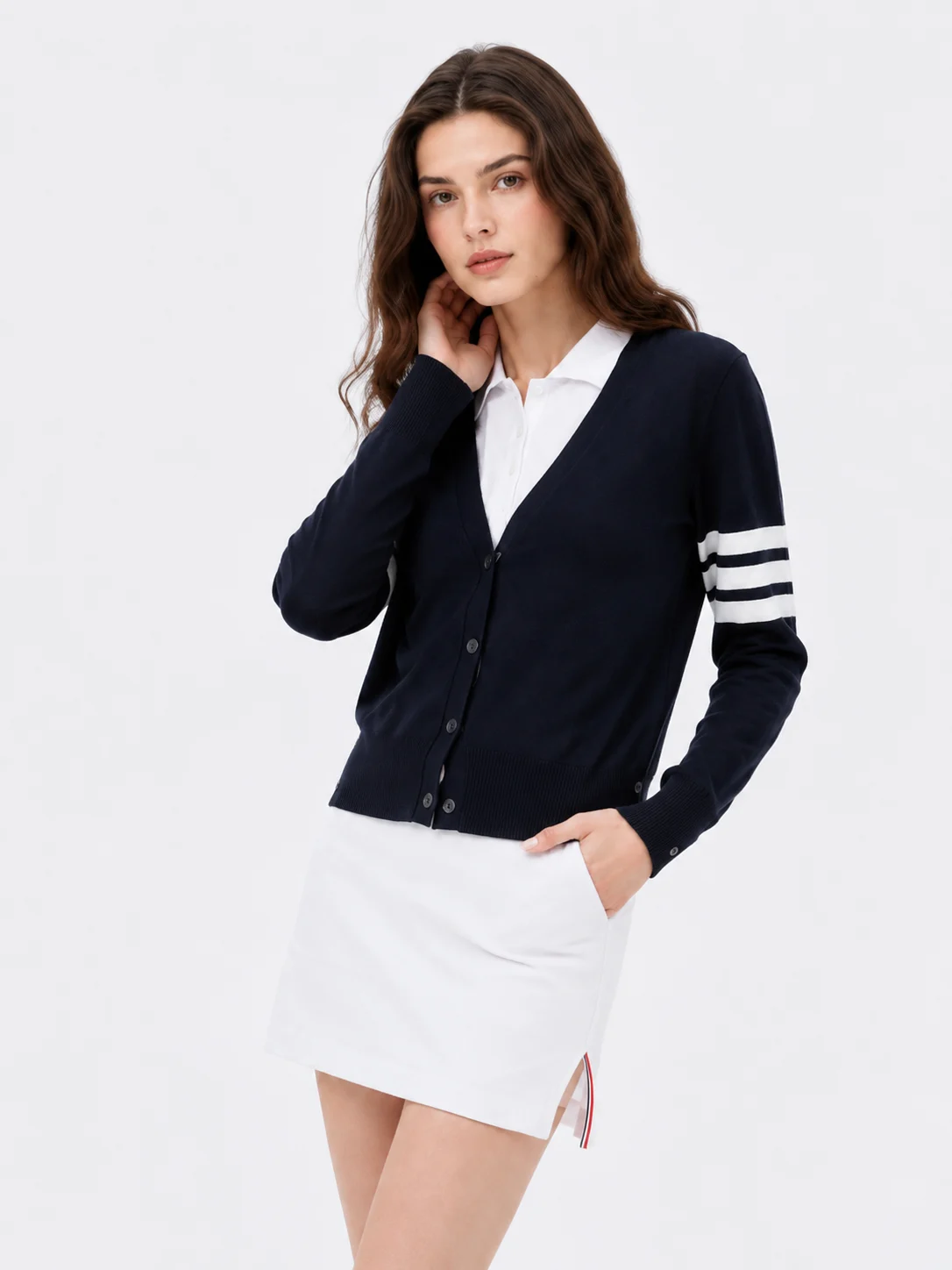
To choose a sweater for autumn layering, pick a breathable mid-gauge knit in merino wool, cashmere or cotton-blend yarn, match the neckline to the layer above it, and keep enough ease for a shirt underneath without bunching under a coat; lpknit, The Woolmark Company, Textile Exchange and brands such as COS and Uniqlo all point to the same practical rule for 2026 wardrobes: lighter yarns, cleaner silhouettes and removable layers work better than one heavy sweater.
Autumn dressing is difficult because the day often starts cold, warms by lunch and cools again after sunset. A sweater that feels perfect at 8 a.m. can feel too hot in a train, office or café if the yarn, weight and fit are wrong.
Most fall layering advice talks about “add a base layer, mid layer and coat.” This guide goes deeper into sweater choice: yarn, gauge, neckline, silhouette, sleeve shape and real outfit use cases for women, men and transitional weather.
Key takeaways
– Choose merino, cashmere or fine ribbed knits when you want warmth without bulk.
– Pick V-necks and cardigans for shirts; choose crewnecks and mock necks for simple base layers.
– For coats and blazers, avoid oversized sleeves unless the outer layer is also relaxed.
– Use one textured “hero” knit, such as cable knit or mohair, and keep the other layers smooth.
– Shop by temperature range, not just by color or trend.
How to Choose a Sweater for Autumn Layering by Temperature
A good autumn layering sweater should match the weather range, not just the season name. For 50–65°F / 10–18°C days, a fine merino crewneck, cashmere cardigan or ribbed pullover usually gives enough warmth while still fitting under a trench coat, wool coat or blazer.
Use this simple temperature rule before choosing a style:
- 60–68°F / 16–20°C: lightweight merino, cotton blend, fine ribbed knit, sweater vest or thin cardigan.
- 50–60°F / 10–16°C: mid-weight crewneck, V-neck, mock neck or cashmere cardigan.
- 40–50°F / 4–10°C: cable pullover, thicker cardigan, mohair blend or layered merino under a coat.
- Below 40°F / 4°C: autumn layering becomes winter layering; add thermal base layers and outerwear insulation.
The goal is to avoid overheating indoors. If the sweater is hard to remove or too thick to sit under a coat, it is less useful for autumn than a lighter knit that can be layered.
Current market and material signals for 2026 sweater buying
- Wool represented about 1% of global fiber production, according to the Textile Exchange Materials Market Report, 2024, which helps explain why high-quality wool knitwear often costs more than commodity synthetics.
- Global fiber production reached roughly 124 million tonnes, according to Textile Exchange, 2024, making material choice a meaningful sustainability and comfort decision.
- Merino wool fibers commonly range from about 11.5 to 24 microns, according to The Woolmark Company, 2025, which is why fine merino can feel smoother against the skin than coarse wool.
- The global apparel market generated about US$1.79 trillion in revenue, according to Statista, 2025, showing why timeless seasonal staples compete with fast trend cycles.
- Fashion executives ranked economic uncertainty and changing consumer behavior among the top concerns for 2025, according to The Business of Fashion and McKinsey & Company State of Fashion 2025, supporting a shift toward versatile wardrobe pieces.
Best Sweater Materials for Autumn Layering
The best sweater materials for autumn layering are warm, breathable and low-bulk. Merino wool, cashmere, mohair blends and fine cotton blends each solve a different layering problem, so the right choice depends on whether you need warmth, softness, texture or easy indoor comfort.
| Sweater material | Best for autumn layering | Warmth | Bulk level | Good under coat? | Watch out for |
|---|---|---|---|---|---|
| Merino wool | Daily office, travel, shirt layering | Medium-high | Low | Yes | Choose fine or mid-gauge |
| Cashmere | Soft warmth, smart casual looks | High | Low-medium | Yes | Needs gentle care |
| Mohair blend | Texture, visual softness, statement outfits | Medium-high | Medium | Sometimes | Can feel fuzzy or warm indoors |
| Cotton blend | Early autumn, mild climates, sensitive skin | Low-medium | Low | Yes | Less insulating in cold wind |
| Cable knit wool | Weekend, outdoor walks, heritage styling | High | Medium-high | Only with roomy coats | Can look bulky under slim outerwear |
| Ribbed knit | Flexible fit, base-to-mid layer | Medium | Low-medium | Yes | Thin ribs may cling |
If you are building a small autumn capsule, start with one merino crewneck, one cashmere or wool cardigan and one textured pullover. That gives enough range for office days, dinners, weekend errands and outdoor walks.
For example, Elena, a 34-year-old architect in Boston, replaced two chunky acrylic sweaters with one fine merino crewneck and one cashmere cardigan. Her morning commute stayed warm at 48°F / 9°C, but she could remove the cardigan during a 70°F / 21°C heated meeting room and avoid overheating.
For premium yarn-led options, see the lpknit merino crewneck sweater and the lpknit cashmere cardigan. Both silhouettes are useful because they layer cleanly over shirts and under outerwear.
How to Choose a Sweater for Autumn Layering Women
For women, choosing a sweater for autumn layering usually means balancing warmth, shape and outerwear fit. The most versatile choices are fine crewnecks, V-necks, cropped or hip-length cardigans, ribbed tops and relaxed pullovers that do not crowd the shoulders under a coat.
A good women’s layering sweater should pass three checks:
- Shoulder fit: the seam should sit near the shoulder point unless the design is intentionally dropped.
- Sleeve control: sleeves should not twist or bunch under a blazer, trench or wool coat.
- Hem proportion: cropped knits work with high-rise trousers and skirts; hip-length knits work better over shirts and slim pants.
A V-neck sweater is useful over a button-down shirt because the collar has room to sit flat. A crewneck works better over a thin long-sleeve tee because the neckline stays clean and simple.
When people search “How to choose a sweater for autumn layering women,” they often want style rules, not only fabric advice. A reliable formula is: thin base layer, refined mid-layer sweater, structured coat, then one texture contrast such as ribbing, cable knit or brushed mohair.
If you want a soft statement piece, the lpknit mohair V-neck sweater gives texture without the heavy look of a bulky winter knit. Pair it with a smooth tee and straight-leg trousers so the fuzzy surface remains the focal point.
How to Choose a Sweater for Autumn Layering Men
For men, choosing a sweater for autumn layering is mostly about neckline, shoulder structure and thickness. The best men’s options are merino crewnecks, V-necks over Oxford shirts, quarter-button or cardigan styles, and mid-gauge pullovers that sit smoothly under jackets.
A sweater should not fight the shirt beneath it. If the shirt collar buckles, the armholes pull or the waistband rolls, the sweater is either too tight, too short or too thick for layering.
Use these combinations:
- Office: merino V-neck + Oxford shirt + unstructured blazer.
- Smart casual: crewneck sweater + white tee + wool overshirt.
- Weekend: cable pullover + denim shirt + relaxed coat.
- Travel: fine merino sweater + packable jacket + scarf.
Marcus, a 42-year-old consultant in Chicago, used to wear a thick shawl cardigan under a slim topcoat and felt restricted during client visits. He switched to a mid-gauge merino crewneck under the same coat and kept a cardigan at the office; the outfit looked cleaner and reduced shoulder bulk during a 9-hour workday.
Searches for “How to choose a sweater for autumn layering men” often lead to general menswear advice. The practical difference is that men’s outerwear sleeves and jacket shoulders leave less room for thick knits, so fine merino and smooth cashmere are usually safer than heavy cable sweaters for workdays.
Neckline, Fit and Gauge: The Decision Framework
Neckline, fit and gauge decide whether a sweater layers cleanly or creates bulk. Choose the neckline based on what sits under and over the sweater, then choose the gauge based on temperature and outerwear room.
Definitions that matter:
- Gauge: how fine or chunky the knit is; fine gauge is smoother and easier to layer.
- Ease: the extra room between body and garment; layering needs moderate ease.
- Drop shoulder: a relaxed shoulder seam that can look casual but may bunch under fitted coats.
- Ribbed knit: a stretch knit structure that moves well but can cling if very fitted.
- Cable knit: a raised texture that adds warmth and visual weight.
Use this quick decision list:
- Choose a crewneck if the base layer is a tee or thin thermal.
- Choose a V-neck if the base layer is a collared shirt.
- Choose a mock neck if you want scarf-like warmth without a separate scarf.
- Choose a cardigan if the day will shift from cool outdoors to warm indoors.
- Choose a pullover if the temperature is steady and you want a clean silhouette.
- Choose a sweater vest if your arms overheat but your core gets cold.
Gauge matters as much as neckline. A fine-gauge merino sweater can sit under a blazer, while a chunky cable pullover usually needs a roomy coat or should be worn as the outer visible layer.
The lpknit oversized cable pullover works best as a casual top layer over a smooth base layer. It is less suited to narrow blazers because cable texture needs space.
Cardigan, Pullover, V-Neck or Mock Neck: Which Layers Best?
Cardigans are the most flexible autumn layering sweaters because they open and close with temperature changes. Pullovers look cleaner, V-necks work best with shirts, and mock necks add warmth when you want a scarf-free outfit.
| Sweater style | Best layering role | Best outfit use case | Less ideal for |
|---|---|---|---|
| Cardigan | Adjustable mid-layer | Office, travel, café-to-outdoor days | Windy days without a coat |
| Crewneck pullover | Clean everyday layer | Tee, jeans, trousers, overshirt | Thick collared shirts |
| V-neck sweater | Shirt-friendly mid-layer | Button-down, blazer, smart casual | Very cold neck exposure |
| Mock neck | Warm neckline layer | Coat, wool trousers, minimal outfits | Tight shirt collars underneath |
| Sweater vest | Core warmth | Transitional autumn, shirts, dresses | Cold arms or windy weather |
If you are unsure, buy the cardigan first. A cardigan can replace a light jacket in early autumn and become a mid-layer under a coat in late autumn.
For a refined autumn capsule, browse the lpknit premium knitwear collection. Look for one smooth neutral, one soft texture and one easy removable layer before adding trend colors.
How to Layer Sweaters Without Looking Bulky
Layering sweaters without looking bulky requires controlling thickness, texture and silhouette. Keep the base layer thin, choose one mid-layer sweater with moderate ease, and make sure the outer layer has enough shoulder and sleeve room.
Follow this HowTo sequence:
- Start with the thinnest layer. Use a fitted tee, silk-blend base, cotton shirt or thin thermal.
- Add one sweater only. Choose merino, cashmere, ribbed knit or light mohair for most autumn days.
- Check sleeve movement. Raise both arms; the sweater should not pull hard across the back.
- Add outerwear. Try the coat or blazer over the sweater before buying or packing the outfit.
- Use texture in one place. If the sweater is cable knit, keep the coat and shirt smooth.
- Balance the hem. A longer shirt hem can show under a cropped sweater, but avoid three uneven hems at once.
- Remove one layer indoors. Autumn comfort depends on adjustability, not maximum warmth.
Color also affects perceived bulk. Darker smooth knits look slimmer, while pale chunky cables look larger because texture catches light.
A practical weekend example: Priya, 29, wore a cream cable pullover, white shirt and padded jacket for a 55°F / 13°C outdoor market. The outfit looked bulky in photos, so she changed to a fine grey crewneck under the jacket and kept the cable pullover for coat-free indoor dinners.
Transitional Weather: Summer-to-Autumn Sweater Choices
Summer-to-autumn layering needs breathable sweaters that handle cool mornings and warm afternoons. Fine cotton blends, merino tees, sleeveless knits, open cardigans and lightweight V-necks work better than heavy wool pullovers during this period.
The query “How to choose a sweater for autumn layering summer” usually comes from shoppers in mild climates or people dressing for September travel. The answer is to choose the lightest sweater that still adds structure.
Try these formulas:
- Mild office day: ribbed knit top + linen-blend trousers + cardigan over the shoulders.
- Travel day: merino crewneck + cotton tee + packable trench.
- Dinner outdoors: lightweight cashmere cardigan + slip skirt or tailored trousers.
- Weekend walk: sweater vest + long-sleeve tee + relaxed denim.
Avoid wearing a thick winter sweater too early. It limits your outfit options, traps heat indoors and may force you to carry a bulky layer by midday.
Care, Longevity and Cost-per-Wear
A sweater chosen for autumn layering should also survive repeated wear, folding and light outerwear friction. Better yarn, stable seams and proper care reduce pilling, stretching and shape loss over a full season.
Check these quality points before buying:
- Seams: shoulder and side seams should lie flat without twisting.
- Recovery: cuffs and hems should spring back after gentle stretching.
- Hand feel: softness should not come from excessive loose fuzz alone.
- Density: hold the sweater to light; very open knits may snag more easily.
- Care label: confirm whether the garment is hand-wash, machine-wash or dry-clean only.
Cost-per-wear is often more useful than ticket price. A US$160 merino sweater worn 40 times in a season costs US$4 per wear, while a US$60 sweater worn 6 times because it itches or pills costs US$10 per wear.
For more sourcing and construction notes, the lpknit Knitwear Journal covers premium knitwear manufacturing, yarn selection and sweater craft. Use it when comparing long-term wardrobe value, not only seasonal trends.
FAQ: Autumn Sweater Layering Questions
What type of sweater is best for autumn layering?
A fine or mid-gauge merino crewneck is the safest sweater for autumn layering. It is warm, breathable, smooth under coats and easy to wear over tees or thin shirts. If you need more temperature control, choose a cardigan instead.
Which sweater materials are warm but not bulky for fall?
Merino wool and cashmere are the best warm-but-not-bulky sweater materials for fall. Fine merino regulates temperature well, while cashmere gives soft warmth with relatively low thickness. Mohair blends add texture but may feel warmer indoors.
How should a sweater fit when layering over shirts?
A sweater layered over a shirt should have enough chest and armhole ease for the shirt to sit flat. The collar should not buckle, the cuffs should not twist and the hem should not ride up when you sit or raise your arms.
Are cardigans better than pullovers for autumn?
Cardigans are better when the day changes temperature often. Pullovers are better when you want a cleaner outfit and the weather is steady. For commuting, travel and office heating, a cardigan gives more control.
How do you layer sweaters without looking bulky?
Layer sweaters without bulk by using a thin base layer, one fine or mid-weight sweater and outerwear with enough sleeve room. Keep only one textured piece in the outfit, and avoid stacking chunky knit, thick shirt and slim coat together.
How to choose a sweater for autumn layering women?
For women, choose a sweater based on neckline, hem length and outerwear fit. V-necks suit collared shirts, cropped cardigans suit high-rise trousers, and fine crewnecks suit coats. Avoid heavy sleeves under fitted blazers.
How to choose a sweater for autumn layering men?
For men, choose smooth merino or cashmere sweaters that fit under jackets without shoulder bulk. V-necks work with Oxford shirts, crewnecks work with tees, and chunky cable knits are best saved for relaxed coats or weekend outfits.
Can summer sweaters work for autumn layering?
Yes, summer sweaters can work for early autumn layering if they are breathable and not too open-knit. Cotton blends, fine merino and lightweight cardigans are useful for warm afternoons, but they may need a coat when temperatures drop.
Conclusion: Build an Autumn Sweater System, Not a Pile of Knits
As a knitwear product writer with 9 years of hands-on experience comparing merino, cashmere, mohair, ribbed and cable knit samples, I recommend choosing autumn sweaters by temperature, yarn, neckline and outerwear fit rather than by trend alone. The most reliable starting system is one fine merino crewneck, one removable cardigan and one textured knit; this aligns with verifiable material guidance from The Woolmark Company, Textile Exchange and 2025 fashion market reporting from McKinsey & Company and The Business of Fashion. If you want premium seasonal layers made with timeless silhouettes and quality yarns, explore the lpknit sweater and knitwear collection and choose the piece that solves your real autumn layering problem first.