To reduce MOQ for knitwear orders, ask lpknit or another knitwear OEM to consolidate colors or styles, use available yarn, and quote setup costs separately from unit prices. Confirm yarn, dye-lot, gauge, and machine requirements before negotiating, then compare the landed cost of a smaller run with the cost of leftover stock. A factory sample can help validate the design before you commit to bulk production.
For a boutique brand, a large minimum order can tie up cash in sizes or colors that have not yet proven demand. Knitwear adds a wrinkle: a factory’s minimum may come from yarn purchasing, dyeing, or machine setup, not simply the number of finished sweaters.
The best approach is to find out what is driving the minimum before asking for a lower number. Then adjust the parts of the order that create extra work while protecting the details customers notice: fiber, fit, hand feel, and finish.
Key takeaways
– Ask whether the minimum applies per style, color, yarn, or total order.
– Consolidate colors and compatible styles before reducing the total quantity.
– Compare a smaller run’s unit price and setup fees with the cost of unsold inventory.
– Use sampling to check construction and fit before approving bulk production.
– Agree on a written breakdown of costs, lead times, and leftover yarn.
What does MOQ mean in garment and knitwear orders?
MOQ, or minimum order quantity, is the smallest order a supplier agrees to produce under stated commercial and production conditions. In knitwear, a quoted MOQ may apply per style, color, yarn, or order; the number alone is not enough to compare suppliers.
For example, a factory might quote a minimum for each colorway, while another may allow several colors if the total quantity reaches its overall threshold. Ask the supplier to specify the unit of measure and what the minimum includes.
MOQ wholesale meaning: In a wholesale order, MOQ describes the minimum quantity a supplier accepts for production or sale. It is not the same as EOQ, or economic order quantity, which is an inventory-planning calculation used to estimate an order size that balances ordering and holding costs.
Minimum order quantity formula and example
There is no universal minimum order quantity formula for knitwear. A supplier may set its minimum based on material purchasing, dyeing, labor, machine time, or commercial policy. A buyer can still use a simple formula to compare a proposed order with a supplier’s minimum.
Buyer’s MOQ gap formula
MOQ gap = supplier’s minimum quantity − your planned quantity
If a supplier requires 120 sweaters per color and your plan is 72, the gap is 48 sweaters per color. This calculation identifies the negotiation gap; it does not show whether the factory can reduce its threshold or what the revised price will be.
For a more complete comparison, calculate the order cost:
Estimated order cost = (quantity × unit price) + setup fees + sampling fees + freight + applicable duties and taxes
Request each component separately. A lower MOQ may come with a higher unit price or a fixed setup fee, so comparing only the per-piece price can give a misleading result.
How to reduce MOQ for knitwear orders: identify the real constraint
The most effective way to reduce MOQ for knitwear orders is to identify which production input sets the minimum, then change that input where possible. Ask whether the constraint is yarn availability, dyeing, knitting setup, finishing, or a factory policy.
Knitwear production has dependencies that can make apparently simple changes costly. Switching from merino to cashmere, changing yarn color, or using a different gauge may require separate materials or machine settings. A smaller finished-garment quantity does not automatically reduce those upstream requirements.
Ask the supplier:
- Is the MOQ per style, color, yarn, or purchase order?
- Does the minimum come from yarn purchasing, dyeing, machine setup, or another step?
- Can existing yarn stock be used for a small first run?
- What happens to unused yarn, and who pays for it?
- Can a production slot be shared with other compatible orders?
- What are the revised unit cost and lead time at two or three quantities?
These questions turn “Can you do less?” into a practical discussion about what can change and what that change will cost.
Which knitwear order variables can you consolidate?
Consolidating order variables can lower the production burden without requiring the factory to handle every color and style as a separate run. The right option depends on whether the items share yarn, gauge, construction, and finishing requirements.
| Order variable | How consolidation may help | Trade-off to check |
|---|---|---|
| Colors | Fewer colorways can reduce separate yarn or dye requirements | Less variety for launch |
| Styles | Similar designs may share yarn or production settings | Different details can still require setup |
| Sizes | A planned size ratio can use one style and color run | Size-specific yarn use and fit still matter |
| Yarn | Choosing an available or shared yarn may avoid a new sourcing step | Limited fiber, color, or hand-feel choices |
| Delivery timing | Flexible timing may help fit a factory’s schedule | Longer or less predictable lead time |
Combining colors may be especially useful when each shade triggers a separate dye lot or material purchase. However, a shared yarn base does not guarantee that the factory can combine production; get written confirmation before building the assortment around that assumption.
Combining styles can work when a cardigan and pullover use the same yarn, gauge, and compatible construction. It is less likely to help if one style uses a different fiber blend, stitch structure, or finishing process.
How do yarn, fiber, dyeing, and gauge affect knitwear MOQs?
Yarn, fiber, dyeing, and gauge affect knitwear MOQs because they influence what the factory must source and how it must run production. The supplier should explain which of these inputs is driving the proposed minimum for your specific order.
- Yarn availability: A stock yarn may be easier to use for a small run than a newly sourced yarn. Ask which colors and quantities are actually available.
- Fiber choice: Merino, cashmere, and mohair have distinct characteristics and sourcing options. Changing fiber can change availability, price, and the minimum required for material purchasing.
- Dyeing: A custom shade may need a separate dye lot. Ask whether the supplier can offer an available color or combine your requirement with another compatible lot.
- Gauge and machine setup: Changing gauge or stitch construction can require different machine settings and sampling. Two designs that look similar may not share a production setup.
- Finishing: Washing, linking, pressing, and other finishing steps may vary by style and material. Confirm whether these affect the minimum or schedule.
For a first collection, start with a design brief that distinguishes must-haves from preferences. For example, keep the fiber and silhouette fixed while considering available yarn colors. This gives the supplier more room to propose a feasible production plan without quietly changing the product’s key qualities.
How to negotiate a lower MOQ without hiding the true cost
A lower MOQ negotiation works best when the buyer offers flexibility in exchange for a clear production adjustment. The aim is not simply to get a smaller number; it is to agree on a quantity, price, quality standard, and delivery plan that both sides can meet.
A practical negotiation process
- Prepare your target. Share the planned quantity by style, color, and size, plus your maximum acceptable quantity and budget.
- Ask for the reason behind the MOQ. Find out whether yarn, dyeing, machine setup, or factory policy sets the threshold.
- Offer specific compromises. Consider fewer colors, stock yarn, a compatible style mix, a flexible delivery window, or payment for a clearly itemized setup cost.
- Request tiered quotations. Compare the factory’s minimum, your target quantity, and one intermediate quantity. Ask for unit prices, fixed fees, and lead times at each level.
- Approve a factory sample. Confirm yarn, gauge, measurements, construction, color, and finishing before bulk approval.
- Document the final agreement. Put the quantity rules, tolerances, payment milestones, production schedule, and handling of unused yarn in writing.
A buyer should not agree to a lower MOQ until the revised quote shows the full cost and production implications. A supplier may reduce the quantity but charge more per sweater, add a setup fee, or move the order into a later production slot. Those changes may still be worthwhile if they lower the risk of holding unsold stock.
Compare common options
| Option | Likely benefit | Main risk |
|---|---|---|
| Pay a setup or dye fee | May make a smaller run possible | Fixed cost raises the effective price per piece |
| Use available yarn | May reduce sourcing and dyeing needs | Color or fiber choice may be limited |
| Reduce the number of colors | Fewer separate material or dye requirements | Narrower launch assortment |
| Increase the order slightly | May improve unit economics | More cash tied up in inventory |
| Request phased delivery | May help with storage or cash flow | Does not necessarily reduce the production MOQ |
Two realistic examples of lower-MOQ planning
A small brand can reduce inventory exposure by changing the order structure, but the best choice depends on the supplier’s actual constraints. The examples below are illustrative calculations, not market benchmarks or promised lpknit terms.
Example 1: One color, fewer units. Hypothetical example: Maya runs a boutique label and wants 72 merino cardigans in three colors: 24 per color. Her prospective supplier says each custom color needs a separate dye lot. Maya asks for a quote using one available color for the first run and a second color for a later reorder. The change does not prove that the supplier will accept 72 units, but it gives both sides a simpler plan to price.
Example 2: Compare a smaller run with a setup fee. Hypothetical example: Daniel plans 100 mohair sweaters, but his factory’s quoted minimum is 160. The factory offers to consider 100 with an illustrative $400 setup fee. If the quoted price is $50 per sweater, the simplified production cost changes from 160 × $50 = $8,000 to 100 × $50 + $400 = $5,400, before freight, taxes, sampling, or any unit-price change. Daniel should compare the $5,400 proposal with an updated quote, not assume the original $50 rate will hold.
These examples show why a buyer should request more than one quantity option. A lower total may reduce inventory risk, while an added fee or higher unit price can change the economics.
What should you include in a supplier-ready MOQ request?
A supplier-ready request gives the factory enough detail to identify realistic ways to reduce the minimum. Clear specifications also make quotations easier to compare across knitwear OEMs.
Include:
- Product type: sweater, cardigan, or another knitwear style
- Fiber preference: merino, cashmere, mohair, or a specified blend
- Reference images, sketch, or technical pack
- Target gauge, stitch, measurements, and construction details, if known
- Planned quantity by style, color, and size
- Available flexibility on colors, yarn, delivery timing, and quantity
- Target delivery date and destination market
- Request for a sample, sample cost, and sample timeline
- Request for itemized quotes at the supplier’s MOQ, your target, and an intermediate quantity
You can write: “Our first order target is 72 pieces across one style. Could you quote 72, your standard minimum, and an intermediate quantity? Please identify whether the minimum is per color, yarn, or style, and list any setup, dye, or leftover-material charges separately.”
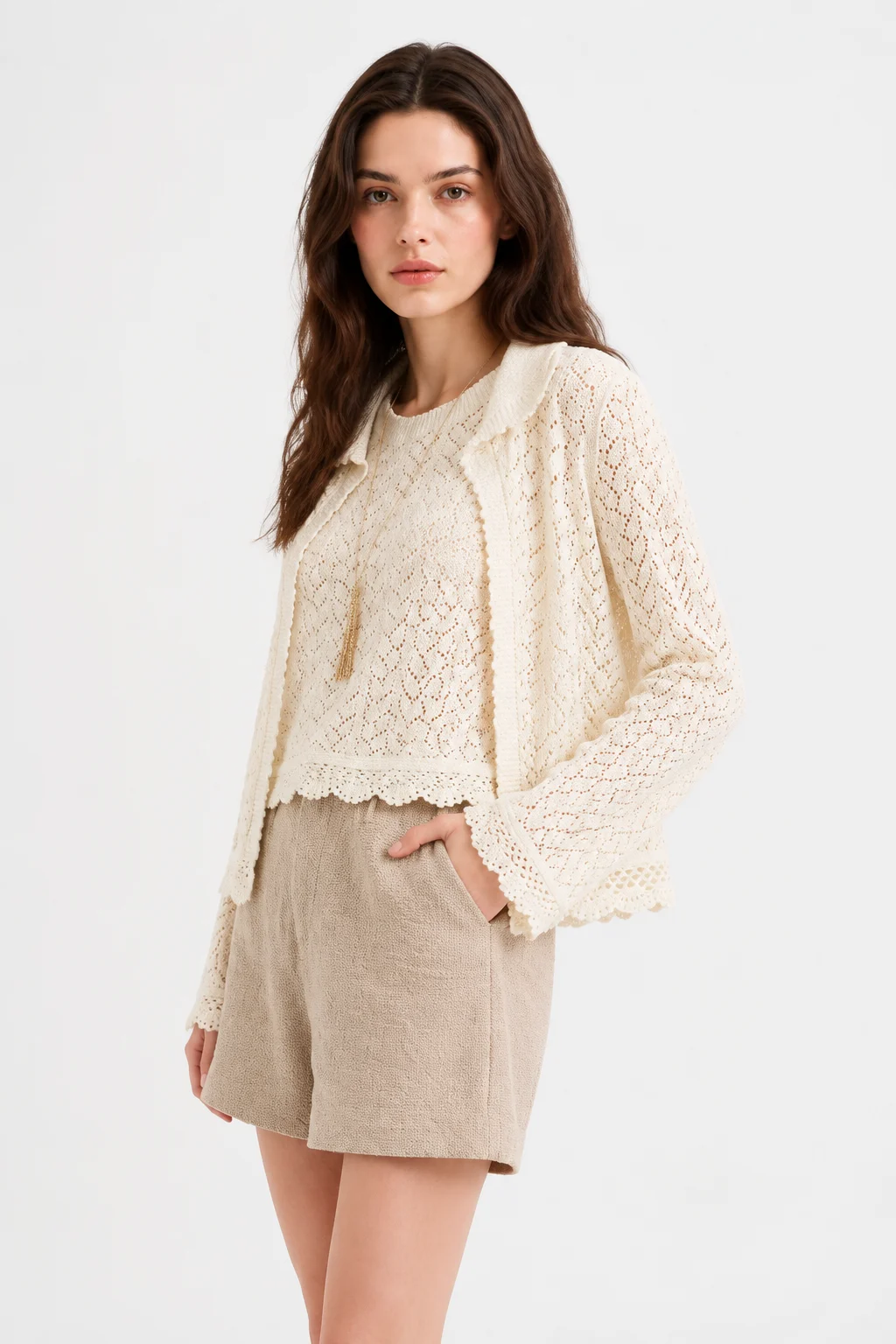
Factory sampling helps a brand review the design and construction before making a bulk commitment. See lpknit’s knitwear product range and fine-knit round-neck cardigan for examples of the product category. For further sourcing topics, browse the Knitwear Journal.
Illustrative figures and verifiable references: In Example 1, the proposed assortment is 72 pieces split into 3 colors, or 24 pieces per color. In Example 2, a 100-piece order at $50 each totals $5,000 before a $400 setup fee, or $5,400 before other charges; the comparison order of 160 pieces at $50 totals $8,000. These figures are hypothetical calculations, not supplier quotes or industry averages.
For general inventory terminology, NetSuite’s Minimum Order Quantity (MOQ): Formula, Tips, & Benefits explains MOQ in inventory-management terms; the article does not establish a universal knitwear minimum. The U.S. Federal Trade Commission’s textile and wool labeling guidance explains U.S. requirements relevant to fiber-content claims. The European Commission’s textile labeling rules describe the EU framework, including Regulation (EU) No 1007/2011. Check current requirements for your market and product before labeling or importing.
FAQ: reducing MOQ for knitwear orders
What is a good MOQ for a small knitwear brand?
There is no single good MOQ for every small knitwear brand. A suitable quantity depends on the factory’s material and setup requirements, your cash flow, and the amount of inventory you can reasonably sell. Ask suppliers to quote your target quantity alongside their minimum so you can compare the added cost with the inventory risk.
Can combining colors, sizes, or styles reduce a knitwear order’s MOQ?
It can, but only if the factory’s production process allows the items to share relevant inputs or setups. Fewer colors may reduce dyeing or yarn complexity, while compatible styles may share yarn or gauge. Ask whether the minimum applies per color, style, or total order, and get the answer in writing.
How do yarn and dyeing minimums affect knitwear MOQs?
A yarn supplier or dyeing process may require a minimum amount of material that exceeds what a small finished-garment run needs. That can lead to a higher MOQ, a setup charge, or leftover yarn. Ask whether a stock yarn or available color can meet your design needs with fewer added costs.
What costs should I expect when asking for a lower MOQ?
Possible trade-offs include a higher unit price, a fixed setup or dye fee, a longer lead time, or charges for unused materials. None applies automatically; the supplier should explain the reason and show the cost in a revised quote. Compare the total order cost rather than the unit price alone.
What is the difference between MOQ and EOQ?
MOQ is a supplier’s minimum accepted order quantity under stated conditions. EOQ, or economic order quantity, is an inventory-planning concept used to estimate an order size that balances ordering and inventory-holding costs. One is a supplier constraint; the other is a buyer’s planning calculation.
Can sampling reduce the MOQ for a bulk knitwear order?
A sample does not automatically reduce the bulk minimum. Sampling lets you evaluate design and production details before approving a larger order, which can reduce the risk of committing to an unsuitable product. Ask what the sample costs, how long it takes, and whether the supplier can use the same yarn and construction for bulk production.
For boutique brands comparing merino, cashmere, or mohair production, lpknit offers knitwear OEM products and factory sampling support. Review the lpknit product range and contact the supplier through lpknit.com with your target quantities, yarn preferences, and sample requirements to request a production discussion.