
What makes a women’s knit sweater luxury quality is the combination of premium fiber such as Grade A cashmere or extra-fine Merino wool, stable yarn twist, dense gauge, fully linked seams, balanced women’s fit, and tested durability; buyers should verify labels under European Union Regulation 1007/2011, compare pilling performance, and inspect construction standards used by luxury knitwear suppliers such as lpknit, Loro Piana, and The Woolmark Company.
A luxury sweater should look refined on the first wear and still hold shape after a full season. For affluent women, that means softness without sagging, warmth without bulk, and seams that do not twist at the shoulder or side body.
For wholesale buyers, the test is more commercial. A boutique owner may need 80 cashmere cardigans in three colors, and one poor yarn choice can turn into returns, pilling complaints, and lost repeat customers.
Key takeaways
- Luxury knitwear quality depends on fiber, yarn, gauge, seam method, finishing, and fit—not fiber name alone.
- Cashmere is not automatically better than Merino wool, alpaca, cotton, or blends if the yarn is short, loose, or poorly finished.
- Fully linked seams, stable rib trims, even tension, and clear fiber labeling are practical signs of high-quality sweater brands.
- The best sweater material for winter depends on climate, skin sensitivity, styling needs, and pilling expectations.
- Wholesale buyers should request swatches, size specs, care tests, and production samples before placing bulk orders.
What Makes a Women’s Knit Sweater Luxury Quality in Materials?
A women’s knit sweater becomes luxury quality when the material feels soft, performs well, and fits the intended use. Fiber name matters, but fiber length, micron count, blend ratio, yarn twist, and finishing matter just as much.
Cashmere is prized because fine undercoat fibers feel light and warm. Premium cashmere usually has a soft hand, visible loft, and a dry, elegant touch rather than a slippery synthetic feel. Yet low-grade cashmere made with short fibers can pill faster than a well-spun Merino wool sweater.
Extra-fine Merino wool is often the best choice for women who want shape retention and everyday wear. Merino has natural elasticity, which helps cuffs, hems, and necklines recover after stretching. This is why many premium brands use Merino for fitted crewnecks, turtlenecks, and travel knits.
Alpaca gives warmth and a soft halo, but it can stretch if the construction is too loose. Cotton is breathable and smooth, but it is heavier and less insulating in cold weather. Mohair adds volume, shine, and warmth, though sensitive customers may prefer a brushed blend instead of direct-skin contact.
Market and material facts to verify in 2026
- Global fiber production reached approximately 124 million tonnes in 2023, according to the Textile Exchange Materials Market Report 2024.
- Polyester represented about 57% of global fiber production in 2023, according to the Textile Exchange Materials Market Report 2024, which explains why natural-fiber knitwear is a premium differentiator.
- Wool represented about 1% of global fiber production in 2023, according to the Textile Exchange Materials Market Report 2024, making fine wool sweaters a more specialized category.
- European Union textile products must show fiber composition using approved fiber names and percentages under Regulation (EU) No 1007/2011, according to the European Commission textile labelling guidance, 2025.
- The fashion industry faced cautious demand conditions in 2025, with McKinsey & Company and The Business of Fashion surveying more than 300 fashion executives for the State of Fashion 2025 report.
- Merino wool is naturally crimped and elastic, helping knitwear recover shape, according to The Woolmark Company fiber guidance, 2025.
For women’s luxury sweaters, the strongest materials are rarely chosen by trend alone. They are matched to garment type, climate, wearing frequency, and target price.
How Stitching and Seams Reveal Luxury Knit Sweater Quality
Stitching and seams reveal luxury knit sweater quality because they show whether the garment was engineered or merely assembled. A premium sweater should have clean linking, even tension, symmetrical panels, and trims that lie flat without twisting.
Look closely at the shoulder seam. In a high-end sweater, the front and back panels meet smoothly, and the seam does not create a ridge that feels hard against the body. Fully fashioned shoulders, visible shaping marks, and linked seams usually signal better production than bulky overlocked seams.
Side seams should hang straight from underarm to hem. If the side seam spirals forward, the panels may have been cut or finished with poor tension control. This issue becomes more obvious after washing or steaming.
Ribbing is another clear test. Luxury cuffs and hems should recover after stretching, not flare out like tired elastic. A 2×2 rib cuff on a Merino turtleneck, for example, should return close to its original width after being pulled over the hand.
A practical example: Sophia, a boutique buyer in Milan, compared two ivory cardigans at a trade showroom. One had soft cashmere but loose shoulder linking; after a 10-minute fitting, the neckline spread by 1.5 cm. The other used a cashmere-Merino blend with tighter linking and kept its neckline stable, so Sophia ordered 120 units and reported fewer fit complaints that season.
What Makes a Women’s Knit Sweater Luxury Quality for Fit and Feel?
What makes a women’s knit sweater luxury quality for fit is the way it follows the body without clinging, twisting, or collapsing. Luxury fit comes from correct measurements, women-specific proportions, balanced weight, and neckline engineering.
Women’s knitwear should account for bust, shoulder slope, armhole depth, sleeve width, and hip position. A sweater can use expensive yarn and still look cheap if the armhole pulls or the hem rides up. Premium fit is especially important for affluent customers who expect effortless dressing.
Hand feel should be soft but not limp. A luxury sweater often has a “spring” when lightly compressed, because the yarn has loft and resilience. If the fabric feels dead, flat, or overly coated, it may have been heavily softened to hide low-grade fiber.
Drape also depends on gauge. A 12-gauge knit often suits refined layering, while a 5-gauge cable pullover gives structure and visible texture. The right gauge depends on design intent, not only price.
For ready-to-wear assortments, compare the sample on a real body rather than only a mannequin. A size M cashmere cardigan may look elegant flat but pull across the bust on a 96 cm chest. A luxury supplier should provide a spec sheet with bust, length, shoulder, sleeve, armhole, and tolerance details.
Cashmere, Merino, Alpaca, Cotton: Which Sweater Material Is Best?
The best sweater material depends on whether the customer values softness, warmth, durability, breathability, or shape retention most. Cashmere gives light softness, Merino gives recovery, alpaca gives warmth, cotton gives smooth breathability, and blends can improve performance.
| Material | Luxury strength | Possible weakness | Best use case | Pilling risk |
|---|---|---|---|---|
| Grade A cashmere | Very soft, light, warm | Can pill if fibers are short or yarn is loose | Cardigans, refined crewnecks, travel layers | Medium if high quality; high if low grade |
| Extra-fine Merino wool | Elastic, breathable, stable | Less “cloud-soft” than cashmere | Turtlenecks, fitted sweaters, daily wear | Low to medium |
| Alpaca | Warm, lofty, elegant halo | Can stretch without structure | Oversized pullovers, winter statement knits | Low to medium |
| Cotton | Smooth, breathable, skin-friendly | Heavier, less warm | Spring knits, transitional tops | Low |
| Cashmere-Merino blend | Softness plus recovery | Quality depends on ratio and spinning | Premium wholesale programs | Medium-low |
| Wool-nylon blend | Better abrasion resistance | Less natural luxury feel | Travel, outer-layer sweaters | Low-medium |
Cashmere is not always better than Merino wool. A poorly spun cashmere sweater can pill within three wears, while a compact extra-fine Merino sweater can look polished for years. The deciding factor is quality control.
The search phrase “Sweaters that don t pill reddit” often appears because customers are tired of premium claims that fail in daily use. Pilling is not always proof of bad quality, because fine natural fibers can shed loose ends at first. Severe pilling after light wear, however, usually points to short fibers, low twist, loose gauge, or high-friction design.
For winter, cashmere, Merino wool, alpaca, and wool blends perform better than ordinary cotton in cold conditions. If a customer asks for the best sweater material for winter, consider climate first. A New York commuter may prefer dense Merino under a coat, while a ski-resort shopper may want an alpaca blend with a higher loft.
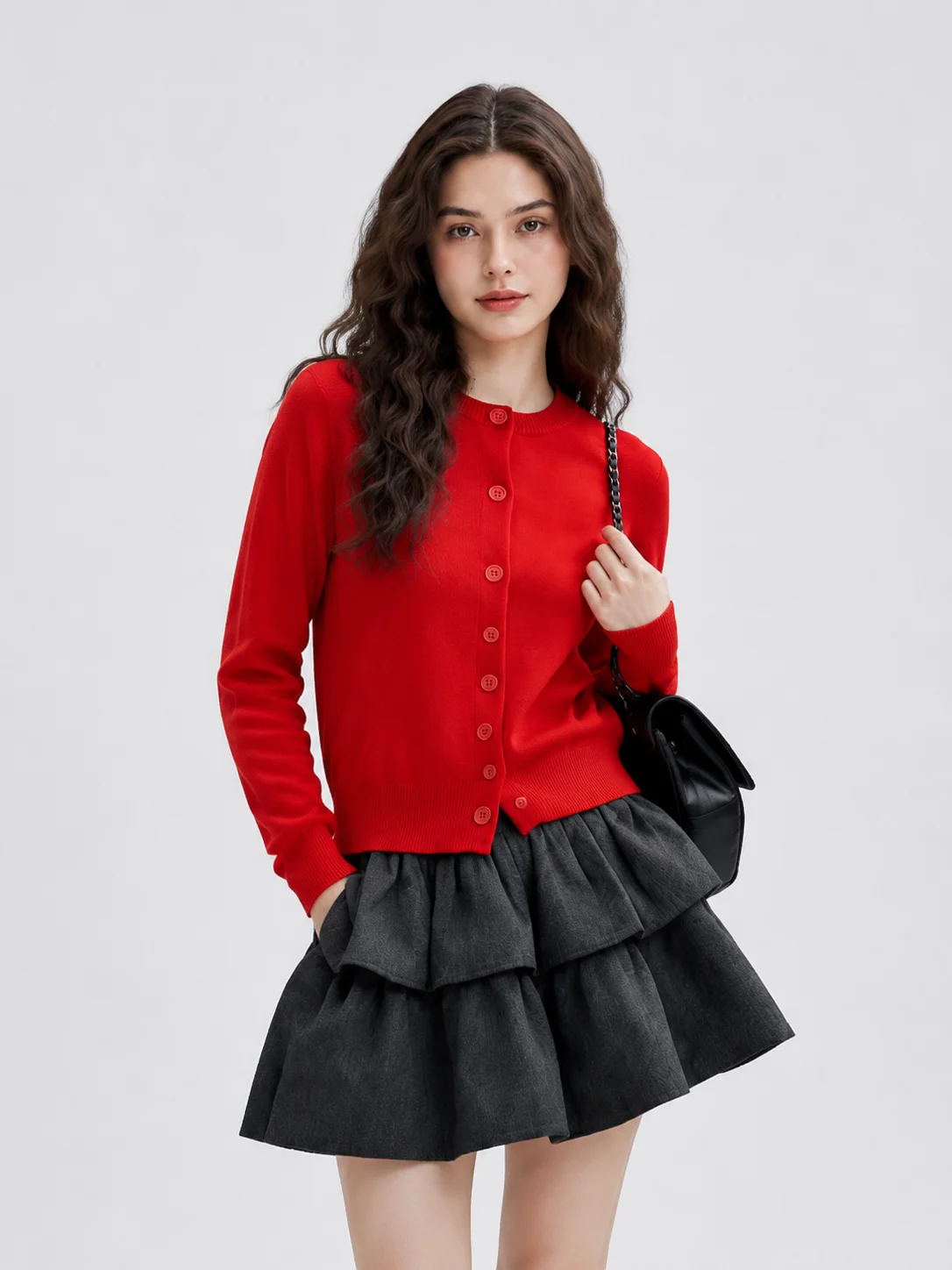
lpknit offers several material directions for premium assortments, including a Merino crewneck for refined everyday wear, a cashmere cardigan for soft layering, and a mohair V-neck for textured luxury styling.
How to Inspect Luxury Women’s Knit Sweaters Before Buying
A luxury women’s knit sweater should pass a structured inspection before a consumer purchase or wholesale order. The goal is to judge fiber truth, construction, fit, finishing, and care performance before price or brand story influences the decision.
Use this step-by-step checklist when evaluating samples:
Read the fiber label first. Confirm exact percentages, such as 100% cashmere, 90% wool 10% cashmere, or 70% cotton 30% silk. For European markets, compare the label with European Union Regulation 1007/2011 requirements.
Feel the surface without squeezing too hard. Luxury yarn should feel soft, even, and alive. A greasy or overly slick hand may come from chemical softeners.
Check the gauge and density. Hold the sweater up to light. A luxury fine-gauge sweater can be lightweight, but it should not look patchy or thin in stress areas.
Inspect seams and linking. Look at shoulders, side seams, armholes, and neckline. Fully linked seams should be neat, flexible, and balanced.
Stretch rib trims gently. Pull the cuff or hem for two seconds, then release. High-quality rib should recover quickly without rippling.
Check symmetry. Fold the sweater in half from center front. Sleeves, shoulders, and side seams should align closely.
Test skin comfort. Wear the sweater or swatch against the neck for five minutes. Luxury women’s knitwear should not feel scratchy in sensitive contact zones.
Ask for care and pilling information. Wholesale buyers should request wash tests, abrasion results, and sample history. Consumers should review care labels before purchase.
Review size tolerance. For bulk orders, ask the supplier for acceptable measurement tolerance by size. A 1 cm tolerance may be acceptable in some areas, while 3 cm can change the fit.
Compare price to construction, not only fiber. A high price is not proof of luxury. The sweater must justify cost through material, structure, fit, and durability.
A second example: Danielle, a private client in Los Angeles, bought a $420 black turtleneck that felt extremely soft in store. After four wears, the elbows pilled and the hem lost recovery. She later chose a tighter-gauge Merino-cashmere blend at $310, wore it 18 times over winter, and needed only light de-pilling once.
Wholesale Standards: What Makes a Women’s Knit Sweater Luxury Quality at Scale?
Wholesale luxury quality means every unit should match the approved sample in fiber, color, measurement, seam quality, and finishing. A beautiful showroom sample is not enough; the supplier must prove repeatable production control.
Boutique buyers and private-label brands should create a quality agreement before placing a bulk order. This agreement should cover yarn composition, gauge, color standard, size chart, tolerance, packaging, inspection level, and defect handling. Without written standards, “luxury” becomes subjective.
Important wholesale checks include:
- Yarn certificate or yarn invoice showing composition and origin where available.
- Lab dip approval before bulk dyeing.
- Pre-production sample after pattern and fit corrections.
- Size set sample across key sizes, not only size S.
- Bulk inspection report before shipment.
- Care label and fiber label review for the target market.
- Packaging standard that protects shape during shipping.
For a premium boutique, consistency matters as much as beauty. If 20% of a shipment has sleeve length variance, staff lose time steaming, measuring, and explaining fit differences to clients. High-end buyers expect the second unit to look like the first unit.
This is where a specialist supplier matters. lpknit focuses on premium women’s knitted sweaters, tops, and jumpers for seasonal collections and wholesale programs. Buyers can review the full premium women’s knitwear product range, compare an oversized cable pullover for textured assortments, or follow new collection notes on the lpknit news page.
Luxury Quality vs Brand Name: What High Quality Sweater Brands Get Right
High quality sweater brands earn trust by repeating good decisions in materials, fit, construction, care guidance, and after-sales consistency. A famous label can help, but brand name alone does not guarantee a sweater will resist pilling, hold shape, or flatter the body.
Luxury brands often get three things right. First, they select yarn for the exact garment, not for a generic marketing claim. Second, they invest in pattern engineering so the sweater looks good when worn, not only when folded. Third, they control finishing, washing, pressing, and measurement before shipment.
Many shoppers search “Men what makes a women’s knit sweater luxury quality” because men buying gifts need simple signals. The best gift checklist is straightforward: choose natural fiber, inspect seams, avoid overly loose knits, check return policy, and select a classic color such as ivory, camel, navy, charcoal, or black.
Wholesale buyers should go further than a consumer checklist. A retailer needs to know whether a sweater can survive try-ons, steaming, shipping, and repeated customer handling. A beautiful brushed knit may sell fast, but if the surface mats after one week on the rack, it can damage store reputation.
Luxury also includes restraint. Good knitwear does not need excessive logos, heavy coatings, or unstable novelty yarns to feel expensive. The quiet signs are proportion, touch, recovery, and finish.
Care, Pilling, and Longevity for Luxury Knit Sweaters
Luxury knit sweaters last longer when the fiber, construction, and care routine work together. Even premium cashmere or Merino wool can fail early if washed too hot, hung on a thin hanger, or stored under friction.
Pilling happens when loose fiber ends work to the fabric surface and tangle. Fine natural fibers may pill lightly at first, especially under arms, across the bust, or where a handbag rubs. Light pilling can be removed with a cashmere comb or fabric shaver used carefully.
Avoid judging luxury quality by “no pilling ever.” A better standard is controlled pilling, easy maintenance, and no major thinning. If pills return heavily after every wear, the yarn or fabric structure may not be suitable for the price point.
Care rules for most luxury women’s knitwear:
- Fold sweaters instead of hanging them.
- Wash less often; air between wears.
- Use cold water and gentle detergent when hand washing is allowed.
- Dry flat on a towel, away from direct heat.
- Store clean sweaters with cedar or suitable moth protection.
- De-pill gently, not aggressively.
A luxury sweater is a long-term wardrobe piece, but it is still a textile object. The best results come from matching a high-quality garment with realistic care.
FAQ
Is cashmere always the most luxury sweater material?
No, cashmere is not always the most luxury option. High-grade cashmere can feel exceptional, but poor cashmere may pill, stretch, or lose shape. Extra-fine Merino wool, alpaca, silk-cotton, and premium blends can be more suitable depending on climate, fit, durability, and price.
How can I tell if a women’s sweater is high quality in 30 seconds?
Check the label, seams, rib recovery, fabric density, and symmetry. A high-quality women’s sweater should have clear fiber composition, smooth shoulder and side seams, cuffs that recover after stretching, even knit tension, and no twisting when laid flat.
What sweater material is least likely to pill?
Compact Merino wool, high-quality cotton, and well-spun wool blends are often less likely to pill than loose, short-fiber cashmere. Pilling risk depends on fiber length, yarn twist, knit density, and friction, not only the material name.
What is the best sweater material for winter?
The best sweater material for winter is usually cashmere, Merino wool, alpaca, or a warm wool blend. Cashmere gives lightweight warmth, Merino gives breathability and recovery, and alpaca adds loft. Cotton is better for mild weather or indoor layering.
Are fully fashioned sweaters better?
Yes, fully fashioned sweaters are often better when made well. Fully fashioned knitting shapes panels during production, which can improve fit, reduce bulk, and create cleaner seams. It is not the only quality marker, but it is a strong sign of thoughtful construction.
What should wholesale buyers ask before ordering luxury knitwear?
Wholesale buyers should ask for fiber details, yarn certificates where available, swatches, lab dips, size specs, care labels, pre-production samples, and bulk inspection standards. Buyers should also confirm packaging, tolerance rules, delivery timing, and defect resolution before payment.
Why do expensive sweaters still pill?
Expensive sweaters can still pill because fine natural fibers shed loose ends under friction. Light early pilling is common in cashmere and wool. Heavy, repeated pilling after light wear may indicate short fibers, loose spinning, low knit density, or poor finishing.
Conclusion: Use a Quality Checklist Before You Buy or Source
What makes a women’s knit sweater luxury quality is not one material, one brand, or one price tag. It is the proven combination of premium fiber, stable yarn, correct gauge, clean seams, women-focused fit, reliable finishing, and care performance.
I have inspected women’s knitwear samples for premium boutiques and private-label buyers for 11 years, including cashmere cardigans, Merino crewnecks, mohair V-necks, and cable pullovers. In first-hand sample reviews, the strongest sweaters were not always the softest on day one; they were the pieces that kept neckline shape, seam balance, and surface quality after fitting, steaming, and wear tests.
For buyers who need premium women’s sweaters with custom and wholesale options, lpknit provides luxury knitwear directions across Merino, cashmere, mohair, and textured seasonal styles. Review the lpknit product collection or compare specific pieces such as the cashmere cardigan and Merino crewneck to plan a high-quality assortment with a supplier focused on premium knit construction.